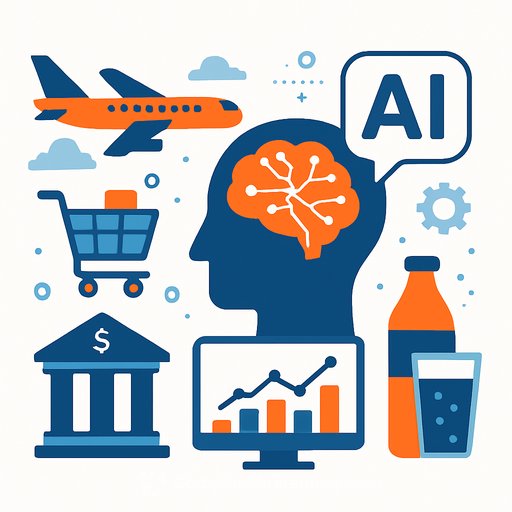
How three industries are actually adopting AI - and getting returns
AI programs live or die by business impact. Leading retailers, beverage makers and banks are proving that steady, disciplined execution beats flashy demos - with machine learning and automation still doing much of the heavy lifting while generative and agentic systems start to scale.
Here's what they're doing, what's working and how you can apply it this quarter.
Retail: AI as a growth and cost lever
Dollar Tree is treating AI as a culture shift. The company is moving off decades-old systems onto modern cloud platforms to improve assortment planning, inventory visibility, workforce management and cost structure at scale. It also appointed a senior leader for AI optimization to keep focus and accountability tight.
Tractor Supply set three clear tracks: off-the-shelf software, custom-built tools and agents/automation. About 1,500 employees now use enterprise-grade GenAI, integrated with its Snowflake data lake, enabling teams to build agents that simplify workflows and cut cycle time. Early signs are positive: Q3 net sales rose 7.2% to a record $3.7 billion, with comps up 3.9%, as AI adoption progressed and vendor add-ons rolled out with clear security guardrails.
Beverage makers: balancing spend and savings
Molson Coors is investing through a turnaround, prioritizing infrastructure and AI while demanding clear returns. The goal: use AI to widen productivity and growth opportunities without bloating cost to serve.
Coca-Cola committed $1.1 billion to expand its Microsoft partnership, exploring Azure OpenAI Service and Copilot across the enterprise. Leadership is preparing for organizational evolution, including 2026 restructuring, to capture productivity from generative and agentic tech. The company reaffirmed guidance as Q3 net revenue grew 5% to $12.5 billion, emphasizing that AI must convert into tangible outputs, not just pilots.
Financial services: scale with guardrails
BNY launched its enterprise AI platform, Eliza, to democratize access and speed adoption. It also partnered with Carnegie Mellon University on an AI lab focused on research, responsible governance and deployment. By quarter-end, BNY had 117 AI solutions in production - up 75% from the prior quarter - including agents that identify business leads, write code and accelerate onboarding.
Citi piloted agentic AI with about 5,000 colleagues, signaling that agent-driven automation will be a major theme in the sector next year. Across the board, banks are chasing efficiency at scale while tightening controls.
What executives can copy this quarter
- Attach every AI initiative to a P&L line: revenue lift, cost to serve, working capital or risk.
- Modernize your data foundation before big bets: clean, governed, observable data pipelines.
- Adopt a three-track portfolio: off-the-shelf, custom builds and agents/automation.
- Democratize safely: enterprise access, SSO, data controls, audit logs and usage guardrails.
- Stand up an AI PMO with product owners, risk, legal and security embedded from day one.
- Measure early and often: weekly leading indicators, quarterly value realization.
- Negotiate vendor add-ons with clarity on functionality, data usage and total cost of inference.
- Run agent pilots in low-risk areas first, then scale with shared components and templates.
Practical starting points by industry
Retail
- Demand forecasting and allocation with ML to reduce stockouts and markdowns.
- Store and DC "copilots" for task lists, SOP lookup and incident handling.
- Planogram and assortment optimization using clickstream and POS signals.
- Labor scheduling that blends traffic, weather and promotions.
- Transport ETA and exception prediction to cut expediting and fees.
Beverage and CPG
- Demand sensing that fuses POS, distributor and social signals.
- Marketing content ops with brand guardrails and approval workflows.
- Price-pack architecture simulations to stress test elasticity.
- Quality control with vision models on bottling and packaging lines.
- Field sales copilots for pitch prep, assortment gaps and order lift.
Banking
- KYC/AML document agents to extract, validate and classify evidence.
- Client onboarding copilots that generate drafts and checklist outcomes.
- Code assistants with policy filters and secure repositories.
- Trade surveillance anomaly detection and triage summarization.
- Treasury cash forecasting with scenario planning and what-ifs.
Metrics boards care about
- Cycle time reduction for targeted workflows.
- Automation rate and percent of work assisted.
- Accuracy/quality uplift versus baseline.
- Revenue lift, cost to serve and working capital impact.
- Adoption rate by role and weekly active users.
- Risk events prevented and policy exceptions.
- Time to production and time to value.
Pitfalls to avoid
- Pilot purgatory: no scale path, no shared components, no owner.
- Skipping data governance; model outputs drift and trust collapses.
- Vendor sprawl without clear contracts on data rights and usage.
- Ignoring change management; tools launch, nobody changes behavior.
- Underestimating inference costs; optimize prompts, caching and batching.
Upskill your org
Democratization works only if people know how to use the tools. If you're standing up AI enablement by role, explore practical learning paths and certifications built for operators and leaders.
- Courses by job for role-based enablement
- Popular AI certifications for team-wide fluency
The thread across all three sectors is clear: set the foundation, target specific outcomes, and scale what works. Keep the scorecard visible, and let value - not hype - determine where AI goes next.
Your membership also unlocks: