Under the Scalpel of AI: How India's Healthcare Quietly Shifted in 2025
2025 didn't fix India's healthcare system. It nudged it. Under constant load and limited capacity, AI moved from pilots to practice, stitched into daily routines where it could save time and reduce misses.
The change was uneven and imperfect, but real. Diagnostics, telemedicine, and planning saw the most visible gains-provided people, processes, and trust kept up.
A system still stretched thin
Public hospitals stayed crowded, especially in big cities. Rural districts continued to lack specialists, pushing patients to travel for scans and consults.
Out-of-pocket costs still hurt families. Chronic conditions like diabetes, heart disease, and cancer demanded long-term care from a system shaped for short episodes. Mental health needs grew faster than trained professionals, particularly outside metros.
AI enters the diagnostic room
Imaging is where AI showed up first. Qure.ai's models helped read chest X-rays and CTs for tuberculosis, lung cancer, and brain bleeds-useful for government TB programs and district hospitals that lack round-the-clock radiology cover.
Niramai expanded non-invasive breast cancer screening using thermal imaging plus AI, bringing early detection to camps and smaller hospitals where mammography is limited.
Large private hospitals leaned on platforms like Aidoc and Lunit INSIGHT as "second readers." The goal wasn't replacement-it was a fresh pair of eyes to cut fatigue-related errors and speed critical findings.
Telemedicine grows smarter
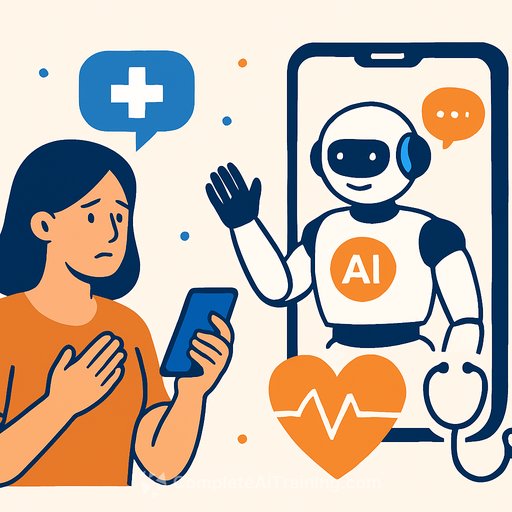
Virtual care matured. Platforms such as Practo added AI-driven triage, appointment matching, and automated follow-ups to shorten waits, especially outside metros. Tools like Ada Health handled initial symptom questions so clinicians could focus on cases that truly needed them.
But oversight mattered. Symptom checkers trained on urban datasets don't always generalize; clinicians kept tight supervision to avoid false reassurance or unnecessary panic.
AI behind the scenes: planning and surveillance
Hospitals and public health teams used predictive analytics to prep for seasonal spikes-dengue, influenza-like illness-estimating bed demand and medicine requirements. Systems like BlueDot fed early-warning efforts with signals from travel, climate, and global reports.
Some hospitals piloted risk tools such as KenSci to flag high-risk patients and plan capacity. The payoff was foresight, not miracles-shortages didn't vanish, but surprises decreased.
Progress varied widely because data quality still swings by state and district. Garbage in still means garbage out.
Private sector moves faster
Corporate chains invested hard in AI for radiology, pathology, and patient management-often marketed as premium care. Health-tech startups scaled platforms for pathology and chronic care; tools like HealthPlix used AI-enabled EMRs to track histories and support decisions.
Capital stayed bullish. Critics flagged the gap: advanced tools clustered in urban, high-end facilities while lower-tier settings lagged.
Ethics, privacy and accountability
Data privacy took center stage. India's digital health stack advanced-think ABDM-but enforcement and practical guardrails still trailed innovation.
Clinicians asked hard questions: if an algorithm misses a bleed or fires a false alarm, who's responsible-the doctor, hospital, or vendor? Bias stayed a real risk when models trained on narrow datasets underperform for women, children, or marginalized communities.
The human element still decides the outcome
AI is a force multiplier, not a fix. Without training, change management, and stable infrastructure, tools can add clicks before they save minutes.
Where teams had clear protocols and feedback loops, AI shaved turnaround times and raised detection rates. Where they didn't, it became another dashboard to ignore.
What you can do now
- Prioritize 1-2 high-yield use cases per site: chest X-ray triage for TB, stroke/bleed alerts on CT, or breast screening adjuncts.
- Run side-by-side validation for 4-8 weeks against local ground truth. Track sensitivity, specificity, turnaround time, and recall rates-not just accuracy claims.
- Set accountability in writing. The clinician makes the call; define escalation and override rules for every AI suggestion.
- Lock down data flows. De-identify by default, restrict access, and align consent/SOPs with national digital health policy. Audit vendor data usage regularly.
- Check equity. Review performance by age, sex, comorbidities, and district. Adjust thresholds and workflows where gaps appear.
- Train for the workflow you want. Short modules for technologists, residents, and nurses; simulate failure modes and downtime. For structured upskilling, see Complete AI Training.
- Integrate, don't bolt on. Push AI flags into RIS/PACS and the EMR; avoid app switching and duplicate clicks.
- Scale deliberately. Prove value at one site, then replicate. Tie outcomes to fewer misses, faster reports, better follow-up, and measurable cost or time savings.
India's 2025 story is quiet progress under pressure. AI helped move care faster and a little smarter-but results depended on people, process, data, and trust. Get those right, and the tools start paying rent.
Your membership also unlocks: