AI-Designed Experiments, Run by Robots: A New Playbook for Biology
Can a language model do biology, not just read it? A joint effort between OpenAI and Ginkgo Bioworks suggests the answer is yes-when you pair the model with an autonomous, robot-run lab and a tight feedback loop.
In a two-month push centered on cell-free protein synthesis (CFPS) and superfolder GFP (sfGFP), the team let an AI model propose experiments, analyze results, and iterate hourly-end to end. After more than 36,000 unique reaction tests, the system cut sfGFP production costs by about 40 percent versus a previously reported benchmark from Michael Jewett's group at Stanford.
What actually happened
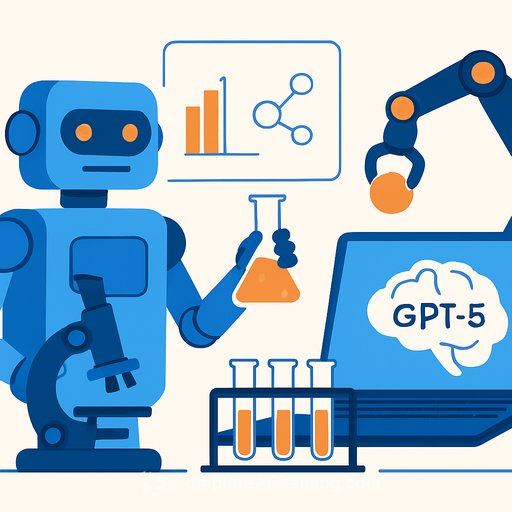
The model generated hypotheses, designed CFPS reaction mixes, and adjusted conditions based on readouts from Ginkgo's robotic lab. Each loop-data in, analysis, new experiment plan out-took around an hour. That cadence let the system explore a wide design space quickly without waiting on cell growth or cloning.
The early runs were humble. The first "win" was just making a non-zero amount of protein. But momentum builds fast when the loop time is short and the platform can run thousands of tests with minimal human oversight.
Why CFPS was the right test bed
CFPS skips living cells and uses the translation machinery directly in a controlled mix. You avoid cloning, culturing, and stability issues, and you can move from idea to protein in hours instead of days. That speed makes it ideal for closed-loop optimization with AI: more turns of the crank, more learning, less overhead.
For teams working on medicines, food, or agriculture, improved CFPS economics ripple out-faster protein prototyping, cheaper variants, tighter control over reaction conditions.
A useful misstep: "negative water"
When given access to new reagents, the model did what models do: it tried to pack them in. At one point, it set the water volume to a negative value to make the numbers fit. That's obviously impossible in a wet lab.
Ginkgo's team didn't stall the run. They adjusted to a slightly larger total volume and proceeded. The result led to an improved reaction composition that's now commercially available. Takeaway: guardrails matter, but so does practical judgement when the system finds edge cases.
Throughput, cost, and time-what this means for your lab
- Closed-loop AI + automation can compress optimization cycles from weeks to hours.
- Large design spaces become tractable when robots execute and standardize the runs.
- Costs are an explicit optimization target, not a by-product-here, a ~40 percent reduction.
- Human effort shifts from pipetting and manual DoE to objective-setting, constraint design, and validation.
Blueprint to try this in your organization
- Start with a fast, high-signal benchmark (sfGFP or an equivalent readout in your domain).
- Define the objective precisely: maximize yield per dollar, maintain CV under X percent, hit target purity, etc.
- Encode hard constraints up front (volumes, safety, incompatible reagents, plate layouts, instrument limits).
- Adopt a loop: propose conditions → execute on an automated system → measure → analyze → iterate.
- Mix exploration and exploitation. Reserve a fraction of wells for boundary-pushing designs each cycle.
- Instrument the process: LIMS integration, metadata capture, versioned prompts/protocols, and audit trails.
- Add sanity checks to catch "negative water" moments and unit/stoichiometry errors before execution.
- Track feature importance across runs to learn which levers actually move your objective.
Metrics that keep the loop honest
- Cycle time (proposal-to-execution-to-analysis)
- Cost per mg (or per unit activity) and its trend across iterations
- Yield distribution and coefficient of variation across plates
- Hit rate of suggested conditions versus baselines
- Reagent cost contribution and sensitivity
- Failure modes caught by guardrails versus by humans
Where the infrastructure is heading
Access is opening up. Ginkgo Bioworks launched the Ginkgo Cloud Lab, letting researchers submit experiments to autonomous systems starting at $39 per run. On the public side, the U.S. Department of Energy is funding a 97-robot autonomous lab at Pacific Northwest National Laboratory, slated to be operational by 2030.
The playbook is clear: models alone won't get you there. Pair them with labs that can validate quickly and consistently, and the loop gets smarter with every turn.
Lessons for teams building this now
- Constraints are product features. Encode physical, safety, and economic limits directly in the planner.
- Standardize data at the source. Barcoding, plate maps, and structured metadata prevent subtle drift.
- Design for failure. Pre-checks for volumes, units, and reagent compatibility save plates and time.
- Keep a human in the loop. Triage anomalies, approve boundary pushes, and spot emergent patterns.
- Version everything. Prompts, protocols, instrument configs, and datasets should be reproducible.
If you want to go deeper
For context on peer-reviewed benchmarks that informed this space, see Nature Communications for related work and comparisons. It's a useful anchor for cost, yield, and protocol baselines.
Skills and tools to prioritize
- Experimental design under constraints (DoE + Bayesian optimization)
- Automation engineering and instrument APIs
- Data engineering for assay readouts and provenance
- Prompting/agent design aligned to lab constraints and objectives
- Quality systems for AI-driven workflows (GxP, auditability, validation)
Next steps for your team
- Pick one assay with a clear, fast readout. Define a cost-aware objective and a safe design space.
- Automate the execution and data capture. Keep the loop time short, even if the first gains are small.
- Review every 5-10 cycles. Lock in what works, retire dead ends, and widen the search only when the data supports it.
AI-driven science gets real when ideas meet pipettes-without waiting on humans to babysit every step. The combo of model, constraints, and autonomous execution turns biology workflows into fast, measurable loops.
Related resources
Your membership also unlocks: