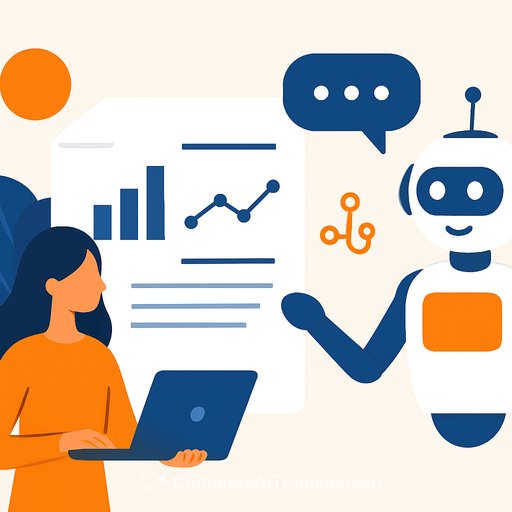
Emerging Tools for Content Creation in 2026
Tech isn't the bottleneck anymore. The real constraint is how fast your team can turn ideas into assets that perform. Research from the Content Marketing Institute's 2026 B2B report points to a clear theme: marketers are past the hype and focusing on tools that deliver measurable results.
Here's a practical playbook for what's coming, what to test now, and how to fold these tools into your workflow without losing your brand's voice.
Multimodal creation tools
The next wave blends formats. One brief will produce a blog draft, social captions, a short video script, and matching visuals-consistently on-brand. Tools like Canva AI already mix prompts, templates, and brand kits to keep assets aligned. Video platforms such as Higgsfield point to real-time control over lighting, angles, and expressions as you edit.
- Standardize your prompts with brand voice, personas, and banned phrases. Save them as reusable templates.
- Build a content "atomization" routine: one long-form piece becomes 10+ clips, carousels, and email snippets in a single pass.
- Use brand kits to lock colors, fonts, and logos so speed doesn't erode identity.
Self-guided AI
We're moving from single prompts to multi-step execution. Give an instruction-"launch a holiday campaign"-and the system researches trends, drafts copy, designs assets, schedules posts, and sets up A/B tests. You supervise; it handles the repetitive parts.
- Automate the "last mile" first: briefs, outlines, and variants for headlines, CTAs, and thumbnails.
- Create approval gates. AI proposes; humans approve before publishing.
- Log decisions. If the AI chooses Variant B, your team should know why and how it performed.
Personalization driven by data
Generic blasts are fading. AI uses browsing behavior, past engagement, and lifecycle signals to tune tone, structure, and visuals for each segment. Subject lines, hero images, and offers adjust without creating chaos in your calendar.
- Start with three segments (new, engaged, dormant). Test tone, value prop, and visual style per segment.
- Define guardrails: never misstate price, availability, or compliance-related claims.
- Measure uplift by segment, not just campaign average, so wins don't get buried.
Ethical and transparent AI
Trust matters. Expect source citations, bias detection, and watermarking to become standard. Translation and summarization will shift toward on-device processing to reduce data exposure. Platforms that show data sources and model limitations will earn more buy-in from legal and your audience.
- Adopt a clear AI policy: disclosure rules, watermarking, approval flow, and data retention.
- Require provenance: what sources fed an output, and where an image or clip originated.
- Add bias checks for sensitive topics and regulated categories.
See ongoing CMI research for benchmarks and team practices. For governance, review the NIST AI Risk Management Framework.
Specific AI assistants to know
A handful of tools already save hours per project. ChatGPT handles ideation, drafting, and summaries. Jasper brings marketing templates and brand voice controls. Claude is solid for long documents and sustained context. Grammarly cleans copy and catches tone issues. Canva AI accelerates visuals. Descript edits audio/video from a transcript. Surfer SEO guides on-page optimization as you write.
- Idea to outline: ChatGPT or Claude
- Draft to brand voice: Jasper + Grammarly
- Visuals: Canva AI (brand kit + prompt-to-image)
- Video/audio: Descript (edits, overdub, filler-word removal)
- Findability: Surfer SEO during drafting, not after
Video and audio innovation
AI video is shifting from static clips to real-time scene control. Platforms like Higgsfield outline features where you adjust camera moves, lighting, and character expressions while the system updates footage. Expect personalized videos that adapt dialogue and pacing for different viewers. Sound will keep pace with models that build scene-aware effects and emotion-led music.
- Build reusable video frameworks: hook, proof, demo, CTA. Let AI swap elements per audience.
- Use Descript for quick fixes-line changes, filler removal, or repurposing webinars into shorts.
- Plan consent and usage rules for voice cloning before you need them.
Translation and localization
Context-aware translation is getting smarter, especially for specialized fields like legal or healthcare. Real-time audio translation and synced subtitles will help you reuse assets across markets without starting over. Systems will flag doubtful sections for human review, which speeds up quality control.
- Write a source style guide: tone, idioms to avoid, and default reading level to reduce mistranslations.
- Run a two-pass check: AI draft, human review for nuance and compliance.
- Localize offers and references, not just words. Swap case studies and pricing logic by region.
Human factors and strategy
Tools help, but people win. The most effective teams in CMI's survey credit content relevance and quality (65%) and team skills (53%) over tech or budget. That should be your filter: clarity of message, distinct POV, and editorial standards. Avoid "AI idea inflation" where tools churn out bland takes that blend in.
- Publish a point-of-view doc: what you believe, what you won't say, and why you're different.
- Train for two skills this quarter: prompt writing and bias detection.
- Set a quality bar with examples of "publish" vs. "revise" vs. "reject."
Workflow integration and ROI
The value shows up when tools work inside your existing stack. Look for integrations with your CMS, scheduler, and analytics. Approve once, distribute everywhere, and let the system adjust headlines, thumbnails, or snippets based on live data.
- Map your workflow end-to-end. Mark delays (briefing, review cycles, repurposing) and automate the worst bottleneck first.
- Instrument content: track time-to-publish, variants tested, and lift by segment.
- Set a quarterly "automation budget" of hours saved and reassign that time to creative testing.
The enduring role of human creativity
AI can draft and analyze. It can't fully catch cultural nuance or read a room. Editors become strategists. Translators become stewards of tone and intent. The best teams pair data-driven execution with a human voice that stands for something.
90-day action plan
- Audit your stack. Cut tools that overlap or lack integration.
- Create brand voice and prompt libraries. Share them across teams.
- Pilot one self-guided workflow (e.g., newsletter production with approvals).
- Segment your email list into three cohorts and test tone + offer variants.
- Add watermarking and citation requirements to your content policy.
- Spin one flagship article into 8-12 assets using multimodal tools.
- Instrument ROI: hours saved, variants tested, lift by segment, cost per qualified lead.
- Upskill your team with focused training on prompts and governance.
Helpful training resources
If you're formalizing skills for your team, consider these:
- AI Certification for Marketing Specialists for workflow, ethics, and measurement.
- Prompt engineering guides to improve consistency and speed.
The next wave of tools will multiply output, unify formats, and tighten feedback loops. The advantage goes to teams that keep a sharp strategy, clear guardrails, and a voice that readers can spot from a mile away.
Main image courtesy of Translators.com
Your membership also unlocks: