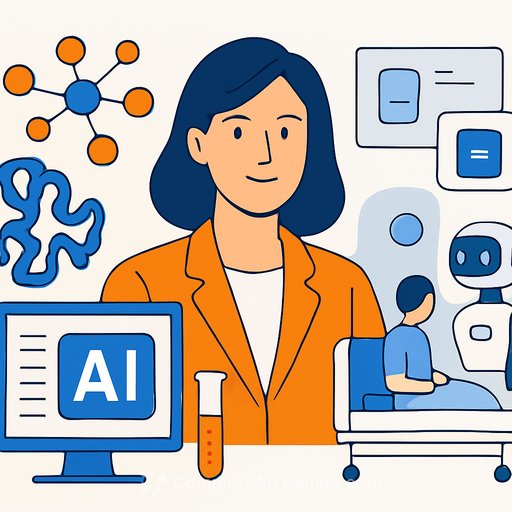
Generative AI in Healthcare: From Protein Models to Trials and Robots
Drug development is slow, expensive, and crowded with failure. A new class of generative models is giving researchers a way to rethink the process-from how we study biology to how we design molecules and run trials.
Kimberly Powell, Nvidia's VP of healthcare, has spent 17 years building the company's health stack. Her perspective is simple: if we can represent biology in compute, we can iterate faster, test smarter, and get safer treatments to patients sooner.
Why modeling proteins and DNA matters
Transformers changed language AI. Then they moved into biology. DeepMind's AlphaFold showed that predicting protein structure at scale is possible, and that shifted expectations for what can be computed in silico.
DNA and proteins are sequences-just like text. That makes them workable with sequence models. The difference is magnitude: 3 billion characters for a human genome, long amino acid chains for proteins, and complex interactions across both. Longer context windows, specialized architectures, and heavy-duty tooling are required to make this practical. AlphaFold Protein Structure Database
Moving beyond the same drug targets
For years, pharma has circled a familiar set of targets. Many are well explored. But disease biology-especially in cancer-often involves multiple targets working together, which helps explain mixed responses across patients.
Generative models help on the second half of the problem: molecular design. They can propose structures far outside a chemist's habits or mental library, opening a search space too large for manual work. That doesn't replace expertise; it multiplies it.
What this demands from infrastructure
Representing long genomic and proteomic sequences pushes past standard language model limits. Teams need models with extended context, efficient attention, and domain-specific pretraining. They also need data pipelines that are secure, governed, and auditable.
Nvidia's view, led by Powell, is that healthcare AI requires full systems: accelerators, operating software, models, and tools that evolve with usage. Models are never "done." Each deployment is feedback for the next iteration, and the stack must support continuous improvement.
Simulating clinical trials before first patient-in
Clinical trials fail for many reasons: poor site selection, narrow eligibility, slow accrual, and patient drop-off. Digital twins can stress-test a protocol before it starts. Powell points to ConcertAI's work in oncology, where simulations help teams see if they have enough of the right patients, at the right sites, with realistic adherence.
The practical value is simple: fewer surprises, better odds of finishing on time, and earlier visibility into risks that can be fixed before launch. For reference on active and historical studies, see ClinicalTrials.gov.
AI agents and robots in care delivery
Software agents can read, summarize, and coordinate. To change care operations, you also need physical agents-robots that handle tasks across the hospital. Think intake, deliveries, room monitoring, and eventually support in the OR with surgical robotics.
The near-term wins are unglamorous: logistics, supply runs, comfort items, and routine checks. Every minute given back to nurses and techs is a minute returned to patient care.
Action checklist for healthcare leaders
- Data foundations: Stand up a de-identified, governed data pipeline that spans EHR, imaging, omics, and pathology. Establish data use committees and audit trails from day one.
- Protein and DNA modeling: Pilot sequence models on a focused use case (e.g., variant effect prediction or protein-ligand screening). Benchmark against open datasets and lab results.
- Trial simulation: Run a digital twin for your next oncology protocol to test accrual, adherence, and site mix. Predefine success metrics (screen failure rate, protocol deviations, time to first patient-in).
- Compute and MLOps: Plan for accelerated computing, containerized workflows, and monitoring for drift, bias, and safety. Treat model updates like regulated software releases with clear change logs.
- Workforce readiness: Upskill clinical, research, and data teams on generative models, evaluation, and prompt practices. A practical starting point: AI courses by job.
What good looks like in 12 months
One validated workflow that links sequence modeling to a wet-lab or in vivo readout. A simulated protocol locked before trial startup. A robotics pilot covering logistics on a single ward. A governance board that meets monthly and signs off on model updates.
None of this requires perfect science on day one. It requires a clear problem, the right data, and an infrastructure that learns from every use.
The bottom line
Represent biology in compute. Let generative models expand the search. Use digital twins to pressure-test trials. Bring in robots where they free up staff time. And build systems that improve with every deployment.
That's how AI moves from potential to daily practice-and how we give clinicians better tools without adding more burden to their day.
Your membership also unlocks: