Inside the U.N.'s Push for Practical AI: What IT and Dev Teams Can Learn
Across U.N. agencies, AI is moving from slide decks to shipped tools. The goal is blunt: do more with less, speed up field work, and meet growing staff demand without blowing budgets.
New AI teams are spinning up, while existing IT units are refocusing on model selection, data pipelines, and deployment standards. Staff are being given space to test ideas and scale what works.
Field-first use cases that are shipping
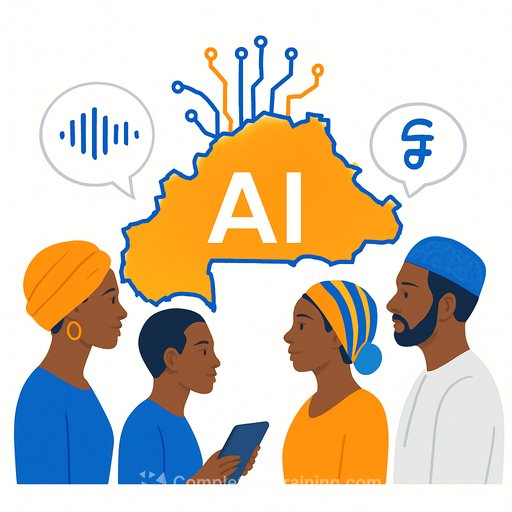
- Language access: Teams are co-designing a Translation tool with refugees for a low-resource minority language. Human-in-the-loop review keeps quality high and bias in check.
- Economic inclusion: A virtual assistant is being built to support migrant entrepreneurs in Paraguay. Think multilingual guidance, local policy FAQs, and structured referrals.
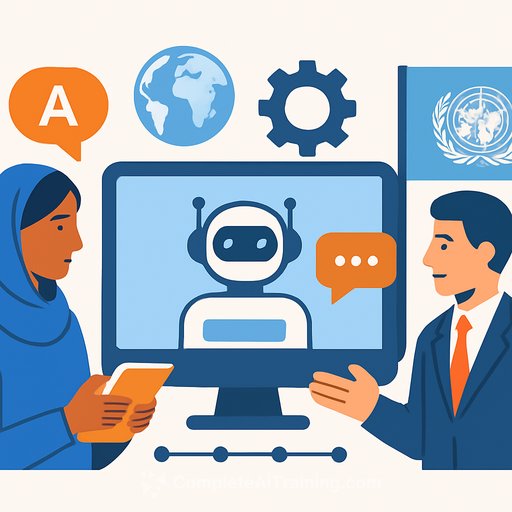
- Multilingual leadership: Communications teams are using AI avatars to deliver speeches across languages, increasing reach without multiplying production time.
There's tension under the hood. "The U.N. is being pulled in two different directions," said Claire Melamed, vice president for AI and digital cooperation strategy at the UN Foundation. Caution on spend is necessary, but staff see opportunities, expectations are rising, budgets are falling - and technology can help.
What this means for IT and Dev leads
Your mandate: ship useful AI safely, cheaply, and fast enough to matter. That requires tight scoping, shared components, and a bias for small wins that stack. For governance, budgeting controls, and risk management, teams can follow the AI Learning Path for CIOs.
- Stand up an AI enablement guild (4-8 people) with reps from IT, data, security, and programs. Keep a two-week cadence of intake, triage, and pilot support - see the AI Learning Path for Project Managers for structured intake and pilot practices.
- Route ideas through a lightweight intake form: problem, baseline process, expected impact, data sources, privacy risks, success metric, and owner.
- Ship thin-slice pilots in 6-8 weeks. Freeze scope. Measure one primary metric (time saved, accuracy, or reach).
- Centralize shared assets: auth, logging, data connectors, prompt libraries, evaluation suite, and a cost dashboard.
Patterns for low-resource contexts
Translation at the edge
- Models: start with NLLB, MarianMT, Whisper small/medium, or localized bilingual models. Use quantization (int8/4-bit) for mobile or offline kits.
- Data: build community glossaries and collect audio/text pairs with consent. Use active learning to prioritize human review.
- Quality: measure with COMET/BLEU and targeted error sets (names, medical terms, dates). Keep a rapid feedback loop with bilingual reviewers.
Virtual assistants
- Architecture: RAG with multilingual embeddings, domain documents chunked with metadata, and strict retrieval filters.
- Safety: refusal rules for legal/medical queries, escalation paths, and transparent "last updated" stamps. Log sources for every answer.
- Ops: cache frequent answers, set token budgets, and add nightly re-indexing. Track deflection rate and handoff success.
AI avatars for comms
- Workflow: translate → human review → TTS → lip-sync. Clearly disclose synthetic media and keep originals archived.
- Risk controls: watermarking, access controls, and approvals from legal/communications.
Architecture notes that keep costs down
- Start small models first; prove value; then consider larger models only if metrics demand it. Cache aggressively and batch workloads.
- Track unit costs: per 1K tokens, per translated sentence, per resolved inquiry. Kill pilots that miss the unit-cost target by week four.
- Use vector DBs with TTL on stale content. Store prompts, outputs, and eval results for reproducibility.
Governance, risk, and ethics
- Map your program to the NIST AI Risk Management Framework. It's practical and widely referenced. NIST AI RMF
- Minimize and classify PII. Document data lineage and consent. Add red-teaming for multilingual abuse, impersonation, and misinformation.
- Bias checks: test on minority dialects and edge cases. Publish model cards and known limitations where possible.
Team skills and enablement
- Upskill on prompt design, RAG, vector stores, evaluation, and secure deployment patterns. If you need a structured path by role, see the course map here: AI courses by job
- Host weekly "show, don't tell" demos. Reuse patterns. Cut anything that doesn't hit metrics within two sprints.
Data and models for low-resource languages
- Source speech/text from community partners and open datasets like Mozilla Common Voice. Compensate contributors and set clear consent terms.
- Run continuous evaluation with domain-specific test sets (health, legal, livelihoods). Track regressions before rollout.
Budget discipline that actually sticks
- Portfolio split: 70% proven use cases, 20% adjacent bets, 10% exploratory. Gate spending by stage and impact.
- Cost guardrails: per-team token caps, caching by default, and distill-to-smaller-model milestones.
What good looks like
- Time-to-pilot under 8 weeks; time-to-scale under 90 days.
- Accuracy gains of 10-20% on target tasks or 30-50% process time saved.
- Clear unit costs and a monthly cost trendline that goes down as usage goes up.
- User satisfaction >80%, with less than 5% escalations for high-risk queries.
Quick start checklist
- Pick one high-friction workflow with measurable pain (translation backlog, inquiry response time).
- Define a single metric and a hard budget cap. Choose the smallest model that can win.
- Ship a thin slice to 20-50 users. Instrument everything. Review weekly. Scale or stop.
The signal is clear: AI inside the U.N. is moving on practical rails. If you build small, measure honestly, and respect constraints, you'll ship tools that staff actually use - and keep them running when budgets tighten.
Your membership also unlocks: