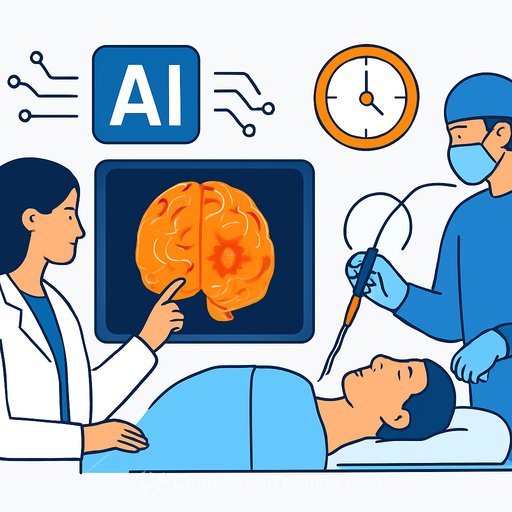
AI in Northeast Ohio Hospitals: What's Working, What's Next
AI is already in the clinical loop across Northeast Ohio. It reads scans, flags risk, routes alerts, and moves patients to treatment sooner. The common thread: AI is a tool embedded in workflow, not a replacement for clinical judgment.
The hospitals that get results do three things well. They pick specific use cases, they integrate AI inside existing workflows, and they train teams on what the AI can and can't do.
How hospitals are using AI right now
Algorithms that once took years to build now reach production in months. The FDA has cleared more than 1,300 AI-enabled medical devices and programs as of February 2026. That momentum shows up on the floor-especially in radiology, emergency care, and follow-up management.
- Summa Health
- Nuance: Natural language processing to catch key findings in reports and prevent missed follow-ups.
- Aidoc: More than 35 algorithms spanning diagnostic radiology, acute care coordination, and patient navigation.
- University Hospitals
- Aidoc: Multi-algorithm platform for triage and workflow alerts.
- Riverain ClearRead CT: Automated detection and characterization of lung nodules on CT.
- Qure.ai: Imaging-based risk identification for select diseases.
- Heartflow: 3D heart models for analysis and measurement.
- NeuroQuant (Cortechs.ai): Quantitative MRI for brain metrics.
- RapidAI: Automated stroke detection and communication in the ED.
- Cleveland Clinic
- Riverain Technologies: Lung nodule detection support.
- Viz.ai: Triage to identify highest-risk stroke patients.
- RadAI: Structured reporting and concise conclusions in radiology.
- iCAD (DeepHealth): Highlights suspicious masses on imaging.
- Image generation for MRI: Accelerated reconstruction to speed reads.
The shift: From standalone models to workflow platforms
Hospitals are favoring platforms that plug into existing IT and trigger the right algorithm at the right moment. Aidoc is one example used across the region. It acts as connective tissue between PACS, EHR, and multiple models, then pushes a customized workflow to the right clinician.
- Diagnostic radiology: Flags urgent findings and routes cases to speed reads.
- Acute care coordination: Streamlines alerts and reduces time to treatment.
- Patient navigation: Identifies abnormal results and drives follow-up.
Key point: configuration matters. Each site tunes routing, thresholds, and notifications to match how its teams actually practice.
Radiology case study: ClearRead CT
ClearRead CT analyzes all CT slices, then pushes results to PACS alongside the original scan. Radiologists open the study with both views ready, allowing a concurrent read and quick verification of flagged regions. Target outcome: better accuracy with less cognitive load.
Speed also helps. The algorithm typically processes a scan in minutes and reduces the chance of oversight as study volumes rise. About 250 sites nationwide use ClearRead CT.
Clinical integration and training
AI is only as safe and useful as the workflow and training around it. Physicians are trained on intended use, intended users, and failure modes. Teams learn where AI adds signal-and where it stays silent.
One practical rule: don't over-trust a negative flag. A "no" from the model isn't a diagnosis. The clinician still owns the case, the decision, and the documentation.
Building and validating new tools
Generalizing models is hard because patient populations differ across sites. A consortium led by Bunkerhill Health brings together 27 academic medical centers to share data and algorithms inside a legal framework. That compresses timelines from years to months and boosts external validation.
Locally, governance is tight. Cleveland Clinic runs AI approvals through an enterprise task force. University Hospitals uses a cross-subspecialty radiology group to vet tools. No system is letting AI run unattended or overrule a physician.
What teams can do this quarter
- Map the workflow first: Identify handoffs, delays, and where a triage or alert could remove friction.
- Pick high-yield use cases: Stroke triage, lung nodule detection, incidental findings follow-up, and structured reporting.
- Set governance: Approval paths, intended use statements, bias checks, and rollback plans.
- Tune thresholds: Calibrate alert sensitivity to your patient mix and staffing patterns.
- Train end to end: Radiologists, ED physicians, nurses, coordinators, and IT-so everyone knows the workflow and their role.
- Measure outcomes: Time to treatment, report turnaround, ED door-to-imaging, follow-up completion, false-positive rate, and reading efficiency.
- Close the loop: Weekly review of flagged misses, alert fatigue, and near-misses to refine settings.
Questions to pressure-test with vendors
- How does the model perform on our population and scanners? Show site-level validation, not just aggregate numbers.
- What's the fail-safe? If the model is down or wrong, how is care unaffected?
- Where in the workflow does the alert appear, and who owns the next action?
- What are the top causes of false positives and negatives, and how do we see them in our QA data?
- How do we export metrics to our analytics stack for ongoing monitoring?
Bottom line
AI is useful when it removes delay and supports clear decisions. Hospitals winning with AI aren't chasing features-they're building reliable workflows, training teams, and auditing results. Tools assist; clinicians decide.
Helpful resources:
- FDA overview of AI/ML-enabled medical devices: FDA AI/ML medical devices
- For structured learning and implementation playbooks: AI for Healthcare and AI Learning Path for CIOs
Your membership also unlocks: