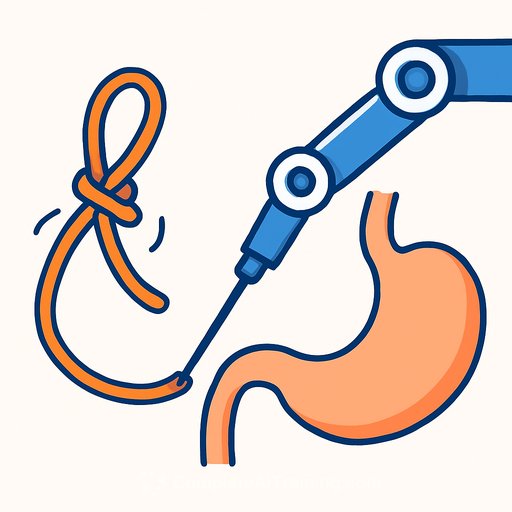
A simple slip knot gives robots surgeon-level precision - without heavy sensors
A team at Zhejiang University has shown that a basic slip knot can give robotic arms the feel and finesse we expect from experienced surgeons. Their approach, featured as a cover story in Nature on November 27, suggests robots can tie, tighten, and suture with consistent tension - even with their "eyes closed."
The core idea is elegant: use the physics of a slip knot to convert small motions into predictable tension. Instead of piling on fragile sensors and complex calibration, the knot becomes a mechanical translator between motion and force.
What's actually new here
- Precision from structure: The knot's geometry provides a built-in way to regulate tension, acting like a passive force controller.
- Sensor-light control: Because the system relies on mechanical feedback, it reduces dependence on vision or high-end force sensors that struggle with occlusion, fluids, or glare.
- Repeatability: Consistent tensioning means ties and sutures can land within tight tolerances, the bar for surgical-grade performance.
Why this matters for labs and clinics
- Lower system complexity: Fewer high-spec sensors and less calibration reduce failure points and maintenance.
- Safety by design: Passive mechanics limit force spikes, supporting safer interaction with tissue and delicate materials.
- Field resilience: Works in messy, low-visibility settings where vision pipelines degrade.
Potential applications
- Automated suturing and ligation in minimally invasive procedures.
- Catheter and guidewire handling where controlled tension is critical.
- Prosthetic and assistive hands that tie laces or knots with consistent tightness.
- Micro-assembly and textile handling that demand stable tension control.
Design principles you can test now
- Let mechanics do the math: Use compliant elements, knots, or wraps to turn displacement into controlled force.
- Bound the problem: Add physical limits, clutches, or knot geometries that cap peak force without active sensing.
- Dual-mode control: Run sensor-light "good enough" control for routine steps, with sensing only where it adds clear value.
- Measure what matters: Benchmark by tension variance, slip events, and task time - not just visual accuracy.
Questions for further research
- Generalization: How does performance hold across suture sizes, materials, and wet vs. dry friction?
- Sterilization and wear: Do repeated cycles change knot behavior or introduce drift?
- Closed-loop handoffs: What's the best way to switch between mechanical feedback and vision/force sensing when needed?
- Standards: Which metrics predict clinical outcomes (e.g., leakage, tissue trauma, knot security) most reliably?
If you want to read the broader context and methodology trends that journals are highlighting, start at Nature. For teams upskilling in AI methods that pair well with mechanical design (control, perception, simulation), see curated training paths at Complete AI Training - Courses by Job.
The takeaway is simple: thoughtful mechanics can replace piles of sensors. A slip knot, used wisely, can make a robot feel more human - and make your system easier to build, verify, and ship.
Your membership also unlocks: