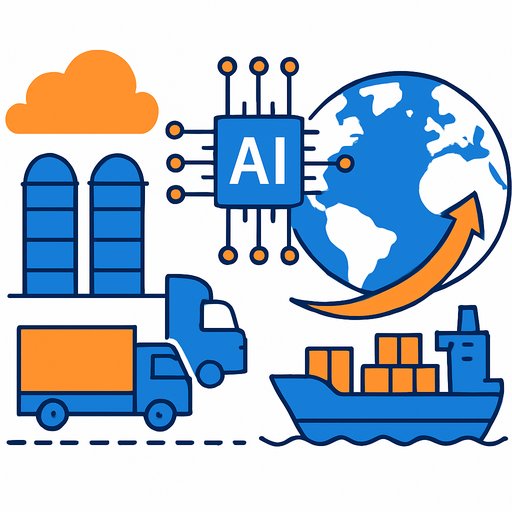
AI Supply Chains 2026: Predictive, Resilient, and Human-Centered
Supply chains are under stress from geopolitics, climate disruptions, and the lingering effects of a pandemic. The old just-in-time playbook breaks down when uncertainty compounds. The next edge comes from processing signal-rich data and acting before issues turn into outages. That requires a shift from descriptive reporting to predictive and prescriptive decisions powered by AI.
Key takeaways
- Predictive orchestration is replacing siloed planning via AI control towers that integrate procurement, manufacturing, and logistics data.
- Generative AI and digital twins are moving from pilots to operations to run "what-if" simulations, optimize safety stock, and expose single-source risks.
- Autonomous logistics and the physical internet reduce last-mile cost, deadhead miles, and emissions while supporting ESG targets.
- Human-in-the-loop remains essential: AI handles routine flows; people manage exceptions, strategy, and relationships.
- Data integrity and cybersecurity are now board-level priorities; clean rooms, provenance, and AI-driven security are baseline.
The rise of predictive orchestration
The historical model-procurement, manufacturing, and logistics running separate systems-creates lag and blind spots. AI-based control towers integrate these views and ingest external signals like weather shifts, port congestion, macro demand shifts, and social sentiment. The result: disruptions are forecasted early, and actions are recommended before performance slips.
What to implement next quarter:
- Unify planning horizons with an AI control layer connected to ERP, WMS, TMS, and MES.
- Ingest external signals (ports, lanes, FX, weather, supplier news) into a single features pipeline.
- Track "forecast-to-action" cycle time, ETA accuracy, and service-level-at-risk as primary KPIs.
Digital twins go operational
Generative AI now powers digital twins that model thousands of scenarios across demand, supply, and logistics. Leaders use this to stress test designs, reveal single-source exposure, and dynamically set safety stock instead of doing annual reviews. The practical benefit is fewer surprise stockouts and less trapped inventory.
- Build a living digital twin for your top value streams (SKU x region x channel).
- Create a scenario library: port closures, component shortages, demand spikes, regulatory shifts.
- Link outputs to S&OP and procurement playbooks so decisions are executed, not just analyzed.
Generative AI: From documents to decisions
Much of supply chain friction comes from unstructured documents-bills of lading, customs forms, and long-form contracts. Generative AI is automating contract lifecycle review, flagging risky clauses, and proposing alternatives tied to live risk signals. That shortens cycle times and reduces exposure during disruption.
Conversational interfaces make data usable for everyone. A warehouse lead can ask, "Which SKUs are at risk of stockout if West Coast port delays persist three more days?" and get a precise answer with recommended transfers or substitutions. No SQL, no tickets, no waiting.
Autonomous logistics and the physical internet
Inside the four walls, autonomous mobile robots have moved beyond follow-the-line. They navigate dynamic floors, coordinate tasks with humans, and reduce pick times and injuries. Across networks, AI optimizes standardized containers across open routes-cutting deadhead miles and improving asset utilization.
This is cost and ESG. Better routing and load planning cut fuel burn and emissions while improving on-time delivery. Expect regulators and customers to demand this level of transparency and performance.
Human-centered AI is the operating model
AI is not a replacement for judgment; it is the new baseline for signal processing and routine decisions. The modern supply chain org shifts to exception management-AI handles 90% of predictable moves and flags anomalies for human review. Managers spend more time on supplier strategy, design choices, and customer commitments.
- Define clear "human-in-the-loop" thresholds for overrides, escalations, and trade-offs.
- Upskill teams in data literacy, scenario thinking, and cross-functional leadership.
- Measure human-AI hit rate: how often AI recommendations are accepted and their outcomes.
Data integrity and cybersecurity
AI is only as good as the data feeding it. Data clean rooms and blockchain-based provenance help verify authenticity and guard against tampering across supplier ecosystems. This reduces model drift and bad decisions driven by noisy or manipulated data.
Attack surfaces are bigger as more processes become software-defined. Use AI for security to monitor shipment patterns, access logs, and network anomalies that signal cyber-breach or physical theft. Treat this as a continuous capability, not a project.
- Stand up a shared data schema with suppliers and logistics partners.
- Add automated data quality checks to every ingestion point; track "AI-ready data" availability.
- Deploy anomaly detection across TMS/WMS/IoT feeds; rehearse incident response quarterly.
90-day action plan for managers
- Days 0-30: Select one critical flow (SKU family or lane). Connect data sources to an AI control layer. Baseline service-level-at-risk, ETA accuracy, and inventory turns.
- Days 31-60: Build a minimal digital twin, run five key scenarios, and implement one safety stock and one sourcing change. Launch a conversational interface pilot for planners.
- Days 61-90: Add external signals (ports, weather, supplier news). Define HITL thresholds. Stand up data quality dashboards and anomaly detection. Publish a playbook for exceptions.
The intelligent enterprise
The destination is a self-healing supply chain: systems detect issues, decide, and act-reroute freight, switch suppliers, or adjust prices-while people govern the big calls. This is not a tech upgrade; it's a new way of running the business. Teams that commit to prediction, simulation, and HITL will grow through the next disruption. The rest will play defense.
FAQs
What is predictive orchestration in supply chain management?
Predictive orchestration uses AI and machine learning to integrate internal and external data-such as weather, port congestion, and demand signals-to forecast disruptions and recommend proactive actions.
How are digital twins being used in global supply chains?
Digital twins powered by AI allow companies to stress-test supply chain designs, model disruption scenarios, and dynamically adjust inventory, sourcing, and logistics strategies.
Does AI replace supply chain professionals?
No. The most effective AI deployments rely on human-in-the-loop systems, where AI handles routine decisions and humans focus on exceptions, strategy, and complex judgment.
What are the biggest risks to AI adoption in supply chains?
Data integrity and cybersecurity are the primary challenges, making clean data, blockchain-based provenance, and AI-driven security monitoring critical priorities for global operations.
Further reading
Upskill your team
If you're building AI capability across roles, see curated learning paths by function:
- AI Learning Path for Operations Managers
- AI Learning Path for Supply Chain Analysts
- AI Learning Path for Procurement Specialists
Your membership also unlocks: