The Contextual Layer: Why AI Unites Marketing and Data Engineering Teams
AI has erased the old divide between customer experience and data infrastructure. Marketing and data engineering now operate as one connected discipline with a single goal: use context to make better decisions, faster.
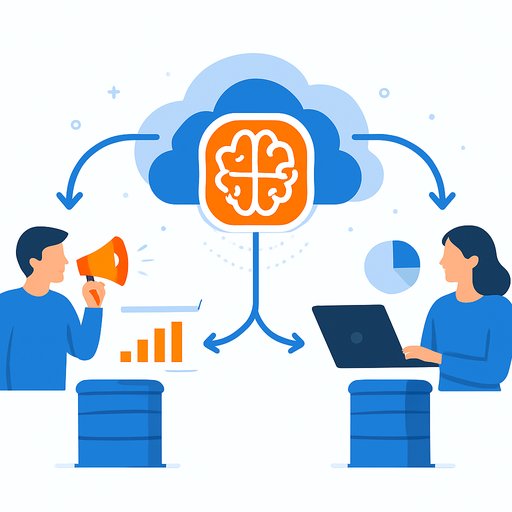
The missing link is a contextual layer. It structures historical and live customer data into signals AI can reason over. That shared context becomes the foundation for what I call Customer Data Intelligence - the system that lets every team and tool "know" the customer instantly and act with confidence.
The market evolved, the core problem didn't
Personalization fails when data is fragmented, stale, or unreliable. You can't greet the right person with the right message at the right moment if identity is flimsy, data is trapped in batch, or signals don't reach decision points in time.
Many platforms picked sides. Some focus on activation and skip the hard parts: identity, real-time data, and governance. Others build great infrastructure and stall before real customer experiences. The answer isn't more tools; it's a shared layer of context that closes the loop from signal to outcome.
What the contextual layer is (and why it matters)
Think of it as live, intent-rich customer understanding that both teams trust. It unifies identity, enriches events, interprets behavior, and keeps profiles up to the millisecond. With that, AI can make decisions that reflect the full customer story - not a partial snapshot.
This is where Customer Data Intelligence lives. It's not a marketing tool or an engineering tool. It's a platform that feeds both, with guardrails for governance and speed for activation.
What marketers should expect from it
- Instant recognition across channels, devices, and sessions
- Accurate profiles that update as behavior changes
- Lower signal-to-action latency (milliseconds, not hours)
- Predictions grounded in fresh, complete context
In short: higher match rates, better decisions, faster launches, and experiences that feel relevant and responsible.
What data engineering needs from marketing
Outcomes, not just pipelines. Data teams can unify records, manage lakehouses, and enforce privacy - but that work has to connect to the last mile where experiences happen. The contextual layer should plug cleanly into existing architecture and reduce manual work while surfacing measurable impact in marketing.
A practical blueprint for the contextual layer
- Define a shared signals taxonomy: intent, propensity, lifecycle state, risk, and value
- Set identity SLOs (match rate, false merge tolerance, latency). Recalculate continuously
- Move from batch exports to real-time streams for key events and profile updates
- Implement decisioning that can reason over state and trigger event-driven flows
- Codify consent and privacy policies as enforceable rules, not PDFs
- Add observability: lineage, drift detection, feature freshness, and model performance
- Close the loop: log decisions, measure outcomes, learn, and adapt (agentic decision loops)
Metrics that actually matter
- Recognition rate across channels (and merge accuracy)
- Signal-to-action latency (event to decision to activation)
- Profile freshness (time since last meaningful update)
- Coverage of consented, usable audiences
- Prediction lift tied to business KPIs (conversion, revenue per message, churn)
- Automation rate (decisions executed without manual intervention)
A system that fits both sides
- For marketing: live profiles, trustworthy segments, and event-driven orchestration
- For engineering: APIs, streaming I/O, quality checks, governance, and clear SLAs
- For leadership: faster experimentation with guardrails and auditable outcomes - see the AI Learning Path for CIOs
If you're new to event-driven thinking, this overview is helpful: Event-Driven Architecture. For governance and risk, see the NIST AI Risk Management Framework.
Avoid these traps
- Building more pipelines without a shared context model
- Over-optimizing channel tactics while identity remains unreliable
- Treating identity as a one-time project instead of a living system
- Relying on batch updates for use cases that demand real time
- Accepting black-box AI without observability and feedback loops
- Ignoring consent, data minimization, and retention policies
Your 30-60-90 day plan
- Day 0-30: Map top use cases. Inventory events, systems, identities, and consent. Define success metrics
- Day 31-60: Stand up real-time ingestion for priority signals. Implement identity resolution with SLOs. Wire basic decisioning
- Day 61-90: Launch two high-impact use cases end-to-end. Instrument the loop from signal to outcome. Publish the scorecard
Skill up your team
Marketers who speak data - and engineers who speak outcomes - accelerate everything. If your team needs a structured path, see this certification for marketers working with AI-driven customer data: AI Certification for Marketing Specialists. Business leaders and cross-functional managers can also explore the AI Learning Path for Business Unit Managers to align teams and strategy.
The payoff
The organizations that win will treat their customer data foundation as a shared system of contextual intelligence. When strong data engineering meets real-time customer understanding, AI can reason, enrich semantics, and drive state-based flows that serve the customer and the business.
That's the point of the contextual layer: one brain across teams and systems, making better decisions in the moments that matter.
Your membership also unlocks: