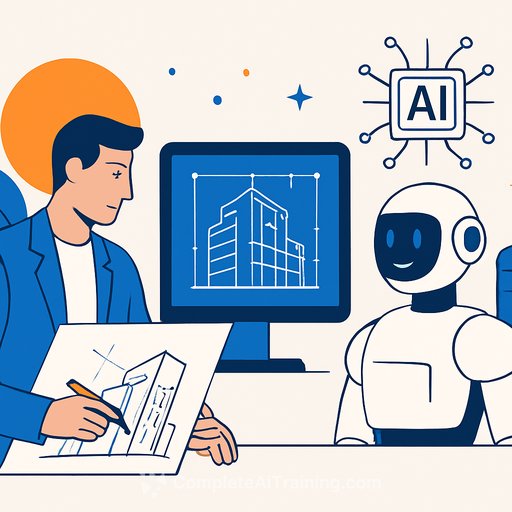
AI in Architecture: Hype, Headwinds, and Where It Actually Helps
AI talk swings between miracle and meltdown. For real estate and construction, the truth is simpler: compute is getting cheaper, models are getting smarter, and the industry will feel it in fees, schedules, staffing, and risk.
Predictions are shaky because the tools change by the week. What AI can't do today might land in your inbox next month. Bet on change, not certainty.
The Context Owners and Builders Can't Ignore
Architecture follows capital, codes, and supply chains. It's reactive by nature, and AI will reinforce that. Money is pouring into AI software and the physical backbone that runs it-data centers.
That buildout hits utilities and communities first: more power, more water, more grid stress. Expect location decisions, entitlement narratives, and MEP planning to absorb those pressures, or suffer them.
The Data Center Wave (and Your Utility Bill)
Data centers are energy and water hungry, and the next wave is large. Independent analyses suggest electricity demand from data centers and AI could surge significantly in the near term, with grid planning struggling to keep pace. See the International Energy Agency's outlook for a sober view of the load ahead. IEA: Data centres and AI
How Firms Are Actually Using AI-Right Now
Architects are cautious adopters. Liability, thin margins, and competitive advantage keep many experiments quiet.
Most active use is outside core design: renderings, marketing, writing, code checks, precedent sweeps, product schedules, and quick optioneering. It's the spreadsheet-and-slide-deck layer of a project, not the big moves-or the legal stamp.
What This Means for You
- Shorter early-stage cycles: more options, faster feedback on massing, daylight, and unit counts.
- Cleaner documentation: better clash detection, schedule QA, and consistency checks across sheets.
- Fewer drafting hours: expect production time to compress and shift toward coordination and review.
- Bigger delta between firms: process-driven teams will widen margins; laggards will eat rework.
What AI Still Struggles With (Yet)
AI predicts; architects synthesize. Models still stumble in multivariable environments where context, constraints, accountability, and judgment collide-also known as "real projects."
Yes, image tools are better, and some systems can now output editable floor plans or CAD. But consistent spatial reasoning, tradeoff logic, and code-savvy detail across an entire building set is a different sport.
Case Example: AI-Powered, Human-Led
Some firms are mapping the entire project workflow into tasks that machines handle (quantifiable, repeatable steps) and tasks humans own (aesthetic intent, sequencing judgment, client persuasion). That split matters.
Practical takeaway: ask your design team where AI shows up in the scope. If they can't point to specific steps in programming, massing, unit mix, energy modeling, cost checks, and documentation QA, you're funding guesswork, not process.
Risk, Speed, and the Owner's Math
Owners don't pay for drawings; they pay to lower risk while moving faster. AI can help de-risk coordination and shorten the time between concept and permit-two places where carrying costs and interest add real pain.
If a project's monthly hold burns six figures, shaving four to eight weeks off design and precon is not a "nice to have." It's fee-neutral-or better-if the team is set up for it.
Pricing Will Shift: From Hours to Outcomes
If production time drops, hourly billing breaks. Expect value pricing to surface around what matters: schedule compression, change-order reduction, utility and envelope performance, leasing velocity, and NOI.
If your RFP still asks for hourly rates and sheet counts, you'll get more of the past. If it asks for quantified outcomes and shared risk, you'll separate signal from noise.
Procurement Playbook: How to Buy Architecture in the AI Era
- Scope the workflow, not the buzzwords: request a task map showing where AI is used, the model types involved, and the human checkpoints.
- Tie fees to outcomes: offer incentives for schedule gains, RFI and change-order reduction, and energy targets verified by third parties.
- Demand evidence: ask for side-by-side submittals-traditional vs. AI-assisted-showing cycle time, conflicts caught, and cost deltas.
- Protect data and IP: require secure handling of models and specs; ban public training on your project unless explicitly approved.
- Integrate GC early: set up shared models and clash protocols in precon; measure issues closed per week, not meetings held.
- Codify QA: mandate automated checks for code keywords, spec conflicts, and quantity anomalies before each issue set.
- Own the truth: designate a single source of data (BIM + cost model) and lock decision logs so AI outputs don't outpace approvals.
What Will Likely Change Next
- Option sets explode: expect 5-10 viable schemes with budget/schedule overlays, not one polished favorite.
- Entry-level work shrinks: drafting and detail repetition decline; early-career paths will need new training and stronger mentorship.
- Integration pressure rises: owners will expect architects, engineers, and GCs to run one connected process, not three parallel ones.
Red Flags to Watch
- AI as theater: pretty images with vague math. Insist on quantities, costs, and code citations.
- Model sprawl: multiple "final" files, zero audit trail. Require version control and issue logs.
- One-size outputs: if every scheme looks the same, the team is optimizing averages, not your site or pro forma.
Where to Push for Immediate ROI
- Programming to test-fit: automate unit mixes, net-to-gross, and core sizing to lock the deal story early.
- Envelope and MEP: run parametric energy and daylight checks before DD; lock specs that reduce long-lead risk.
- Clash and submittals: track conflicts closed per week and submittal turnaround time; tie payments to throughput.
- Spec and code QA: use text checks to catch contradictions and missing references before permit.
Final Word
AI won't replace skilled architects or seasoned builders this year. It will compress tasks, expose weak process, and reward teams that make decisions with data and ship faster with fewer surprises.
Buy process. Price outcomes. And make the tech prove itself on your critical path.
Further learning
Your membership also unlocks: