Why Education Needs Urgent Reform In An AI-Driven World
AI is now woven into higher education. A UNESCO survey reports widespread use for research, writing, lesson planning, marking, and admin work-yet there's limited clarity on its impact on rights, democracy, and equity. Ethical concerns, uneven access, and policy gaps are common friction points.
AI also makes confident errors. That should change how we treat knowledge. Students need to test claims, verify sources, and think independently-because speed is no longer the differentiator. Discernment is.
Why the old model no longer works
Mass education was built for factories: recall, compliance, punctuality. Exams still reward memory over judgement and conformity over curiosity. In a world where tools can produce answers in seconds, that approach is outdated.
We need holistic education that develops ethical judgement, self-knowledge, and meaningful contribution. The goal: graduates who can decide well under uncertainty and live out values in public.
What today's learners must build
- Discernment: differentiate fact from fiction; detect bias and missing evidence.
- Critical thinking: reason from first principles; change views with new data.
- Ethical judgement: evaluate intent, impact, and trade-offs.
- AI literacy: prompts, verification, provenance, bias, and limits.
- Deep work habits: focus, reflection, and sustained attention.
- Civic purpose: contribute beyond personal gain.
Assessment and admissions that match reality
- Open-resource performance tasks: assess thinking, sourcing, and decision quality, not recall.
- Portfolios with transparent AI use: process notes, drafts, and data trails.
- Viva-style defences: students explain choices, sources, and trade-offs.
- Scenario-based ethics cases: competing values, real constraints, public impact.
- Community capstones: measurable outcomes for people, not just grades.
- Continuous micro-assessments: small, authentic checks over time.
Whole-Human Qualifications (Humanity Streams)
- Ethics and epistemology: how we know, what we value, how we choose.
- Reflective digital literacy: AI bias, hallucinations, provenance, and model limits.
- Vocation and purpose: identity, values, contribution beyond economic output.
- Civic and creative labs: projects requiring empathy, imagination, and collaboration.
Practical rollout plan (first 12 months)
- Days 0-90: audit assessments for recall bias; set an AI-use policy (allowed, conditional, prohibited cases); run staff clinics on AI prompts, verification, and student feedback with AI.
- Days 90-180: pilot one performance task per subject; add a short ethics case; require process evidence (sources, checkpoints, reflection).
- Days 180-360: scale pilots; introduce a cross-curricular capstone; add viva defences; update rubrics to include judgement, originality, and AI accountability.
- Partnerships: co-design tasks with 3-5 employers and at least 2 universities; align admissions with portfolios and vivas.
- Data: track student wellbeing, attention habits, and time on task-not just grades.
Classroom practices you can use next term
- Source-tracing protocol: every claim needs a link, author, date, and why it's credible.
- "AI sandwich" method: student brainstorm → AI draft → human revision with citations and critique of AI errors.
- Bias lab: compare outputs from two tools; list differences; test with counter-prompts; document findings.
- Evidence codes: label sentences E1 (verified), E2 (credible but unverified), E3 (speculative); revise up the ladder.
- Reflection micro-logs: what changed your mind, what you'd test next, which source you now distrust and why.
- Community project sprint (2-3 weeks): define a local problem; design, test, and present a solution with stakeholders.
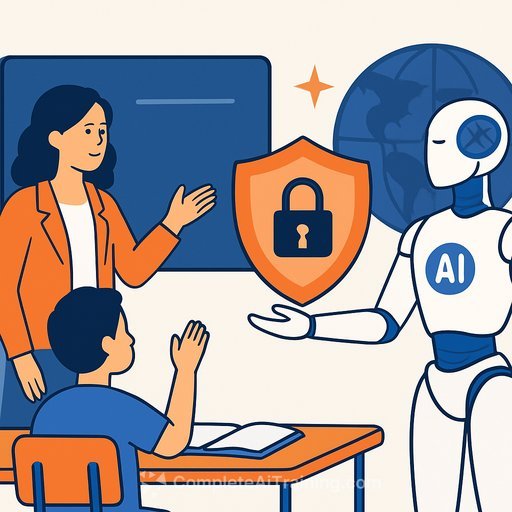
Guardrails for AI use
- Attribution and provenance: require citations, model names, versions, and prompts used.
- Human-in-the-loop: AI can draft; students must verify, edit, and defend.
- Tool boundaries: specify what's allowed on each task; explain why.
- Privacy and safety: no sensitive data in public tools; use approved platforms.
- Equity: provide school-managed access so advantage isn't based on wallet size.
Supporting educators
Teachers need time, tools, and clarity. Start with practice libraries, shared rubrics, and co-planned tasks across departments. Build peer feedback loops and short, frequent PD that respects workload.
Measuring what matters
- Judgement: can students explain trade-offs and uncertainty?
- Originality: novel connections, not just format changes.
- AI accountability: accurate citations, error detection, and clear reasoning.
- Wellbeing and focus: habits that protect attention from short-form noise.
- Graduate outcomes: adaptability, ethical conduct, and community contribution.
The wider context
Social media incentives push instant validation over reflection. AI is taking over routine knowledge tasks, some creative work, and admin. Opportunity and wealth may centralize if schools keep producing passive consumers instead of active citizens.
Skills demand is shifting. Creativity, resilience, flexibility, and AI literacy will be core. For a high-level overview of AI's role in education, see UNESCO's work on AI and education here.
Next step for your institution
Run one pilot per subject this term. Add a viva. Require transparent AI use. Build a civic capstone. Update admissions to value portfolios and purpose.
If you need curated learning paths for educators and students, explore role-based AI course collections here.
Closing thought
Education should awaken, not sort. Rousseau's Emile argued for self-discovery and empathetic engagement with the world. That is the assignment now: teach young people to be good humans who can think clearly, choose wisely, and contribute with courage-especially when machines can do so much of the rest.
Your membership also unlocks: