Solarisdo's AI Core: South Korea Prepares a 40MW National Computing Center in Haenam
South Korea is preparing a vast reclaimed site in Haenam, Jeollanam-do, for a government-backed National AI Computing Center, the anchor of a new corporate city called Solarisdo. The center is planned to begin service in 2029, positioning the region as a high-performance computing hub under a public-private partnership.
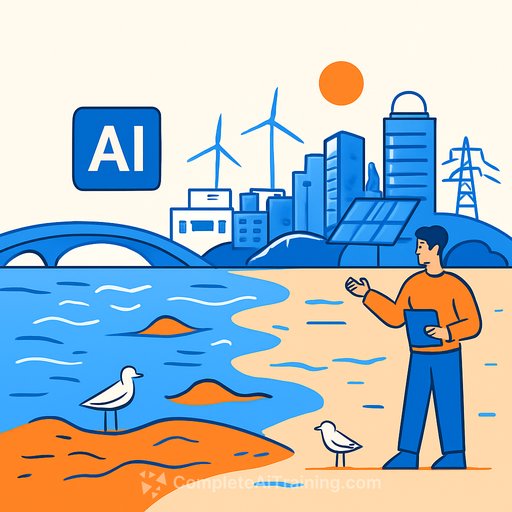
In Sani-myeon, where tidal flats met the sea two decades ago, construction vehicles have already scored deep tracks across flattened ground marked by a simple "Data Center" sign. A groundbreaking date has not been finalized, but the build is moving through early-site preparation and planning.
Scale, Utilities, and Site Fundamentals
The initial facility is planned at 40 megawatts, with average cooling demand projected at 2.4 million liters of water per day. Jeollanam-do aims to attract 20+ additional data centers to Solarisdo, which could lift daily water use to as much as 60 million liters.
Provincial officials cite nearby Yeongam Lake, Geumho Lake, and the Yeongsan River, noting average freshwater availability of about 1 billion liters per day. Electricity demand is set to be addressed through a planned solar power plant and new substations within Solarisdo.
What Solarisdo Is Aiming to Build
Solarisdo spans 6.32 million pyeong (about 20.8 million square meters) and is envisioned as a self-sufficient city for more than 60,000 residents. The name blends "solar," "sea," and "do" (province), signaling a focus on renewable energy, waterfront development, and smart-city infrastructure layered into a single build-out.
The National AI Computing Center is expected to serve research and development needs at scale, with operations coordinated through a public-private model. Officials project around 100 R&D roles initially, with pathways for local university graduates and potential spillover to startups and related vendors.
Local Concerns and Policy Trade-offs
Civic groups are calling for tighter scrutiny on resource use and equitable growth. They argue that large complexes often prioritize national demand over local interests-citing the Yongin semiconductor cluster-and question both long-term employment impact and pressure on water and electricity supplies.
Provincial leaders maintain that water resources are sufficient and that the center can fuel a broader digital ecosystem in the region. They also note that additional government support-such as lower utility fees and rental assistance-may be required to attract investment and anchor supply chains.
What to Watch for (Government, IT, and Development)
- Water strategy: confirm allocation, seasonal variability, and reuse options. Daily demand could scale quickly if more facilities cluster in Solarisdo.
- Cooling approach: track whether designs favor air-side, liquid, or hybrid cooling and how that shifts water and energy profiles.
- Power mix and reliability: how solar is paired with grid interconnects, storage, and backup to meet 24/7 compute needs.
- Environmental review: transparency on impact assessments for reclaimed land, including hydrology and biodiversity offsets.
- Local benefits: targets for local hiring, supplier development, and university partnerships to move beyond short-term construction jobs.
- Incentives package: clarity on utility pricing, land terms, and tax treatment to attract additional data centers without overextending public budgets.
Key Milestones Ahead
- Finalized groundbreaking date and construction phasing for the National AI Computing Center.
- Detailed water allocation plan and any commitments to recycling or alternative sources.
- Power procurement, substation timelines, and grid integration details.
- Cooling design decisions and energy-efficiency targets.
- Governance structure for the public-private partnership, including service-level and sustainability metrics.
- Announcements on additional data center tenants and the full Solarisdo utilities build-out.
Resources
- IEA: Data centres and data transmission networks - a concise view on energy and resource trends in digital infrastructure.
- Complete AI Training: Courses by Job - practical upskilling paths for teams planning AI operations, data center analytics, or AI R&D roles.
- AI Research Courses - resources for university partnerships and R&D training relevant to the center's research roles.
- AI Learning Path for CIOs - guidance on IT governance, procurement, and infrastructure planning for public-private AI computing projects.
Your membership also unlocks: