Can AI fix India's healthcare gaps? Inside IIT Delhi's push from ideas to outcomes
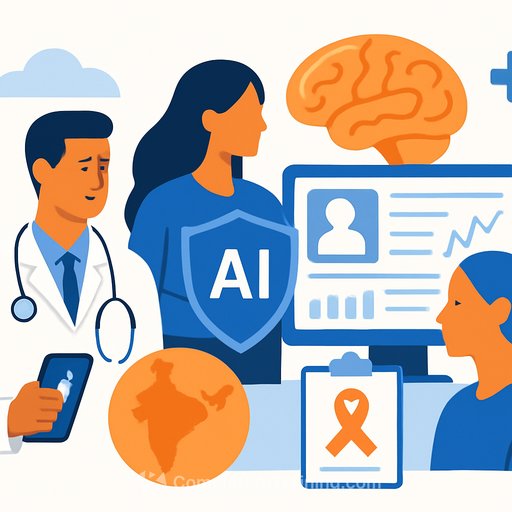
At IIT Delhi, researchers, policymakers, clinicians, investors and health-tech founders met for "AI Impact in Biotech and MedTech Innovation - The Next Frontier," the curtain-raiser to the India AI Impact Summit 2026. The focus was simple: move AI from buzz to outcomes that work in India's constraints.
The forum combined expert panels, investor networking and 12 startup pitches. The throughline: faster insight from data, lower-cost diagnostics and tools that work at the last mile.
What stood out from the pitches
- A non-invasive device to manage post-treatment lymphoedema in breast cancer patients, aiming to reduce clinic visits and improve comfort.
- An IoT-enabled vaccine cooling carrier powered by battery and solar for remote areas-solid-state, portable and built for rough field conditions.
- A smart protective belt to reduce fall-related hip injuries among older adults, targeting preventable morbidity and admissions.
- A smartphone-based, AI cervical cancer screening tool that runs offline, enabling frontline workers to spot early abnormalities without lab infrastructure. See WHO guidance on screening and triage: WHO cervical cancer screening.
Cold-chain reliability also took the spotlight. For context on standards and procurement, see UNICEF's overview of cold-chain equipment: UNICEF cold-chain.
Diagnostics: moving more tests to the point of care
Several teams showed compact platforms that can analyze 25+ parameters across kidney, cardiac and pancreatic function-at significantly lower cost per test. For clinicians, that means faster triage and fewer referrals delayed by lab turnaround times.
For program managers, the promise is clear: lighter logistics, tighter care pathways, and better data capture for cohorts that rarely reach tertiary centers.
What leaders in the room said
Tarun Chaturvedi, COO of the Foundation for Innovation and Technology Transfer at IIT Delhi, emphasized that AI is turning large datasets into actionable insights. "India is likely to see a surge in successful AI startups over the next three to five years," he said.
Sandeep Nailwal, founder of Blockchain For Impact, argued that India can take AI health solutions global-if they scale beyond pilots and reach the grassroots.
From pilot to practice: what it takes
- Clinical validation: demand peer-reviewed evidence, local population data and clear sensitivity/specificity or NPV/PPV for your use case; explore focused Research resources on validation and evidence.
- Workflow fit: prefer offline-first tools, low-power hardware and simple UX for ASHAs, ANMs and primary care teams - see practical guidance on Design for frontline, offline-first systems.
- Data governance: define ownership, consent, de-identification and retention from day one; map data flows for audits.
- Equity checks: test across diverse cohorts to avoid bias; monitor for drift once deployed.
- Procurement and cost: model capex vs opex, consumables, service SLAs and uptime; set ROI metrics tied to avoided referrals or bed-days.
- Interoperability: plan integrations with your HIS/LIS; standardize data formats to ease reporting and research.
- Training and change management: create short, recurring skill blocks for frontline workers; measure competency, not just attendance.
- Last-mile logistics: budget for power backups, spares and rapid replacement to keep devices in service.
Ecosystem momentum
Two expert panels, 12 startup pitches and curated time with 15+ investors signaled real appetite for healthcare AI that fits India's realities-rural delivery, cost pressure and workforce constraints. The opportunity is less about novelty and more about scale, reliability and measurable outcomes.
Practical next steps for healthcare teams
- Pick two bottlenecks-e.g., cervical screening backlog and CKD triage-and run time-bound pilots with pre-agreed outcome metrics.
- Track impact on wait times, diagnostic yield, referral appropriateness and cost per diagnosis.
- Form a small review group (clinician, nurse, biomedical, IT, finance) to approve go/no-go decisions within 30 days of pilot end.
- Lock in a playbook for scale: device provisioning, spares, training cadence, data reporting and escalation paths.
If you're tasked with evaluating or deploying AI in clinical or operational workflows, curated training can speed up your team's learning curve. Explore role-based options here: AI courses by job.
Bottom line: AI won't fix access gaps by itself. But with offline-first design, strong validation and clear ownership for last-mile delivery, these tools can cut delays and costs across cancer care, chronic disease and immunization-exactly where India needs leverage.
Your membership also unlocks: