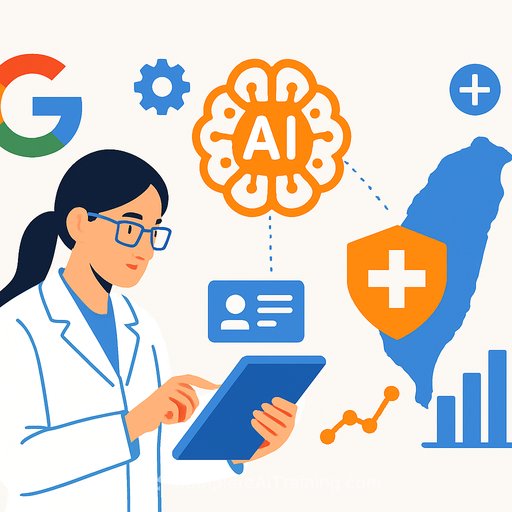
How Google and Taiwan are building an AI blueprint for public health
Taiwan and Google are turning 20+ years of securely aggregated health data into proactive care. By bringing a predictive diabetes-risk model into clinicians' workflow and a Gemini assistant into a government health app, they're giving doctors and patients fast, practical support at scale.
The aim is simple: find risks earlier and act sooner. With limited clinician time, the right AI makes the hours count.
From weeks of work to seconds
The NHIA's AI-on-DM model cuts diabetes risk assessment from 20 minutes per patient to about 25 seconds. At population scale, screening 20,000 people no longer takes 40 professionals three weeks - it now finishes in under 90 minutes.
- Processing speed-up: ~14,400x
- Per-case time: ~25 seconds (down from ~20 minutes)
- Population run: 20,000 cases in under 90 minutes
How it works: NHIA digitized clinical logic and runs assessments in parallel using Google Cloud concurrency. The model flags patterns for clinical review, helping doctors move faster without skipping oversight.
More time for what matters
Doctors get prioritized risk signals and can intervene before complications escalate. The model supports consistent, high-quality assessments across regions, so patients get the same standard of care no matter where they live.
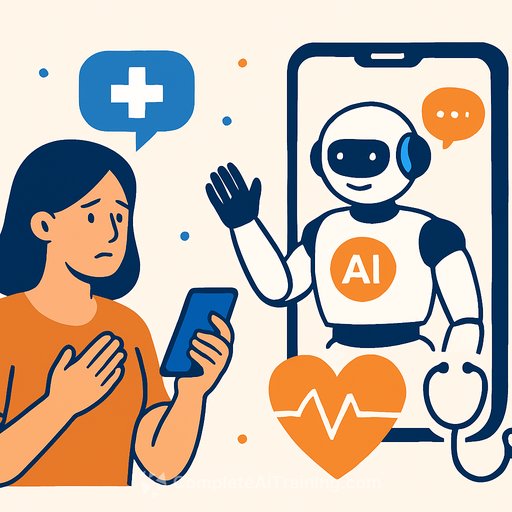
Next, the NHIA will launch a Gemini-powered assistant in its government health app used by 10 million people in Taiwan. It offers personalized, secure guidance grounded in clinical guidelines for daily care and follow-up.
Proven in real clinical settings
This work builds on AI deployments across Taiwan's hospital networks. CMUH is using MedLM in cancer care, Chang Gung Memorial applies AI to enhance ultrasound diagnostics, and TMU's affiliated hospital uses automated workflows to ease clinician shortages.
The NHIA also used MedGemma to process over 30,000 pathology reports. These wins show the value of combining clinician expertise with model-driven workflows.
Reaching every community
To extend impact beyond hospitals, Google.org funded the Digital Humanitarian Association (DHA) with $1 million USD. The initiative supports diabetes management services and digital training at 300 community centers.
- 240,000 health check-ins planned
- 200 local caregivers trained
What this means for healthcare, IT, and development teams
This collaboration is a blueprint any health system can learn from. Here's a practical path you can adapt:
- Start with a high-burden condition (e.g., diabetes, hypertension) and define clear outcome metrics.
- Establish secure, governed data access with audit trails. Create a validated feature set aligned to clinical logic.
- Train, validate, and calibrate models with clinician input. Track recall, precision, and fairness across subgroups.
- Run scalable inference (batch or streaming) with concurrency. Keep latency budgets explicit for clinical workflows.
- Embed scores and recommendations inside the clinician's existing tools. Maintain a human-in-the-loop review step.
- Provide a patient-facing assistant that follows clinical guidelines, explains next steps, and respects data privacy choices.
- Monitor performance and drift, log interventions, and feed outcomes back to improve models safely.
What changes for patients
Faster risk detection, clearer guidance, and timely follow-up. A smart assistant in your pocket to help with daily decisions, while your doctor has a sharper view of who needs attention now.
What changes for clinicians
Less manual triage. More time on complex cases. Consistent, explainable risk signals surfaced where you already work.
What changes for policymakers and payers
Population-scale screening that's actually feasible. Consistency across regions. Real-time insight into outcomes so programs can be improved continuously.
What's next
The NHIA plans to extend the same framework to hypertension and hyperlipidemia. The lesson is clear: when you pair unified data, clinician-led models, and patient tools, preventative, predictive, and proactive care becomes real at national scale.
If you want to go deeper on sector-specific practices, see AI for Healthcare and AI for Government.
Learn more about Taiwan's National Health Insurance Administration here, and review global guidance on diabetes from the World Health Organization.
Your membership also unlocks: