Musk Steps Onto the Davos Stage: What Executives Should Take Away
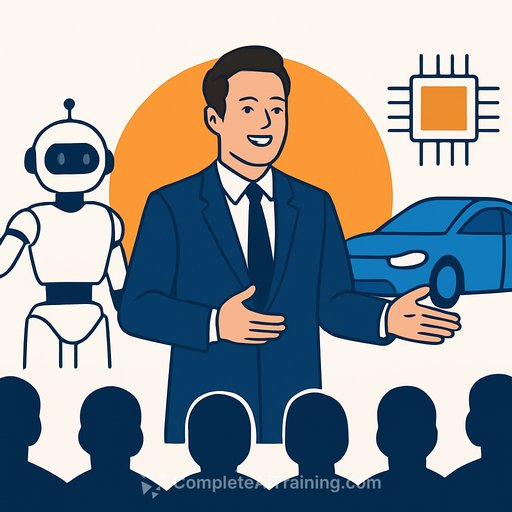
After years of blasting the World Economic Forum, Elon Musk took the Davos stage-his first appearance at the event. He sat down with BlackRock CEO Larry Fink and spoke to a room already stacked with heads of state and senior officials. The message was clear: he's engaging directly with the people who shape policy, capital, and infrastructure.
For leaders, this wasn't spectacle. It was a signal. Musk used Davos to outline a near-term path for humanoid robots, an expansion of autonomous services, and a stance on trade policy that affects energy deployment.
Why This Appearance Matters
Musk has long criticized Davos as an unaccountable elite forum. Showing up marks a shift-from firing shots on social media to shaping the conversation in person. His businesses now sit at the intersection of regulation, defense, logistics, and communications. Being in the room accelerates coordination with policymakers and financiers.
Robots Outnumbering People: The Forecast
Musk projected a future where robots become more numerous than humans. He framed it as an economic boost: fewer labor bottlenecks, higher Productivity, and support for aging societies. One practical use case stood out-humanoid robots assisting older adults in daily tasks.
For operators and strategists, the takeaway is to plan for mixed human-robot workflows. That means new safety standards, new process maps, and new metrics for productivity per task-not just per headcount.
Tesla's Optimus: Timeline and Scope
Musk said Tesla's Optimus is already handling basic factory tasks, with more complex work next. The company aims to tighten reliability over the next year and target public availability in roughly two years, contingent on performance. The priority is stability before scale.
The humanoid robotics market is already worth several billions and is expected to grow as deployments spread across manufacturing, logistics, and services. Tesla is positioning to compete in that expansion.
Autonomous Driving and Robotaxi Expansion
Musk said Tesla's self-driving stack is mature enough for wider rollout. Limited robotaxi services are live in select cities, with plans to expand across the U.S. by year-end. He's optimistic on supervised approvals in Europe, with China following a separate track.
Regulators still hold the keys. Safety reviews and public acceptance will be the gating factors. Local laws and insurance frameworks will determine speed of adoption-and margins.
Trade Policy and Energy Economics
Musk called out high U.S. tariffs on imported solar panels, arguing they inflate domestic deployment costs. With China producing a large share of solar components, tariffs can shift the math on clean energy projects. This is a supply chain question as much as a policy stance.
For energy operators and CFOs, watch landed cost curves, storage pairings, and tax credits in tandem. Policy adjustments can swing project IRRs as much as technology gains.
Humor, Politics, and Signal Value
On stage, Musk mixed humor with geopolitics, referencing President Trump's remarks on Greenland and Venezuela and joking about a "peace board." It drew laughs, but the signal was practical: he's willing to engage on sensitive topics in public, knowing the audience includes heads of state and major funds.
Davos Backdrop: Diplomacy in Plain Sight
One day prior, President Trump spoke about Greenland and European trade measures, then paused certain planned tariffs for countries supporting Greenland. NATO's Secretary-General Mark Rutte discussed a potential framework for a greater alliance presence in the Arctic, with details still under negotiation. Davos functioned as informal diplomacy-proximity driving progress.
Musk's participation placed his agenda inside that environment, even as he keeps voicing skepticism about the forum itself.
Broader Influence and Scrutiny
Musk's reach extends across space, defense, and communications. SpaceX's Starlink supports remote and conflict zones, drawing attention from governments. His AI startup xAI faces scrutiny over Grok's content safety, while X remains under pressure over moderation policies. Attention and regulation follow wherever his products touch civic infrastructure.
Economics and Market Response
Automation promises productivity but shifts labor markets-especially in manufacturing, transport, and services. Some see the gains enabling shorter workweeks or new roles; others expect meaningful displacement. Financial services are tracking the downstream effects on payments, logistics finance, and risk models.
Markets responded with interest rather than sharp swings. Investors are watching Tesla's progress in autonomy and humanoid robotics, and SpaceX's satellite services continue to attract defense and telecom demand. Musk's wealth amplifies every statement, but execution remains the test.
What Executives Should Do Next
- Run a two-year scenario for humanoid robots: pilot in facilities with repetitive, low-variance tasks; define safety, uptime, and ROI thresholds.
- Evaluate autonomy exposure: fleet operations, insurance structures, and city-by-city regulatory readiness. Build regional rollout playbooks.
- Redesign workforce plans: upskill frontline teams for robot supervision and exception handling; set clear human-in-the-loop policies.
- Tighten data and safety governance: labeling, telemetry, incident reporting, and third-party audits for autonomy and robotics.
- Model energy project economics with and without tariff impacts; adjust procurement across panels, inverters, and storage.
- Stand up a policy function that engages early with transport and AI regulators; track EU and U.S. pathways for supervised systems.
- Stress-test capex and opex: hardware lifecycles, service contracts, and redundancy for mission-critical tasks.
- Create a cross-functional "Autonomy & Robotics Council" to prioritize use cases, budgets, and compliance timelines.
Useful References
World Economic Forum Annual Meeting
NHTSA: Vehicle Automation
If you're building internal capability around AI and automation, explore role-based learning paths here: AI Learning Path for Training & Development Managers.
The Bottom Line
Musk used Davos to set clear expectations: humanoid robots moving toward commercial availability within about two years and broader robotaxi deployment contingent on regulators. He also put energy trade policy on the table. The next few years will be decided by deployment quality, regulatory wins, and how fast customers-and the public-accept machine-led work.
Your membership also unlocks: