FrontierScience: a higher bar for AI in real scientific work
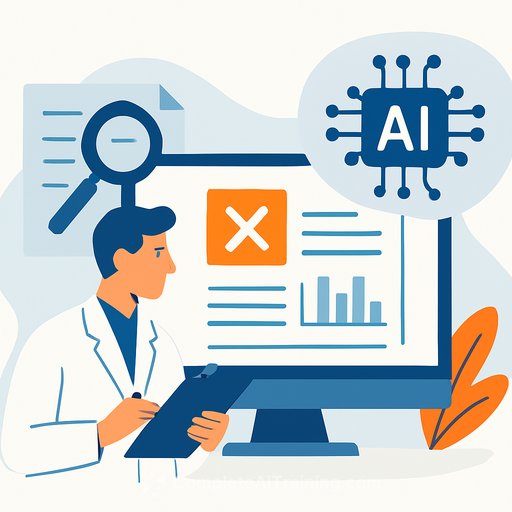
Let the robots do the thinkin'. OpenAI has introduced FrontierScience, a benchmark built to test whether AI is ready for expert-level research, not trivia contests. It measures deep reasoning on original problems across physics, chemistry, and biology.
The intent is simple: stress-test models on tasks that feel like actual science. That means new questions, precise constraints, and evaluation that favors reasoning quality over rote recall.
Two tracks that mirror how scientists actually work
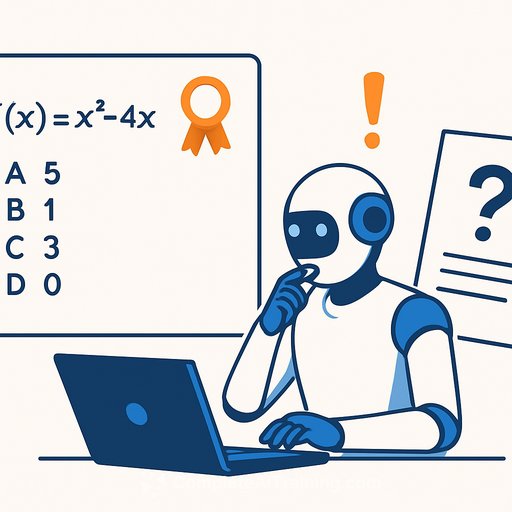
- Olympiad track: constrained, competition-style problems that demand tight, stepwise reasoning under rules and fixed inputs.
- Research track: open-ended subtasks that simulate lab work-framing a problem, choosing methods, interpreting outputs, and stating limits.
Early results show the split clearly. GPT-5.2 scores 77% on Olympiad questions and 25% on open-ended Research problems. Solid at structured reasoning, but still thin on framing, study design, and validation-where human judgment carries the weight.
Why this matters for your lab
Top models already compress certain research tasks from weeks to hours. But the hard parts-posing the right question, sanity-checking assumptions, and deciding what "good enough" looks like-still sit with you.
FrontierScience gives you a reference point for where to trust automation and where to keep a tight human loop. That clarity helps you plan workflows, budgets, and review protocols.
A practical playbook for using AI with FrontierScience in mind
- Split your workload: use models for structured tasks (derivations, dimensional analysis, unit checks, code scaffolding, literature triage). Keep humans on hypothesis generation, experimental design, and final interpretation.
- Define acceptance criteria: specify required outputs (units, error bounds, datasets, references). Ask for assumptions and named equations used, plus uncertainty estimates and failure modes.
- Guardrails: maintain vetted prompt templates, forbid training-data guesses, and require citations with links or DOIs. Log model versions, seeds, and tool calls for repeatability.
- Evaluate like a benchmark: create a held-out test set, track pass@k, constraint violations, and time-to-solution. Compare AI, human baseline, and paired human+AI.
- Data hygiene: prevent leakage by scrubbing problem sets and keeping private corpora offline. Use document provenance and snapshots for audits.
- Human-in-the-loop by default: require sign-off for experimental steps, safety-sensitive suggestions, or claims that imply causality.
- Upskill the team: train researchers on prompt patterns for scientific tasks, verification tactics, and model limits. A focused curriculum saves cycles and reduces review fatigue. AI Research Courses.
How to read the current scores
High Olympiad performance means you can lean on models for tightly defined problems with clear ground truth and constraints. Use them to accelerate derivations, baseline simulations, unit tests, and code generation around known methods.
Low Research performance means you still need human oversight for problem framing, dataset selection, and choosing evaluation metrics. Treat model outputs as structured drafts, not conclusions.
What to implement this quarter
- Pick three repeatable, high-volume tasks and write standard operating prompts with acceptance criteria.
- Set a gated deployment path: sandbox → shadow mode → partial automation with mandatory review.
- Add a weekly "error review" for AI-assisted work. Catalog failure modes and update prompts/checklists.
- Track ROI: time saved, error rate, rework rate, and citation/replication outcomes.
A north star for AI that actually helps discovery
Benchmarks steer behavior. By rewarding deep reasoning on original problems, FrontierScience pushes models to be useful research partners-not trivia engines.
Adopt it as a reference in your lab: map tasks to the two tracks, run small pilots, and upgrade automation only where performance holds under audit. Keep the scientist in charge of framing, safety, and sign-off.
Learn more
- OpenAI announcement hub for updates on benchmarks and model evaluations.
- ARC: Abstraction and Reasoning Corpus for background on reasoning-focused evaluation.
- AI Design Courses for building researcher-ready workflows and tooling that support rigorous scientific tasks.
Your membership also unlocks: