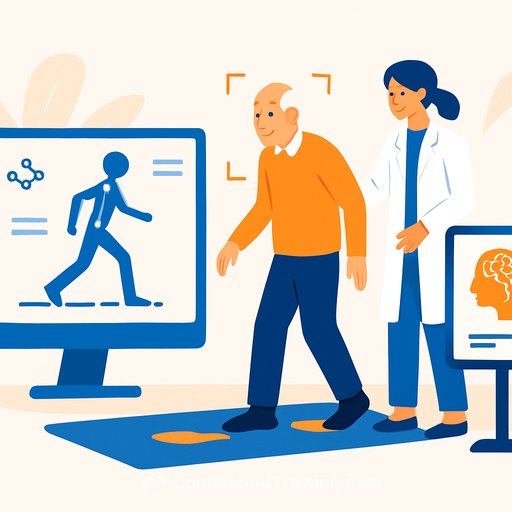
Fujitsu and Acer Medical Trial AI to Detect Disease Risk in Elderly Through Gait Analysis
Fujitsu Limited and Acer Medical Inc. have partnered to develop “aiGait” powered by Uvance, a new AI service that detects abnormalities in gait patterns to support early diagnosis of dementia and Parkinson’s disease. This AI solution uses Fujitsu’s advanced skeleton recognition technology to analyze movements such as standing, sitting, and walking, offering healthcare professionals quantitative data to aid clinical decisions.
The collaboration, formalized in June 2025, is conducting initial trials at the daycare center connected to Taipei Veterans Hospital. Cameras capture patients’ motions and compare them to known movement patterns associated with dementia, enabling early identification of potential risks. Acer Medical plans to introduce this solution across elderly care facilities in Taiwan by the end of 2025.
Transforming Movement Data into Clinical Insights
By integrating Fujitsu’s skeleton recognition AI into a mobile-friendly platform, Acer Medical turns everyday movements into meaningful health indicators. The system helps caregivers and clinicians spot subtle gait changes early, facilitating timely medical intervention and enhancing patient outcomes. Acer Medical emphasizes affordability and ease of use, aiming to bring smart healthcare to communities with growing elderly populations.
This initiative aligns with Fujitsu Uvance’s broader goal of applying AI and data to social challenges. Together, Fujitsu and Acer Medical aim to improve elderly care access and plan to expand applications of their AI technology to areas such as sports science, pediatric neurodevelopmental disorders, and cerebral palsy.
Expert Perspectives
Allen Lien M.D., DrPH., Chairman of Acer Medical, highlights the synergy between Taiwan and Japan's expertise. He stresses ongoing improvements to the user experience based on feedback from healthcare professionals to ensure the solution is practical and scalable.
Hidenori Fujiwara, Head of Human Digital Twin Division at Fujitsu, expresses pride in contributing to early detection of neurodegenerative diseases. He notes that combining Acer Medical’s clinical know-how with Fujitsu’s AI movement analysis creates a solution ready for global deployment, supporting the World Health Organization’s vision of healthy aging.
How the aiGait Solution Works
- Caregivers use smartphones or tablets to record patient movements at participating daycare centers.
- Fujitsu’s skeleton recognition AI analyzes the data, providing detailed motion assessments.
- Results are delivered in an easy-to-understand format to caregivers and nurses.
- If gait patterns deviate from normal ranges, the system generates reports recommending physician consultations.
The AI quantifies abnormal gait patterns, enabling healthcare professionals to assess the likelihood of dementia or Parkinson’s via standardized procedures. This supports early diagnosis and appropriate treatment planning.
Technology Behind the Solution
Fujitsu’s AI leverages technology developed for its Judging Support System for gymnastics — the only officially recognized AI judging support system in competitive sports. The system uses proprietary algorithms to minimize posture estimation errors common in deep learning image analysis of movement.
Photorealistic technology creates extensive training data, drastically reducing the AI’s learning period. The AI model trained with 3D data is applied to 2D video inputs, allowing high-precision analysis from standard smartphone or tablet footage. This practical approach makes the solution accessible in care settings without specialized equipment.
Addressing an Urgent Health Need
As populations age, the risk of chronic diseases like dementia and Parkinson’s increases, making early diagnosis essential to managing progression and maintaining quality of life. Traditional assessments are manual and can be subjective, which limits early detection.
In Taiwan, the number of people aged 65 and older with dementia was approximately 350,000 in 2024, with projections nearing 680,000 by 2041, according to the National Health Research Institutes. Simple, accessible tools like aiGait offer a practical way to integrate early detection into daily routines, potentially slowing disease progression and easing the burden on healthcare systems.
For healthcare professionals interested in AI applications in medicine, exploring AI courses tailored to healthcare can provide valuable insights into emerging technologies.
Your membership also unlocks: