Fujitsu and Nvidia: AI agents to ease Japan's healthcare workload
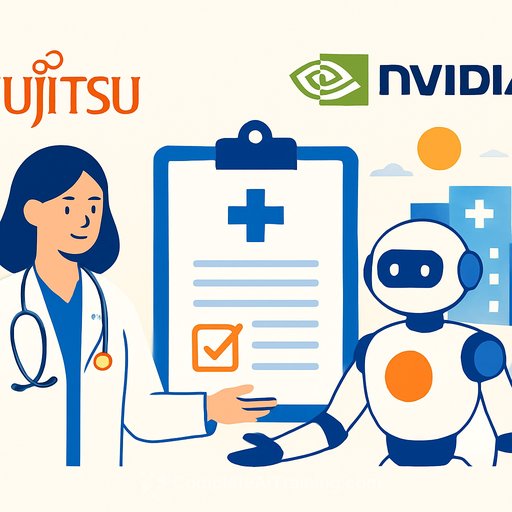
Japan's ageing population is stretching hospitals and clinics thin. Fujitsu and Nvidia are pairing up to build an AI "orchestrator" that coordinates many small, task-focused agents so care teams can spend less time on admin and more time with patients.
Fujitsu, a major enterprise tech provider, sees healthcare AI as a strategic growth area. The plan is practical: plug AI into existing systems instead of forcing a costly rip-and-replace.
What the orchestrator actually does
Think of it as a conductor. The platform directs multiple AI agents-each handling a specific job-so they work together without extra manual coordination. One agent might standardize patient data, another routes documents across systems, and another drafts notes or insurance forms.
Nvidia supports this with its NIM microservices and reference "Blueprints" for quicker deployment. Hospitals can add or swap agents as needs change, while keeping their current EHR and middleware intact. For background on NIM, see Nvidia NIM.
Why this matters for care delivery
The initial focus is admin automation. That means less time on paperwork, fewer bottlenecks, and more attention on direct patient care. For patients, this can translate to shorter waits and a more personal experience.
- Documentation: draft clinical notes, discharge summaries, and referrals
- Intake: standardize histories, consent forms, and questionnaires
- Scheduling: triage requests and coordinate appointments across departments
- Revenue cycle: prior auth prep, claims data checks, and denials support
- Data quality: normalize codes and terminology for analytics and population health
How integration could work in your hospital
The orchestrator sits above your existing stack, calling agents as needed and passing results to the right system. It should connect through common standards like HL7 and FHIR, log actions for audit, and let you set guardrails for PHI and safety.
Nvidia's infrastructure plus Fujitsu's orchestration aims to reduce the "last-mile" effort of wiring apps together. The goal is to add useful AI without breaking your workflows.
What to expect from upcoming pilots
Fujitsu plans to evaluate the platform in real healthcare settings next year. These pilots will measure real-world outcomes under regulatory and safety constraints.
- Key metrics: documentation time per encounter, claim touch rate, message turnaround, patient wait times
- Quality: error rates, handoff safety, escalation rate to humans
- IT fit: uptime, latency, auditability, and ease of adding/removing agents
Governance, safety, and compliance
Any AI that touches patient data needs strict controls. Expect role-based access, PHI masking where possible, human-in-the-loop for clinical-facing outputs, and full audit trails.
- Data protection: encryption, minimal data movement, and clear retention policies
- Model oversight: versioning, bias checks, and drift monitoring
- Clinical safety: clear escalation paths and scope limits for non-diagnostic use
A marketplace of agents, not a single vendor stack
Fujitsu's approach invites tools from other companies. That means your team can pick agents that fit your needs and replace them if better options appear.
For conservative organizations, a modular path lowers risk: start with one or two admin use cases, prove value, then scale to more units and workflows.
Beyond healthcare: what else is coming
The companies also plan a full-stack AI setup for sectors like manufacturing and robotics. On the hardware side, they reference a mix of FUJITSU-MONAKA CPUs and Nvidia GPUs linked with NVLink Fusion.
For multi-tenant enterprise use, Fujitsu will apply its Kozuchi and AI workload orchestrator with Nvidia's Dynamo platform. Expect similar agent patterns: faster workflows, simulation with digital twins, and automation to offset labor shortages.
Market reality: promise vs. execution
This space is crowded. Established vendors and startups are all racing to deliver safe, reliable AI that fits into complex clinical environments.
The differentiator will be execution: does the orchestrator cut admin time without creating new headaches? If it performs in live settings, clinicians get more clinical time, and patients feel the benefits.
Action plan for healthcare leaders
- Pick one high-friction admin use case per site (e.g., discharge summaries or prior auth packets)
- Define targets: time saved per task, error rate, and escalation thresholds
- Map data flows and permissions; restrict PHI exposure to what's necessary
- Run a 6-12 week pilot with a small cohort; compare against baseline and a control group
- Set up a review board (clinical, IT, compliance) to approve scale-up
Japan has the highest share of people aged 65+ among major economies, so the need is urgent. For context, see World Bank data on Japan's age profile here.
If you're preparing teams for AI-assisted workflows, consider the AI Learning Path for Training & Development Managers to explore role-based training and governance approaches tailored to scaled AI deployment.
Your membership also unlocks: