Fulbright Scholar Davide Tuzzolino Joins Seton Hall to Teach AI and Law
Seton Hall has appointed Italian attorney and legal scholar Dr. Davide Tuzzolino as its 2026 Fulbright Scholar. This semester he is teaching IDIS 2222: Artificial Intelligence (AI) and Law, bringing his practice in Rome and research on AI and data protection into the classroom.
University leadership called his expertise timely as artificial intelligence outpaces traditional legal and ethical frameworks. They highlighted the value of pairing his day-to-day experience as a lawyer with his academic work in European private law.
Why this matters for legal professionals
Tuzzolino argues that AI has already forced the legal field to rethink long-settled categories and principles. The core challenge, he says, is bringing AI into the legal system in a coherent way-through coordinated efforts across doctrine, policy, and procedure-with ethics guiding how systems are designed, deployed, and supervised.
EU vs. U.S. approaches-what your team should track
Expect a clear comparative lens. As Tuzzolino notes, Europe emphasizes risk prevention through a more structured regulatory model, while the U.S. approach tends to be flexible and market-driven. Teams should also track sector-focused compliance and training resources such as the AI Learning Path for Regulatory Affairs Specialists.
- For context on the EU model, see the European Commission's materials on the AI Act: Regulatory framework for AI.
- For U.S. risk guidance and controls, review NIST's AI Risk Management Framework: NIST AI RMF.
Inside the seminar
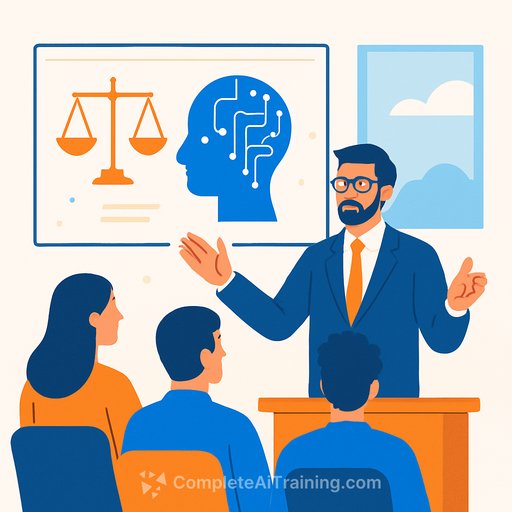
The 12-session seminar focuses on helping students grasp AI systems at a conceptual level, spot when their use raises legal or ethical concerns, and reason through those issues with legal and policy tools. The aim is to strengthen critical thinking-examining not just the rules, but their real impact.
Students will work with real cases and targeted hypotheticals. Case law in areas such as copyright and personal data protection sits at the center of the course.
- Analyze fact patterns that test liability, accountability, and risk allocation.
- Evaluate policy tradeoffs and enforcement paths in fast-moving disputes.
- Develop clear arguments grounded in doctrine and regulatory guidance.
Interdisciplinary reach
The course isn't limited to future attorneys. Its focus on AI and law connects with business operations, public policy, communication, and technical development-reflecting how these issues surface across an organization.
Seton Hall's U.S.-Italy Fulbright connection
Tuzzolino is the University's third consecutive scholar from the U.S.-Italy Fulbright Partnership, following Dr. Mario Milazzo (2025) and Dr. Giovanni Schiuma (2024). His background and network are expected to deepen Seton Hall's ties with Italy through Italian Studies, the Alberto Institute, the Rome Connection, Catholic Studies, and related study abroad and cultural initiatives.
Signal for law firms and in-house teams
This curriculum mirrors the questions your clients and business units are already asking: how to classify AI use cases, assess and mitigate risk, handle copyright exposure, and align governance with emerging standards. Consider governance and strategic adoption resources such as the AI Learning Path for CIOs (Chief Information Officers) when setting oversight and policy.
- Map high-risk AI uses against EU-style categories; document controls and oversight.
- Tighten copyright review for training data, outputs, and licensing strategies.
- Run privacy and security risk assessments for models and data pipelines.
- Adopt a controls-based approach using frameworks such as the NIST AI RMF.
- Upskill legal, compliance, and product counsel with focused training: AI for Legal.
As Tuzzolino put it, engaging with different viewpoints and legal traditions is the point-exposure to new contexts helps teaching and research grow, evolve, and become more nuanced.
Your membership also unlocks: