
AI news ·
Gallagher flags AI liability as next silent risk for New Zealand businesses
87% of New Zealand organisations use AI, but insurance and liability rules haven't caught up, creating a silent coverage gap that echoes the early years of cyber insurance. The most immediate risk is over-reliance on AI outputs without proper governance, not catastrophic system failure.
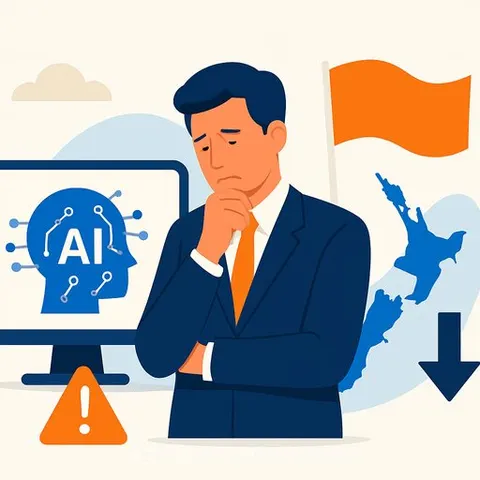
Eighty-seven percent of New Zealand organisations already use AI in some form, according to Datacom research, yet the insurance, governance and regulatory structures meant to manage that adoption have not caught up. A new report from Gallagher Insurance warns that this gap is creating a silent risk in liability coverage - one that mirrors the early, uncertain years of cyber insurance, when exposures sat hidden inside traditional policies until losses made them visible.
New Zealand's regulatory posture remains deliberately light-touch. Policymakers favour broad principles over AI-specific legislation. Existing laws, particularly the Privacy Act, still apply across the full AI lifecycle - from data inputs through to outputs and decisions - a point the Office of the Privacy Commissioner has explicitly confirmed. The Reserve Bank of New Zealand has separately flagged concerns that AI could amplify financial, operational and cyber risks, especially where third-party providers are involved.
The primary exposure, according to the Gallagher report, is not catastrophic system failure. It is over-reliance on AI outputs without sufficient challenge or validation. Governance frameworks and oversight mechanisms that lag behind adoption - rather than the technology itself - represent the most immediate risk for most New Zealand businesses right now.
Why standard policies may not respond as expected
AI risk does not fit neatly into a single insurance category. A flawed output or recommendation can simultaneously raise issues across professional advice, customer outcomes, operational performance and governance. That means a single claim could trigger professional indemnity, cyber and directors' and officers' liability at once - or fall between all three.
Most businesses do not build AI systems in isolation. They rely on networks of external providers, platforms and data sources, creating shared and often unclear accountability across supply chains. Globally, disputes have most often arisen when contractual protections and insurance responses were not aligned in advance. This pattern echoes the early cyber insurance experience, where policy language became more explicit only after claims started appearing.
GlobalData senior insurance analyst Ben Carey-Evans said the hesitation among insurers reflects a genuine unresolved question. "Regulation has not yet caught up and uncertainty remains over who is liable when AI makes mistakes," he said. A separate global poll of more than 100 insurance professionals published in May found roughly a quarter of respondents believe AI itself is not yet ready for widespread use in the industry.
The direction of travel in global insurance markets
The international insurance market's response to AI liability is already moving in a direction New Zealand businesses and their brokers need to monitor. From January 2026, the US Insurance Services Office issued new generative AI exclusion endorsements for commercial general liability cover. Carriers adopted them within weeks. Berkley Insurance filed an absolute AI exclusion across directors and officers, errors and omissions, and fiduciary lines.
These are US developments. But if the exclusion pattern follows the trajectory of cyber, equivalent wordings will eventually appear in New Zealand policy language. For insurance professionals tracking how coverage frameworks evolve alongside technology, resources on AI for Insurance can provide context on the shifting risk landscape. For leaders responsible for aligning risk, governance and insurance strategies with AI adoption, understanding the strategic implications through AI for Executives & Strategy is equally relevant.
Why this matters for insurance professionals
Gallagher's priority is not to slow AI adoption but to ensure risk, governance and insurance strategies evolve alongside it. That means mapping where AI is used within operations, understanding how decisions are made and tracing how exposures could flow into existing insurance programmes. The question of whether current policy wordings respond to an AI-related loss needs to be tested before a claim arises - not after. For brokers and underwriters, the message is clear: the coverage gap is real, it is growing, and the time to pressure-test policy language is now.