'Garbage in, garbage out': Insurance leaders warn about junior underwriters leaning too hard on AI
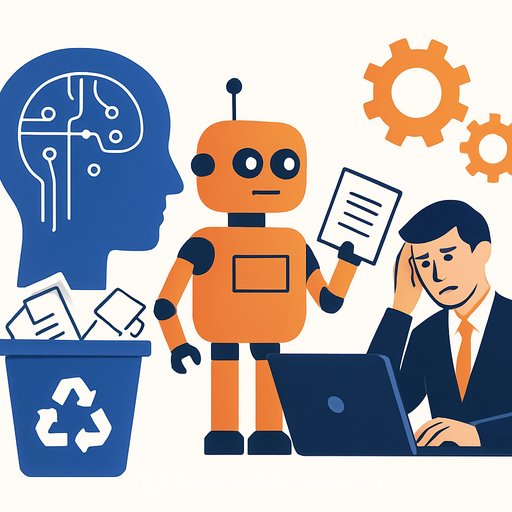
AI is eating the grunt work in underwriting. Senior leaders are fine with that. What they're not fine with: a crop of juniors who can present AI output with confidence but can't back it up with judgment.
At a recent industry event in Toronto, CFC Underwriting CEO Kate Della Mora didn't mince words: "Yes, 100%," when asked if she worries about early-career staff getting too reliant on AI. The problem isn't replacement-it's erosion of thinking.
The risk: strong tools, weak judgment
"Critical thinking is going to be incredibly important for us as leaders to continue to foster… because, again, it's garbage in, garbage out," Della Mora said. She's seen large language models sound confident and be flat-out wrong-and younger users often miss the tells.
She also flagged reputational risk. If enough distorted reviews circulate online, an unwary system can surface those as "facts." As she put it: "It's going to spit that out to you as fact, and it's not. It's been created."
Frederic Ling, SVP and head of specialty at Liberty Mutual, shares the concern. His worry: a junior reads a Copilot output, presents it convincingly, and wins the room-without real analysis underneath.
His fix: deliberate stress-testing. "It's really around context… to see if there's enough layers behind the comment or the conviction to see if you understand the risk or analysis." Without that, teams slip into a circular loop where chatbots cite each other and everyone nods along.
AI as assistant, not underwriter
Della Mora is clear: use AI to compress the heavy lift, not to make the call. Let it digest complex submissions, pull the pertinent points, and cut time to the first view of risk. Then underwriters do what only they can: apply context, judgment, and commercial sense.
Ling recalls spending three or four days on a complex, publicly traded banking risk-only to realize he'd used all his time gathering data and none forming an opinion. AI should flip that ratio: spend far less time getting to the dataset, far more time deciding.
As Ling put it, specialty underwriters pride themselves on expertise. Data and transformation tools can take you 80% of the way; the final 20% is context and relationship.
Practical guardrails for underwriting teams
- Show your work: Any AI-assisted analysis must include sources, snippets, and a short rationale. No orphaned outputs.
- Two-step verification: Cross-check AI summaries against filings, policy wordings, or first-party documents. If it can't be tied to evidence, it doesn't ship.
- Stress-test the opinion: Ask the model for the opposite view and compare. Look for what would change the recommendation (key assumptions, thresholds).
- No single-model dependence: When stakes are high, sample a second system or run a different prompt to spot blind spots and circularity.
- Red flags to escalate: Low-confidence outputs, novel perils, thin data, or reputational signals should trigger a senior review.
- Client-safe rule: Nothing AI-generated goes to brokers or clients without human edit and sign-off.
- Decision log: Keep a short record of the question, sources, human judgment applied, and final call. Protects quality and speeds audits.
- Data hygiene: Strip PII, respect confidentiality, and keep training data separate from client data unless contractually cleared.
A 90-day skill plan for junior underwriters
- Weeks 1-2: Core underwriting drivers by line; loss triangles; key ratios; how a great submission looks.
- Weeks 3-4: Prompt basics, citation checks, comparing outputs to filings, and spotting fabricated details.
- Weeks 5-8: Case reps: 10 real submissions, each with a human-first view, then an AI-assisted view. Present deltas and lessons.
- Weeks 9-12: Live deals with supervision; mandatory stress-tests; written recommendations with sources and a clear stand.
Where AI adds real value today
- Submission triage: Extract entities, sectors, and red flags to route faster.
- Document distillation: Pull key facts from financials, loss runs, engineering reports, and wordings.
- Comparisons at scale: Highlight differences across policy versions or endorsements in minutes.
- Market intel scan: Summarize earnings calls, litigation, recalls, sanctions, and regulatory updates-with links back to source.
- Portfolio views: Aggregate qualitative notes into themes for appetite, aggregates, and accumulation checks.
Watchouts you can't ignore
- Confident mistakes: Fluent output can hide thin analysis. Look for numbers tied to sources.
- Reputation drift: Be wary of reviews and scraped content treated as truth. Verify with primary documents.
- Circular consensus: Don't let one chatbot "confirm" another. Independent evidence wins.
- Model drift: Re-test prompts over time; what worked last quarter may shift.
- Privacy and contracts: Keep client data out of tools that learn from prompts unless you have explicit terms.
Helpful references
For a structured approach to risk, see the NIST AI Risk Management Framework here.
Level up your team's AI fluency
If you're rolling out training for underwriters and analysts, explore focused programs by job role here. Keep the tools, the thinking, and the guardrails advancing together.
Bottom line: use AI to reduce the drag, not the thinking. Speed is good. Judgment still wins.
Your membership also unlocks: