
AI news ·
Gartner says agentic AI will manage enterprise data pipelines and analytics
Gartner says agentic AI will replace static data pipelines for enterprise analytics. This shift is unavoidable because each data reuse generates 100 new metadata points.
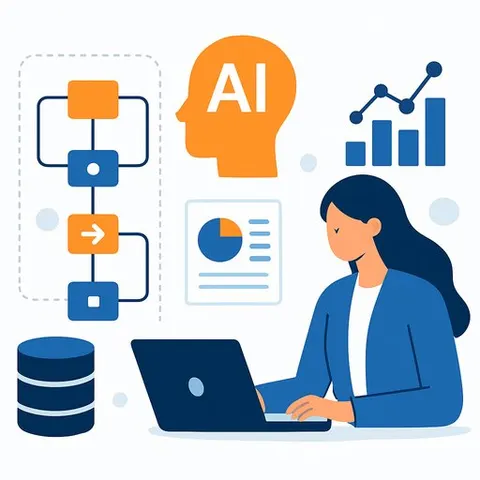
Agentic AI-not generative models alone-will reshape how enterprises build data pipelines and analytics systems, analysts said at the recent Gartner Data and Analytics Summit in Sydney. IT leaders who pin their strategies on a single AI approach risk repeating past mistakes, according to Erick Brethenoux, Gartner's chief of research for AI.
"I've lived through two AI winters so far. I'm hoping the next one is further away," Brethenoux told the audience. He argued that combining different AI capabilities has historically proven more reliable than betting on one dominant technique.
"Generative AI has advanced this to some amount, but agentic AI - the ability to build independent software entities that will do work on your behalf or on behalf of a machine - is actually a step function," Brethenoux said. As enterprises prepare for agentic architectures, training resources on AI Agents & Automation help teams bridge the skills gap.
The 'internet of agents'
Brethenoux outlined seven AI trends that shift focus away from monolithic models toward multi-faceted systems. Composite and neurosymbolic AI blends neural networks with symbolic logic to strengthen reasoning and transparency. World model AI builds systems that understand physical reality more holistically, aiming to reduce hallucinations beyond domain-specific language models. First principles AI combines machine learning with scientific laws so that, as Brethenoux put it, "even if something has not happened before, the equation can catch it."
One of the most disruptive ideas is adaptive collective AI, which Gartner calls the internet of agents. It distributes decision-making across multiple autonomous systems. Brethenoux described a Gartner client using drone swarms to inspect wind turbines in the North Sea. Each drone photographs cracks and colour degradation independently. On returning to base, the drones collectively decide if issues exist and produce a report without human input.
Still, Brethenoux sees a place for people. He quoted child psychologist Jean Piaget: "Intelligence is what you use when you don't know what to do." Generative AI, he noted, reproduces patterns it has seen before rather than developing genuinely new ideas.
Metadata explosion pushes agentic AI inevitability
Preparing AI-ready data has become the top investment priority for data management executives, said Mark Beyer, Gartner research vice-president. But the process creates a fresh problem. "Every time you reuse data, 100 new metadata points are created about that data," Beyer explained. "If you access that data 100 or 1,000 times more frequently, you'll be overwhelmed with metadata in a matter of weeks."
Humans cannot keep up with that exponential growth, which makes agentic AI unavoidable in the data ecosystem. AI agents-ranging from simple task-based helpers to multi-agent swarms-will eventually handle connectivity, orchestration and data governance. Beyer gave the example of an AI agent that detects a pattern of declining data quality every Tuesday and adds a warning note to reports generated that day, with no manual intervention.
"Rather, we're now building agents that recognise how the data is used, how often it is used, which part of the organisation uses it and, most importantly, whether it leads to the desired outcome," Beyer told the Sydney audience.
Applying manufacturing efficiency to FinOps
As agentic systems scale, costs rise. Adam Ronthal, Gartner research vice-president, suggested that data teams adopt the discipline of a factory production line where every step has a measurable cost and outcome.
While calculating the cost of a specific SQL query is largely solved through modern FinOps practices, assigning value to that data remains hard. Ronthal urged organisations to use empirical evidence. "Frequency of access is a strongly correlated proxy for value," he said. Dashboards used daily by many people carry clear weight. By contrast, heavy data downloads into separate analysis environments often signal unmet needs.
Ronthal recommended ranking workloads by value using metadata about consumption patterns. Once workloads are empirically ranked, an agentic optimisation framework can take over. For example, a daily 9 a.m. critical report could trigger AI agents to select the most cost-effective cloud compute resources, structure the data and meet the service-level agreement automatically.
"Over the next 12 months, start to pilot the concepts of empirically derived value and ranking by value," Ronthal said. "If the number of arguments over relative value decreases, you know you are making progress."
Why this matters for IT and development professionals
The message from Sydney is clear: future data infrastructure will be built around autonomous agents, not static pipelines. For general IT and development roles, that means metadata management and agent integration become core skills, not side concerns. Teams that begin piloting value-based workload ranking and small-scale agent orchestration now will be better positioned to contain costs and maintain control as these systems reach production.