How a St. Louis Charter School Uses AI to Spark Creative Thinking
Missouri's education department recently released statewide guidance on AI in schools. One St. Louis campus is already showing what that looks like in practice-using AI to help students think more creatively, write with more confidence, and learn by doing.
At Gateway Science Academy, AI isn't a novelty. It's a classroom tool students use to explore ideas, test assumptions, and improve their work-without skipping the thinking. Eighth grader Hayden Ramey put it simply: "With using AI so far, I have gotten a more imaginative way of thinking with that."
AI as a creative collaborator, not a shortcut
For students, the value shows up in the messy middle of the process. Eighth grader Matthew Nehre said, "If I'm stuck on what to write about, I can just ask it like an example of something that would be accurate in that time period in social studies or like how to write my thesis statement."
Eighth grader Coletta Quain-Terry shared a common concern and how the school addresses it: "At first I was a little bit hesitant because a lot of students like to use AI to cheat, but using MagicSchool, it helps me form the ideas. It doesn't just give me the answer."
Teachers set the rules-and the tone
Shaun Ballman, an 8th grade social studies teacher, captures the challenge many educators feel: "AI usage is one of our top concerns for students, and so a way that we've been getting ahead of that is teaching students how to use AI for their own educational benefit."
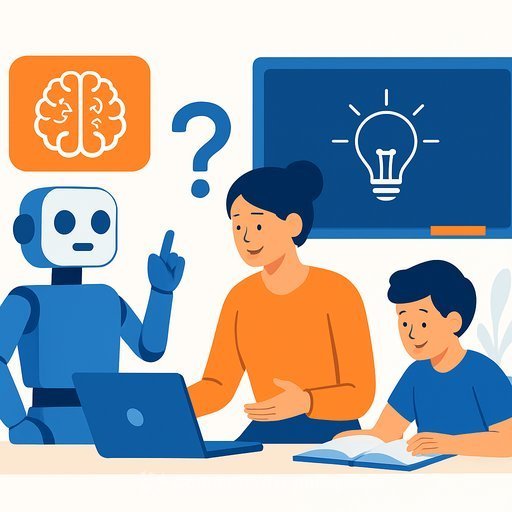
The school uses an AI platform called MagicSchool. Ballman frames it for students as a consultant: a place to bounce ideas, refine prompts, and get feedback. On the back end, teachers can set firm parameters. "I can put into the coding, 'Don't give students the answers. Let them work it through themselves.'"
That intentional structure matters. It protects academic integrity and builds skills students will actually use-asking better questions, stress-testing ideas, and iterating faster.
State guidance and the bigger picture
Noah Devine, Executive Director of the Missouri Charter Public School Association, put it this way: "AI is here, it is here to stay. The question now for educators is how are you going to use it well and what are you gonna allow kids access to do that." He also pointed to the need for clear guardrails, which Missouri has begun to outline.
For context on policy and best practices, see the Missouri Department of Elementary and Secondary Education's official site here and the U.S. Department of Education's guidance on AI in teaching and learning here.
What creatives can borrow from this classroom
- Treat AI like a collaborator, not a crutch. Use it to widen your idea surface area, then make the final calls yourself.
- Set constraints first. Tell the model what not to do, define tone and audience, and force it to ask clarifying questions.
- Work in stages. Ask for outlines, then angles, then examples-separate ideation from drafting and editing.
- Build prompts around context. Share your brief, goal, and constraints; ask for 3-5 options, not a single "perfect" answer.
- Keep authorship clear. Use AI for structure and momentum; keep original thinking and voice distinctly yours.
Inside the day-to-day
Ballman uses AI to plan projects, structure debates, and shape historical writing assignments. "It gives a number of different creative ideas that, as a teacher, you know, we're stretched thin sometimes." That's time saved for feedback and coaching-the work that moves students forward.
And every day is another rep. "Once I got into utilizing the technology, I saw the benefits. I saw more importantly the benefits for our student and any teacher will tell you. That's what we're focused on. Anything that benefits our students, we're all for it," Ballman said.
Want to sharpen your own AI workflow?
If you're a creative looking to build similar habits-prompting, ideation, and fast iteration-these resources can help:
- AI courses by job for role-specific skill building.
- Popular AI tools for copywriting to speed up drafting without losing your voice.
Your membership also unlocks: