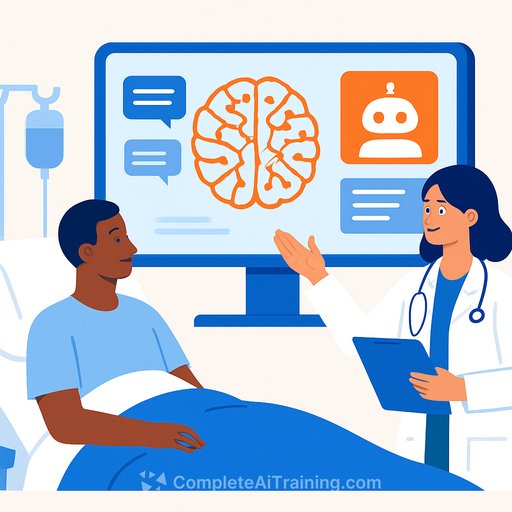
AI in Healthcare: How generative tools are transforming clinical practice
Generative AI is moving from hype to bedside reality. Used well, it cuts clerical load, speeds up routine tasks, and gives clinicians more time for care. The key is simple: keep humans in control, use it where it's safe, and measure results.
What "generative" means in clinical work
Generative models produce drafts: notes, letters, summaries, patient instructions, even templated reports. Think of it as a fast assistant that writes first drafts and structures data. It's helpful, fast, and sometimes wrong. That's why review and clear guardrails matter.
Where it delivers value today
- Clinical documentation (ambient scribing): Converts conversations into structured SOAP notes for clinician review and sign-off.
- Patient communication: Creates plain-language after-visit summaries, multilingual instructions, and teach-back materials at the right reading level.
- Decision support drafts: Summarizes guidelines or institutional pathways into quick briefs with citations from approved sources.
- Intake, triage, and routing: Structures symptom input, maps terms to SNOMED/ICD, and routes to the right clinic or service line.
- Radiology and pathology pre-drafts: Produces first-pass structured reports and comparison language for attending review.
- Coding and billing assistance: Suggests ICD-10/CPT codes and drafts clean denial-appeal letters, always requiring coder validation.
- Prior authorization packets: Auto-assembles chart elements, writes clinical rationale, and attaches evidence excerpts for payer requirements.
- Clinical trial screening: Matches patient criteria to trial protocols and drafts outreach messages for coordinator follow-up.
- Quality and population health: Generates outreach messages, flags likely care gaps, and drafts HEDIS abstraction notes.
Real examples you can model
- Ambient note in primary care: Mic captures the visit, model drafts a SOAP note with meds, problems, and orders; clinician edits and signs in the EHR.
- Radiology comparison language: Model pulls prior measurements and drafts stable vs. changed findings while preserving required structure.
- Discharge instruction assistant: Drafts clear steps, warning signs, and follow-up info at a sixth-grade reading level in the patient's preferred language.
- Prior auth builder: Pulls diagnoses, imaging, and conservative care history, then drafts a payer-specific letter citing guideline criteria.
Benefits that matter to clinicians
- Time back: Less typing, more eye contact. Notes and letters start as drafts instead of a blank screen.
- Consistency: Structured, complete documentation that reduces rework and back-and-forth.
- Access and equity: Plain language and translation reduce misunderstanding and missed care.
- Throughput: Faster handoffs and authorizations mean fewer bottlenecks.
Risks you must manage
- Incorrect content: Hallucinations, overconfident summaries, and fabricated citations.
- Bias and fairness: Uneven performance across demographics or language groups.
- Privacy and security: PHI exposure, weak data controls, and unclear vendor practices.
- Over-reliance: Automation complacency and rubber-stamping without proper review.
- Model drift and versioning: Output changes over time without oversight or audit trails.
Governance and safety guardrails
- Human-in-the-loop: Clinicians review and approve every clinical output.
- Clear claims: No autonomous diagnosis or treatment. Drafts only. Label it.
- Data minimization: Send the least PHI needed. Prefer de-identified context when possible.
- Audit and traceability: Log prompts, versions, and edits. Keep a rollback path.
- Bias checks: Monitor performance by age, sex, language, and other relevant factors.
- Incident handling: Define escalation, correction, and notification steps before go-live.
Regulatory signals that matter
Use cases that influence diagnosis or treatment decisions can fall under SaMD. Expect stronger evidence requirements, validation, and post-market monitoring. For non-device use (like documentation), keep claims accurate and workflows review-based.
Useful references: FDA: AI/ML-enabled medical devices and WHO: Ethics & governance of AI for health.
Technical patterns that work
- RAG over local sources: Ground outputs in your guidelines, order sets, and policies to reduce errors.
- Structured templates: Enforce SOAP, synoptic radiology, or discharge formats to keep quality high.
- Terminology mapping: Normalize to SNOMED CT, LOINC, and RxNorm for clean downstream data.
- Privacy architecture: Use on-prem or VPC isolation, PHI redaction where feasible, BAAs with vendors.
- Guardrails and filters: Prompt templates, content policies, and automatic unsafe-output blocks.
- Version control: Lock model, prompt, and retrieval changes with release notes and approval.
How to pilot in 90 days
- Week 1-2: Pick one low-risk use case (e.g., discharge instructions). Define success metrics and failure modes.
- Week 3-4: Legal/Privacy review, BAA, data flow diagram, DPIA/TRA as required.
- Week 5-6: Build RAG with approved sources, create templates, set up logging and feedback.
- Week 7-8: Small-group pilot with daily clinician feedback and rapid fixes.
- Week 9-10: Validate against baseline, QA for bias and safety, document results.
- Week 11-12: Go/No-Go. If Go, scale to next clinic and keep monitoring.
Metrics that matter
- Time: Minutes saved per note, turnaround time for auth, report completion time.
- Quality: Error rate, missing data rate, adherence to templates, readability scores.
- Adoption: Use rate, edit distance from draft to final, override rate.
- Safety: Near-miss reports, escalation events, inappropriate content rate.
- Equity: Performance across languages and demographics.
- Experience: Clinician satisfaction, patient comprehension scores.
Change management with clinicians
Co-design with the people who will use it. Start with high-friction tasks they dislike and keep the UI simple: one click to accept, one to edit, one to reject. Be transparent about data use, model limits, and how feedback improves the system.
Share early wins, publish metrics, and make it easy to report issues. Trust grows when teams see faster workflows and fewer late-night notes.
Practical checklist (print and use)
- Defined use case, scope, and clear "no-go" boundaries
- Human review required before anything reaches the patient record
- Approved sources for RAG and clear citation format
- BAA in place, data minimization documented, access controls set
- Bias tests, safety filters, and incident response plan
- Audit logs for prompts, outputs, edits, and versions
- Training for clinicians, coders, and admins with quick reference guides
- Baseline metrics and a monthly dashboard
What to do next
Pick one use case, set a 90-day window, and measure everything. Keep humans in charge, start small, and scale the wins.
If you want a structured path to upskill your team, explore practical programs here: AI courses by job role.
Your membership also unlocks: