
AI news ·
Generative AI in education carries hidden risks for students, equity and the environment, review warns
Schools overlook serious risks when adopting AI tools like ChatGPT, including data surveillance, environmental costs, and erosion of critical thinking. A new review urges stronger governance before AI becomes deeply embedded in education.
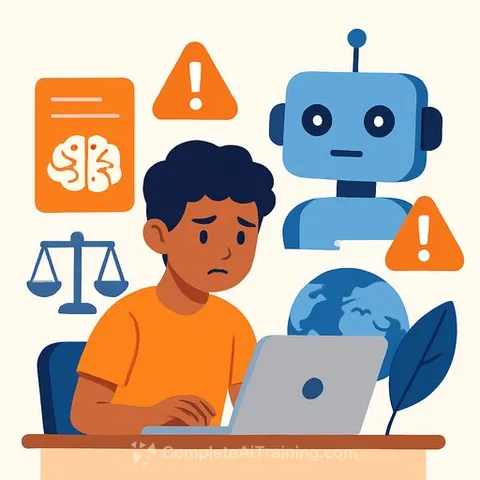
Generative AI in Education Carries Ethical Costs Schools Often Overlook
A new review of international research warns that while generative AI tools like ChatGPT and Claude offer real benefits in education-personalized support, faster feedback, improved accessibility-their use also creates risks that fall unevenly on students, schools and the environment.
The study, published in AI in Education, examined literature from 2022 to 2026 through a consequentialist lens, asking whether the gains outweigh the harms. The analysis moves beyond early concerns about cheating and academic integrity to identify deeper ethical problems that schools are still figuring out how to address.
What Schools Are Missing
Generative AI differs from older educational technology in a fundamental way: it can produce complex language, offer seemingly authoritative answers and complete tasks that once required sustained student effort. This changes the ethical stakes because AI systems now affect how students think, write, learn and make judgments.
The practical benefits are real. AI can explain difficult concepts to students without access to tutoring, generate practice material, reduce barriers to participation and free teachers from administrative work. For under-resourced schools, these gains matter.
But assessing AI adoption in isolation misses the full picture. The review identifies several costs that rarely surface in school discussions:
- Environmental impact: Large AI models require energy-intensive data centers and significant water for cooling. Schools promote sustainability while relying on systems whose environmental footprint remains poorly understood by users.
- Bias and misinformation: AI systems trained on internet data absorb stereotypes, cultural assumptions and factual errors. When students treat fluent AI outputs as authoritative, they may absorb false or narrowly framed information.
- Loss of critical thinking: Students who routinely depend on AI to draft essays, summarize readings or generate arguments may lose confidence in their own judgment. The intellectual struggle through which learning happens gets bypassed.
- Data surveillance: When students submit prompts and personal learning data to commercial platforms, they expose information to systems beyond school control. Student interactions can become part of a data economy in which learning behavior is collected and monetized.
- Corporate control: Major AI platforms are developed by private companies with business models shaped by scale and market capture. Their growing presence in education raises questions about who controls learning infrastructure and whether educational values are being reshaped by corporate priorities.
The Agency Problem
The difference between helpful and harmful AI use depends heavily on pedagogy. AI can support learning when students are required to critique its outputs, test assumptions and explain their own reasoning. It becomes harmful when learners accept answers passively or use it to avoid difficult tasks.
Education is not only about producing correct answers or polished texts. It is also about developing the ability to question, evaluate, reason, revise and create. If AI becomes a substitute for cognitive effort rather than a tool for reflection, students lose something essential.
What Needs to Change
Schools need stronger ethical governance before generative AI becomes deeply integrated. The issue is no longer whether students and teachers will use AI, but whether it will be used in ways that serve learning and equity or in ways that create short-term efficiency while producing long-term harm.
The review proposes that institutions assess AI adoption by weighing benefits against harms across several dimensions:
- Learning outcomes and student autonomy
- Privacy and data governance
- Algorithmic bias and misinformation risks
- Environmental sustainability
- Equity across different student populations
AI policies should go beyond academic integrity rules. They need to address procurement decisions, data governance, environmental impact, teacher training, student rights and accountability.
What Teachers and Schools Can Do
Students should learn how generative AI systems work, why they produce errors, how bias enters outputs and what environmental costs are linked to large-scale AI use. This literacy should become part of general education, not just computer science.
Teachers need training to design assignments that require critical engagement with AI rather than simple outsourcing. Assessments may need to emphasize process, reflection, oral defense, in-class reasoning and original judgment over polished final products.
Schools should scrutinize AI platforms before adoption, ensure student data are not exploited without meaningful consent and prefer tools that provide transparency about data use. Where possible, public institutions may consider open-source or education-specific systems that reduce dependence on commercial platforms.
Environmental accountability should also become part of AI governance. Schools can ask providers for sustainability disclosures, include environmental criteria in procurement and teach students about the resource costs behind digital convenience.
Equity requires attention too. Generative AI may widen gaps if wealthier institutions gain better tools while under-resourced learners rely on lower-quality systems. Vulnerable students may bear greater risks from biased outputs and surveillance. Policies must ensure that AI adoption does not deepen existing inequalities.
The Deeper Question
A tool should not be judged only by whether it improves speed or short-term performance. It should be judged by whether it strengthens or weakens the deeper purposes of education: independent judgment, critical inquiry, creativity, ethical awareness and democratic participation.
For more guidance on integrating AI responsibly in your classroom, see AI Learning Path for Teachers and explore AI for Education resources.