Generative AI Analyzes Medical Data Faster Than Human Research Teams
Date: February 21, 2026
Source: University of California - San Francisco
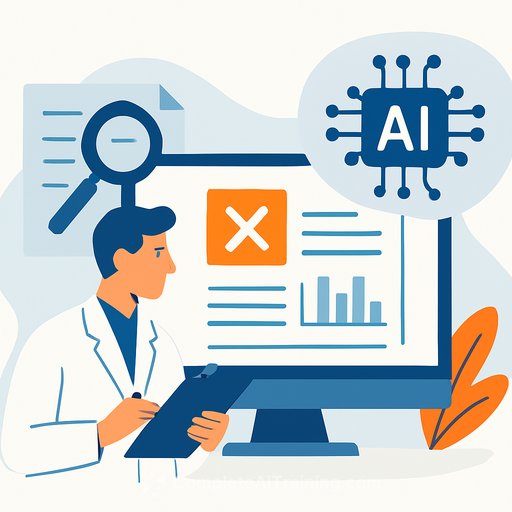
AI just showed it can turn mountains of medical data into meaningful discoveries at record speed. In a head-to-head test across large pregnancy datasets, generative AI matched or beat human-built models in some cases, while delivering working analytical code in minutes.
The result: analyses that normally take months were completed in weeks, and a full study-from kickoff to journal submission-wrapped in six months. For teams under pressure to move from data to decisions, this removes a major bottleneck.
What the Researchers Tested
Teams at UC San Francisco and Wayne State University compared human-only workflows to scientists using AI tools. The core task was to predict preterm birth using data from more than 1,000 pregnant women, plus additional challenges estimating gestational age from blood and placental samples.
Even a junior pair-a UCSF master's student, Reuben Sarwal, and a high school student, Victor Tarca-built competitive models with AI's help. The key advantage: AI systems generated usable code from precise prompts in minutes, work that would typically consume hours or days for seasoned programmers.
Performance and Speed
- 8 AI chatbots were prompted to build models across three pregnancy-related challenges; 4 produced code that ran and matched human-team performance.
- In some tasks, AI models outperformed models developed by teams that spent months building pipelines.
- The AI-supported effort moved from concept to submission in about six months, compared with the multi-year arc often seen after crowd challenges.
"These AI tools could relieve one of the biggest bottlenecks in data science: building our analysis pipelines," said Marina Sirota, PhD, interim director of UCSF's Bakar Computational Health Sciences Institute and principal investigator at the March of Dimes Prematurity Research Center at UCSF. "The speed-up couldn't come sooner for patients who need help now."
Why Preterm Birth Research Matters
Preterm birth is the leading cause of newborn death and a major driver of long-term motor and cognitive challenges. In the U.S., about 1,000 babies are born prematurely each day. Risk factors remain poorly understood.
To find signals, Sirota's team assembled vaginal microbiome data from roughly 1,200 pregnancies across nine studies. They used the DREAM competitive framework, where more than 100 global teams built machine learning models within three months. Consolidating and publishing those findings still took nearly two years-highlighting the drag created by data wrangling and pipeline building.
How the AI Evaluation Worked
Researchers guided eight AI systems with carefully written prompts to produce end-to-end analytical code-no direct human coding. Objectives mirrored prior DREAM challenges: detect preterm-birth signals in vaginal microbiome data and estimate gestational age from blood or placental samples.
Teams then executed the AI-generated code on the same datasets used in DREAM. Half the systems produced functional pipelines that matched human benchmarks, and in some cases, delivered stronger performance. The others failed to produce usable workflows-evidence that tool selection and prompt quality still matter.
"Thanks to generative AI, researchers with a limited background in data science won't always need to form wide collaborations or spend hours debugging code," said Adi L. Tarca, PhD, co-senior author and professor at Wayne State University. "They can focus on answering the right biomedical questions."
Practical Takeaways for Healthcare, Science, and Research Teams
- Start with well-scoped questions and structured prompts. Clear, specific instructions were essential for AI to produce working code. See: Prompt Engineering.
- Use benchmarked datasets for first passes. Reproducing known results is a fast way to validate AI pipelines before moving to proprietary data.
- Expect variance across tools. Only 4 of 8 chatbots delivered usable outputs-pilot multiple systems before committing.
- Keep humans in the loop. Statistical review, clinical sense-checks, and error analysis are non-negotiable.
- Track provenance. Log prompts, versions, and packages so results are reproducible and auditable.
Implementation Guardrails
- Validation: Use hold-out cohorts, cross-site data, and pre-registered analysis plans where possible.
- Bias checks: Examine subgroup performance (race/ethnicity, site, assay) and report disparities.
- Security and compliance: Keep protected health information off third-party tools unless agreements and controls are in place.
- Interpretability: Favor models and explanations clinicians can review-especially for decision support.
- Deployment discipline: Separate exploratory notebooks from production pipelines; enforce code review.
Where This Helps First
- Retrospective research: Multi-omics association studies, feature screening, and baseline model baselining.
- Operational analytics: ETL scaffolding, cohort building, and QA scripts that normally drain analyst time.
- Pilot diagnostics: Rapid hypothesis testing before investing in full-scale development.
Caveats
AI can produce misleading or non-reproducible outputs. Tool performance is uneven, and domain oversight is essential. Treat AI as an accelerator for pipeline creation and iteration, not a substitute for methodological rigor or clinical judgment.
Learn More
- Study in Cell Reports Medicine: Benchmarking large language models for predictive modeling in biomedical research with a focus on reproductive health.
- DREAM Challenges background: dreamchallenges.org.
Related Training
- Generative Code - resources on getting from prompt to production-grade analysis faster.
Your membership also unlocks: