Generative AI vs. Predictive AI
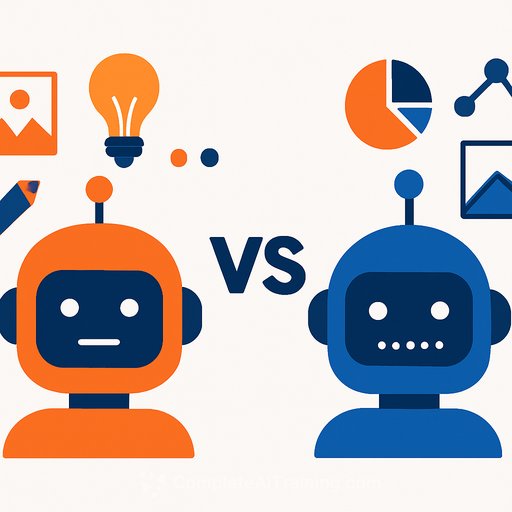
Generative AI and predictive AI are two branches of artificial intelligence that handle data differently and serve distinct purposes. Generative AI creates new content—such as text, images, code, or audio—by recognizing patterns in unlabeled data. Predictive AI, on the other hand, forecasts future outcomes like customer behavior or equipment failure using historical, labeled data.
Both systems mimic human cognition by processing data to anticipate what comes next. However, generative AI focuses on producing novel content, while predictive AI concentrates on forecasting based on past information.
The Key Differences
The main difference lies in their output and goals. Generative AI generates content by predicting the next element—whether a word, pixel, or code snippet—based on user prompts. Predictive AI identifies patterns in datasets to estimate likely future events or behaviors using machine learning and statistical analysis.
While generative AI is geared toward content creation, predictive AI shines in forecasting and decision-making scenarios.
Generative AI
Generative AI models respond to prompts by predicting the next logical component in a sequence. They use techniques from natural language processing and computer vision, built on different architectures:
- Generative Adversarial Networks (GANs): These involve two neural networks competing—the generator creates content, and the discriminator assesses its authenticity. This dynamic improves the realism of generated images or videos.
- Transformers: Foundational for many large language models, transformers utilize self-attention to understand relationships between words or phrases across large datasets, enabling fluent text generation.
- Variational Autoencoders (VAEs): Commonly used in image generation, VAEs compress data into a latent space and then reconstruct or generate new images from that representation.
Generative AI is widely used for:
- Text generation like articles, emails, and marketing copy
- Conversational AI such as chatbots and virtual assistants
- Image synthesis for artwork, product mockups, or photorealistic visuals
- Video and audio synthesis including synthetic voices and music
- Code generation or debugging based on user input
Predictive AI
Predictive AI estimates the likelihood of future events by analyzing historical trends in structured data sets. It employs more targeted models such as decision trees, linear and logistic regression, and random forests.
Common applications include:
- Predicting customer behavior based on purchase history
- Detecting fraud in real time to prevent losses
- Forecasting when machinery might fail to plan maintenance
- Optimizing inventory through demand forecasting
- Financial risk assessment and market trend analysis
Similarities Between Generative AI and Predictive AI
Both technologies rely on machine learning and statistical models to identify patterns within large datasets. They use these insights to predict what comes next—whether that’s the next word in a sentence or the probability of equipment failure. Both also face ethical challenges related to biased training data influencing their outputs.
Differences Between Generative AI and Predictive AI
How They’re Trained
Predictive AI typically uses supervised learning, where the model trains on labeled data with known inputs and outputs. This helps it establish clear relationships for accurate forecasting. Generative AI, conversely, often uses unsupervised learning on vast amounts of unlabeled data, discovering patterns without explicit guidance.
How They Work
Predictive AI learns correlations between input and output variables to forecast future states. Generative AI finds internal data patterns—for example, how words or pixels relate—and generates new content based on those correlations.
How They’re Used
Predictive AI is focused on anticipating future events by analyzing historical data. For instance, an e-commerce platform might predict what products a customer will buy next. Generative AI creates new content, such as drafting blog posts or generating code snippets, based on learned data patterns.
Advantages and Disadvantages of Generative AI
Increases Productivity
Generative AI speeds up content creation by automating tasks like writing, image rendering, and code generation. This reduces manual effort and frees up time for higher-level work.
Hallucinations
One challenge is that generative AI can produce convincing but inaccurate or misleading information—known as hallucinations. These errors are often hard to detect because the output looks polished and coherent.
Intellectual Property Issues
Generative AI models are trained on massive datasets scraped from the internet, which may include copyrighted materials. This raises concerns when outputs closely resemble protected works, potentially causing legal complications.
Advantages and Disadvantages of Predictive AI
Improved Decision-Making
Predictive AI helps organizations act proactively by providing data-driven forecasts. It supports fraud detection, risk assessment, and maintenance planning among other critical functions.
Makes Mistakes
Predictive AI’s accuracy depends on the quality of training data. Biases, outdated information, or gaps in data can lead to incorrect predictions.
Frequently Asked Questions
Is ChatGPT generative AI or predictive AI?
ChatGPT is a form of generative AI because it creates text and code in response to user prompts.
What is the difference between generative AI and AI?
Generative AI is a subset of artificial intelligence focused on producing new content by predicting the next element in a sequence.
Can generative AI be used for prediction?
Generative AI is not designed to predict future events accurately but to generate likely next words, images, or code based on learned patterns.
What are the use cases for generative AI?
Use cases include customer support chatbots, code generation, document summarization, and personalized marketing content.
What are the use cases for predictive AI?
Predictive AI is used in customer churn forecasting, healthcare diagnostics, supply chain optimization, and market research.
For those interested in expanding their knowledge of AI technologies, exploring detailed AI courses and training can provide practical skills applicable to both generative and predictive AI fields.
Your membership also unlocks: