AI adoption in Europe: What finance leaders should act on now
Cloud and AI are moving through firms fast, but the pattern isn't uniform. Fresh, harmonised surveys from Germany, Italy, and Spain show where adoption stands, who's leading, and what actually drives impact on the P&L. For finance teams, the signal is clear: Productivity gains hinge on breadth and intensity of firm-level use, not headlines.
These surveys align on sector and size (firms with 20+ employees across manufacturing and services) and use a common questionnaire, so the cross-country comparison holds up. The focus is both on predictive AI and, crucially, generative AI (GenAI)-and how deeply firms are using it, not just whether they tried it once.
Adoption levels and pace
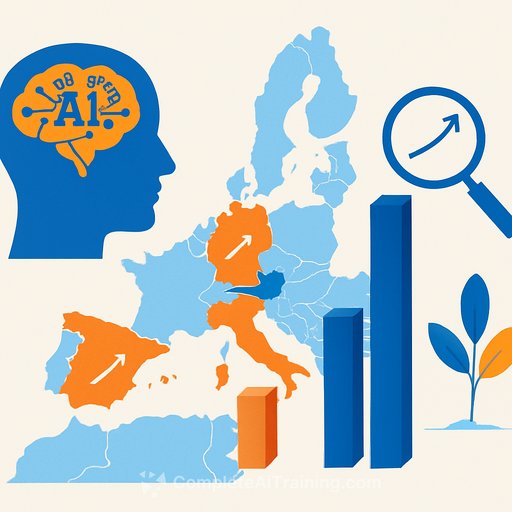
Starting from 2024, adoption rates vary widely. Around a third of German firms reported using GenAI, compared with roughly a quarter in Spain and a small single-digit share in Italy. Within a year, GenAI use climbed sharply-Germany to well over half of firms, Italy into the mid-20s-signalling fast diffusion.
Here's the catch: most of that growth sits in experimental or limited use. Fewer than 4% of firms in each country report intensive integration into core processes. That means most organisations are still stuck in pilot mode, with only a small tier converting trials into durable productivity.
Who's adopting-and where
Adoption increases with firm size in all three countries, with the jump for the largest firms especially strong in Italy and Spain. Bigger balance sheets, better data foundations, and stronger IT governance help reduce time-to-value.
Services lead across the board-especially logistics, telecoms, and professional/support activities. One outlier: German manufacturing is closer to services than you'd expect, while Italian and Spanish manufacturing lag their own services sectors. Higher-productivity firms are also more likely to adopt, suggesting capability and readiness matter as much as intent.
What accelerates adoption
Two complements consistently raise the odds of GenAI use: cloud computing and robotics. Firms already operating in the cloud or with automation on the shop floor move faster because the data plumbing, security model, and change processes are in place.
Early experimentation is another strong signal. Firms that tested AI in 2024 were far more likely to use it-more intensively-in 2025. Diffusion is path-dependent: capability building compounds; practical training such as an AI Learning Path for Process Engineers helps operational teams translate pilots into repeatable process improvements.
Why firms adopt-and what it means for jobs
Most companies are aiming at process gains first: upgrading already automated workflows, tightening support functions, and streamlining tasks. New products and services sit lower on the list for now.
On jobs, the centre of gravity is stable employment. Many firms expect no headcount change overall, while current adopters are more likely to expect job creation and task reshuffling. Early evidence points to reallocation within roles rather than broad cuts.
Implications for CFOs and finance teams
- Run a digital readiness audit: cloud coverage, data pipelines, access controls, lineage, and audit trails. Weak data governance stalls any GenAI ROI.
- Prioritise near-term wins: FP&A scenario builds, management reporting, closing routines, shared services ticketing, procurement triage, and policy FAQs.
- Budget for "pilot → scale": standard sandboxes, model registries, approval workflows, and performance gates. Track cycle time, error rates, variance reduction, rework, and unit costs.
- Invest in complements: data quality, integration with ERP/data lake, MLOps, vendor security reviews, and change management. These show up as the real bottlenecks.
- Strengthen controls: human-in-the-loop for material outputs, segregation of duties, sensitive-data redaction, model risk management, and documented fallback procedures.
- Workforce plan: upskill analysts into automation supervisors and prompt specialists; redesign roles around review and exception handling.
- Vendor selection: choose tools that fit your cloud and ERP, with clear TCO, data residency options, and strong admin controls.
- Measure intensity, not buzz: % of processes with GenAI steps, automation coverage by task, model performance vs. baselines, and cost-to-serve trends.
Country notes for investors
Germany leads on adoption and shows unusual strength in manufacturing. Italy is climbing fast from a low base, which could signal outsized gains as capabilities mature. Spain sits in the middle with solid service-sector traction. These differences matter for productivity outlooks, capex plans, and re-rating potential.
What to watch through 2026
- Shift from pilots to embedded use in core processes (adoption intensity, not just incidence).
- Cloud and robotics capex as leading indicators of GenAI readiness.
- EU AI Act compliance programs and their effect on speed-to-production.
- Firm-level productivity deltas before they surface in macro data.
Further reading and tools
For evidence on potential productivity gains, see the OECD's analysis of AI and productivity growth: OECD AI and productivity.
Looking for practical tools in finance? Explore a curated set of options here: AI tools for finance.
Your membership also unlocks: