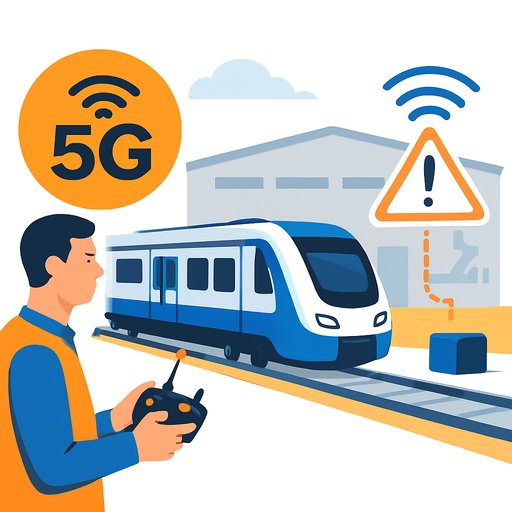
Secure Remote Control With AI-Based Obstacle Detection Moves Into Depot Operations
05 December 2025
A new consortium project, "RemODtrAIn" (Remote operated train with AI-based Obstacle Detection), led by Siemens Mobility, is building and testing a secure remote control system and modular AI-supported obstacle detection for rail depots. The goal: make depot, stabling, and shunting moves safer, faster, and more consistent-while working over public 5G networks with high availability.
The project builds on prior work from AutomatedTrain and safe.trAIn and extends a strong collaboration with Deutsche Bahn and academic partners. Funding of €17 million comes via the program "DNS der zukunftsfähigen Mobilität. Digital - Nachhaltig - Systemfähig" from the Federal Ministry for Economic Affairs and Energy.
What Operations Teams Need to Know
- Scope: Train availability, depot, and stabling movements-where remote control reduces idle time and manual repositioning.
- Control: An ICE 4 will be remotely operated from a central station on depot grounds using 5G.
- Safety: AI-based obstacle detection acts as a support system, adding an additional layer of situational awareness.
- Architecture: Safety-critical design delivered as a modular kit for stepwise rollout, including retrofits for existing and regional fleets.
- Connectivity: Built to function under varying conditions on public 5G; options for multi-network and satellite are being explored.
Where and How It Will Be Tested
- Depot operations: ICE 4 testing at the ICE depot Cologne-Nippes.
- 5G field tests: Desiro Classic at the Smart Rail Connectivity Campus in Annaberg-Buchholz (project site).
- Obstacle detection in daily service: Testing on S-Bahn Berlin.
- Vehicle testing and validation phase: Planned for 2028.
Why This Matters for Operations
- Faster turnarounds: Remote moves cut wait time for drivers and ground staff, improving depot flow.
- Capacity gains: More consistent shunting and stabling sequences unlock throughput without major civil works.
- Staffing relief: Supports operations during driver shortages and reduces exposure to trackside risk.
- Safety and consistency: AI-supported detection and standardized procedures reduce human-error hotspots.
- Data-driven control: Continuous telemetry enables tighter KPIs for dwell time, coupling cycles, and incident rates.
Technology Snapshot
- 5G-based command-and-control with provisions for variable public network conditions; developed with leading mobile network companies.
- Vehicle sensors built for universal use across operating modes; obstacle detection supports operators rather than replacing them.
- Safety architecture defined for gradual implementation, with cybersecurity and approval processes embedded.
- Forward path includes potential satellite communication to improve coverage and resilience.
Voices From the Project
Marc Ludwig, CEO Rail Infrastructure at Siemens Mobility: "With RemODtrAIn, we at Siemens Mobility are advancing automated rail operations. Together with strong partners from industry, research, and the railway industry, we are developing solutions that are technologically advanced and precisely aligned to current rail operations. Siemens Mobility is responsible for the specification and development of a remote control system, as well as its integration and practical testing. Our goal is to make remote-controlled operations in the depot and premises safe, efficient, and scalable."
Dr. Jasmin Bigdon, Chief Technical Officer, Deutsche Bahn AG: "With the RemODtrAIn project, Deutsche Bahn is taking an important step towards the remote control and automation of shunting movements. Our goal is to develop a pragmatic solution for remote-controlled train operations by closing specific technological gaps and to consider necessary adjustments in roles, processes, and regulations. The close integration of technical solutions and real-world application on-site is the focus of our actions. With remote control in shunting operations, we aim to increase capacities, make processes more flexible, alleviate staff shortages, and achieve tangible operational improvements quickly for customers and our employees."
What to Prepare Now
- Map depot workflows: Identify moves with repeatable patterns, time loss, or safety exposure-prime candidates for remote control.
- Connectivity audit: Measure 5G coverage and latency across depot tracks; plan for multi-carrier and fallback options.
- Safety case groundwork: Start hazard logs, operational scenarios, and interface controls for remote moves.
- Process updates: Define new roles, sign-off procedures, and HMI expectations for the remote operator station.
- Training plan: Upskill dispatchers and shunting teams on remote operations and AI-assisted awareness tools.
- Stakeholder alignment: Coordinate early with regulatory bodies, works councils, and maintenance teams.
- Pilot metrics: Set clear KPIs-turnaround time, incident rate, throughput, operator workload, and network availability.
Program Details and Consortium
Funding: €17 million via "DNS der zukunftsfähigen Mobilität. Digital - Nachhaltig - Systemfähig" by the Federal Ministry for Economic Affairs and Energy.
Builds on: Insights from AutomatedTrain and safe.trAIn. For standards context on connectivity, see 5G specifications from 3GPP.
Partners (12):
- Siemens Mobility GmbH
- Siemens AG
- DB AG
- DB Fernverkehr AG
- DB Systemtechnik GmbH
- DB RegioNetz Infrastruktur GmbH
- Mira GmbH
- Smart Rail Connectivity Campus e. V.
- Deutsches Zentrum für Luft- und Raumfahrt e.V. (German Aerospace Center)
- Technische Universität Berlin
- Technische Universität Chemnitz
- Technische Universität München
Bottom Line for Operations
Remote-controlled depot moves with AI-supported obstacle detection are moving from concept to practical testing. If you run depots or fleet operations, now is the time to line up pilots, data baselines, and stakeholder buy-in so you can move quickly once the trials mature.
If your team needs a structured path to build AI fluency for operations and safety teams, explore curated courses by job role at Complete AI Training.
Your membership also unlocks: