Ghana moves to deploy AI education tools in local languages - with zero data charges
Ghana's Minister for Education, Haruna Iddrisu, has outlined plans to bring AI tools into teaching and learning in local languages. After a high-level meeting with the Vice President of Google at the Generative AI Summit in the UK, the Ministry is setting a path to improve comprehension, preserve languages, and expand access nationwide.
The initiative targets real classroom outcomes: curriculum-aligned content, responsible use of AI, and equitable access regardless of location or income. The goal is simple - make learning clearer and more inclusive for every learner, from Accra to the most remote communities.
What's coming
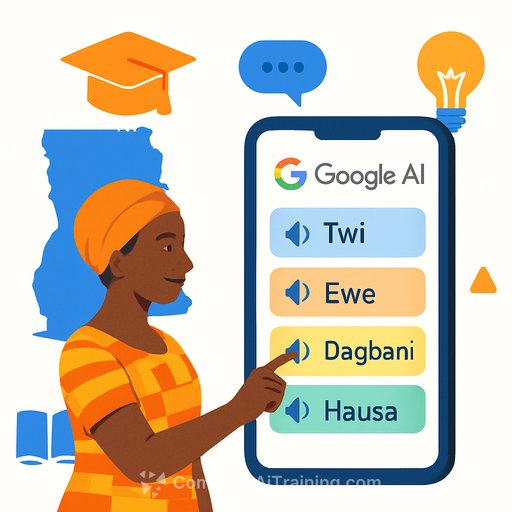
- Local language support: Speech recognition and AI-powered tools for Twi, Ewe, and Dagbani, with an emphasis on non-standard speech to improve inclusivity for learners with different accents or speech patterns. This work includes translation and localization efforts (AI Translation Courses).
- Broader regional reach: Hausa will be prioritised to extend impact across Ghana and West Africa.
- Zero-rated access: Google has assured the Ministry that its education tools will be available in Ghana without data charges or subscription fees.
- Partnerships in place: Google is collaborating with the University of Ghana and the Global Disability Innovation (GDI) Hub to advance these capabilities for education and digital services.
Why this matters for education and government
Local-language AI tools help learners grasp concepts faster and keep cultural context intact. This is especially important for early grades, rural areas, and students with disabilities who often face the highest barriers to digital content.
For government, zero-rated access reduces cost pressure, speeds uptake, and supports national goals for literacy, inclusion, and digital skills. It also sets a shared baseline for quality content and responsible classroom use. Ministries and district leaders may find dedicated leadership pathways useful when planning scale-up (see the AI Learning Path for Training & Development Managers).
Funding and timing
Google announced a US$37 million investment in AI research and digital skills across Africa in July 2025, including a new AI Community Centre in Accra. This sits within Google's broader US$1 billion commitment to Africa's digital transformation.
See Google's Africa investment overview
What zero-rated access means in practice
Students and teachers can use the tools without data charges. Schools won't need to budget for bandwidth just to access core content or AI features.
This lowers the barrier for rural and low-income households and makes it plausible to embed AI tools into daily instruction, not just pilot programs.
Implementation checklist for ministries, agencies, and districts
- Define use cases: Start with literacy, foundational numeracy, and language arts where local-language AI support has immediate impact.
- Map language coverage: Prioritise Twi, Ewe, Dagbani, and Hausa by region and grade level; plan for phased expansion.
- Curriculum alignment: Vet AI content against national standards and approved textbooks; set guardrails for classroom use.
- Teacher readiness: Run short, practical training on prompts, lesson planning, and formative assessment with AI (AI Learning Path for Training & Development Specialists).
- Accessibility: Ensure support for non-standard speech, screen readers, captions, and offline modes where connectivity is weak.
- Data governance: Establish policies for student privacy, data retention, and consent; monitor bias in speech models.
- Pilots and scaling: Launch in a representative mix of urban and rural schools; collect baseline and outcome data; scale on evidence.
- Community validation: Involve local language experts and teachers to review translations and cultural accuracy.
- Monitoring: Track usage, learning outcomes, and cost per learner; adjust based on what actually works.
- Sustainability: Plan device maintenance, updates, and a support desk so tools stay usable month after month.
Safeguards to get right
- Quality control: Require human review for translations used in exams and high-stakes content.
- Academic integrity: Set clear policies for student use of AI and teach citation and transparency in assignments.
- Equity by design: Keep paper-based and offline options for schools still coming online.
What leaders said
Haruna Iddrisu shared that Google's Director of Operations for Africa and the Gemini Lead gave firm assurance on zero-rated deployment for Ghana. His message was clear: Ghana isn't sitting on the sidelines; the country intends to help set the agenda for AI in education across Africa.
Where to learn more
- Global Disability Innovation Hub
- Professional development: role-based AI learning pathways and translation/localisation resources for educators and administrators (see links in the article above).
Your membership also unlocks: