
AI news ·
Ghost Font uses optical illusion to hide text from AI models
Ghost Font hides text in moving dots to block AI scraping, drawing nearly 18 million views on X. Humans read the hidden messages easily, but AI models fail.
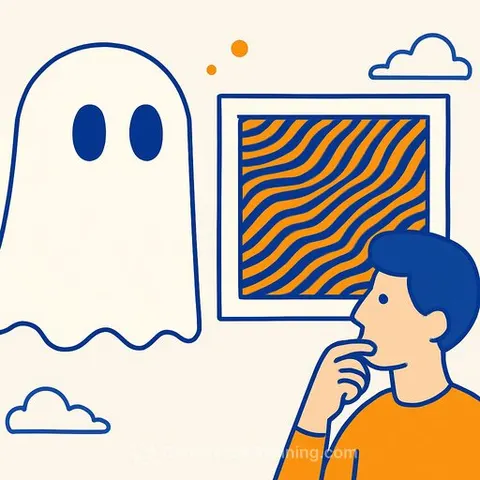
A new font called Ghost Font hides messages from AI by embedding them in moving dots that only the human brain can decipher. Created by designer Eric Lu, the font has attracted nearly 18 million views on X as creatives search for ways to shield their work from unauthorized AI scraping.
How Ghost Font works
The optical illusion at the heart of Ghost Font is a feat of typographic Design. Instead of displaying text in a single frame, the font hides letters among hundreds of moving dots in a video animation. Dots that form the hidden message drift upward, while surrounding dots move in the opposite direction. The human brain's motion detection instantly groups the dots into recognizable letters, but freezing the video on any single frame makes the text disappear.
"I created a font called Ghost Font that only humans can read," Lu said on X. "Tested it in Fable and GPT 5.6 Sol Ultra and neither was able to decipher it correctly."
Ghost Font files also contain a static decoy message - "written in Ghost Font" - that misleads AI models into confidently reporting that as the hidden text.
Testing against AI models
Lu, who is developing an AI font generation model called Mixfont, said he wanted to test whether typography could serve as an alternative to passwords or encryption for protecting content from bots. He tested Ghost Font with Anthropic's Claude Fable and OpenAI's GPT-5.6 Sol Ultra, and both failed to read the concealed message. We tested it in ChatGPT and Gemini, and the models could only identify the decoy phrase.
Some users have reported guiding AI models to the hidden message by explaining how the font works, but without that assistance, the text remains invisible to the systems. Lu has no current plans to turn Ghost Font into a practical communication tool, and he acknowledges that AI will likely overcome this weakness by analyzing video through optical flow rather than individual frames.
How to try Ghost Font
To test Ghost Font yourself, visit the Ghost Font website, type a short phrase, and generate the animation. You can then download the video or make a screen recording and upload it to an AI model. Ask something like "What does this animation say?" to see if the model falls for the decoy or misses the message entirely.
Why this matters for creatives
Ghost Font arrives amid growing concern among artists, writers, and designers that AI companies are harvesting their work without consent. Tools like Nightshade have already given image creators a way to poison training data. Ghost Font extends that idea into typography and motion graphics. This development is part of a broader conversation around AI for Creatives, as professionals seek ways to maintain control over their intellectual property. While the font remains an experiment, it demonstrates that creative disciplines can produce unexpected defenses against unauthorized scraping.