
AI news ·
GM uses AI to speed up vehicle design and aerodynamic testing
GM designers can now take a sketch to 3D animation in under a day - work that once took multiple teams months. A separate AI wind tunnel cuts aerodynamic testing from two weeks to about 90 seconds.
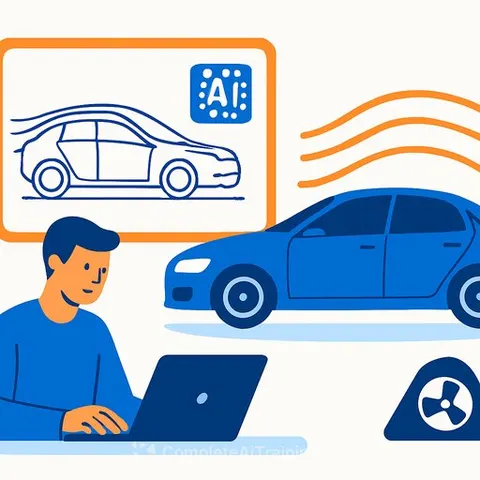
GM designers use AI to compress months of work into hours
General Motors has embedded AI tools throughout its design studios and engineering labs, cutting weeks of manual work down to minutes or hours. The shift isn't about replacing designers-it's about freeing them to explore more ideas faster.
Bryan Styles, GM's Director of Design Innovation and Technology Operations, said the company is focused on "augmenting and accelerating processes" rather than automating creativity. "Our goal is to pioneer the future of transportation with AI," he said.
From sketch to 3D in less than a day
Daniel Shapiro, a creative designer at GM, recently took hand-drawn sketches of a futuristic Chevy concept and fed them into an AI visualization tool. The AI generated a series of images and eventually a 3D animation showing how the concept could move.
"Traditionally, going from design sketch to high-quality animation would have taken multiple teams multiple months of work," Shapiro said. "Now this can be all done in less than a day by a single designer."
The time savings change what's creatively possible. Designers can now generate dozens of variations on a single concept, select the strongest ones, and refine them from a more advanced starting point. The AI handles technical setup-virtual cameras, lighting, CGI environments-that used to consume days of manual work.
"Instead of just going down this one path, we can explore so much more, and you can be a bit less precious with the ideas," Shapiro said.
Human judgment still filters the output. Shapiro emphasized that AI isn't a one-click solution. "We're working with it and we're often working against it to get the result we want. We're still the ones deciding what feels like a Buick, a GMC, a Cadillac, and in this case, a Chevy," he said.
Virtual wind tunnel cuts aerodynamic testing from weeks to seconds
On the engineering side, GM developed an AI-powered virtual wind tunnel that predicts aerodynamic drag in real time. Scott Parrish, a Technical Fellow at GM R&D, said his team built the tool using the company's own computational fluid dynamics data.
Traditionally, designers would complete a vehicle surface, send it to engineers for CFD simulation, wait days or weeks for results, then incorporate feedback. By the time results arrived, designers had often moved on to new concepts, creating redundant cycles.
The new tool lets an aerodynamicist and designer sit at the same screen, adjust a roofline or hood, and see how those changes affect drag in under a minute. "We could have made a decision about the roofline in about one minute, 18 seconds," said Rene Strauss, Director of GM's Virtual Integration Engineering.
What took two weeks now takes one minute. The speed enables better efficiency tradeoffs earlier in the design process.
For battery electric vehicles, reducing drag translates directly to customer benefits. "Reducing aerodynamic drag allows us to provide more range to our customers," Parrish said. "Maybe a smaller, more cost-effective battery that we can pass on to the customer."
Company expertise becomes the foundation
The virtual wind tunnel's accuracy depends on its training data. Parrish said GM built the AI model using decades of CFD data refined through years of lessons learned. "The model is only as good as the training data," he said.
This means GM's design and engineering experience becomes a more valuable asset, not less. The company uses its own expertise as a base for accelerating design possibilities.
GM isn't handing control to AI. It's using AI to buy back time-the most valuable resource for designers and engineers-so they can spend more cycles exploring and refining ideas.
If you work in creative fields, understanding how tools like these reshape workflows is increasingly relevant. AI Design Courses and Generative AI Courses can help you build skills in these applications.