Goa FES adds AI-enabled underwater scanners to speed up water rescues and recoveries
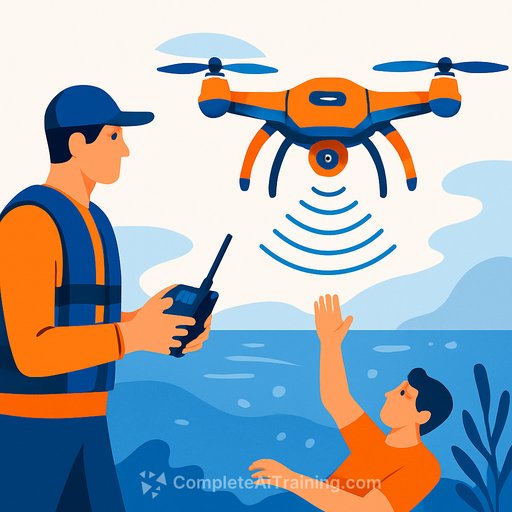
Goa Fire and Emergency Services has procured two handheld underwater scanners that pair SONAR with AI to locate drowned victims in low-visibility conditions. The investment is approximately Rs 21 lakh and is aimed at shortening search time while reducing diver exposure.
The devices work across fresh and polluted water bodies. Each unit weighs under 1.4 kg, so a single operator can carry and deploy it with minimal setup.
How the scanners work
The handheld units use SONAR to map the underwater environment, with an AI layer that flags likely human bodies. On the display, human forms appear with a "X" marker, while vehicles, debris, and other objects are labeled with an "O" to cut noise and speed decisions.
For those new to SONAR, this quick explainer from NOAA is useful: How SONAR works.
Why this matters for operations
- Faster location in murky water means less bottom time for divers and tighter scene control.
- Single-person operation lowers the footprint at the water's edge and frees up crew for perimeter and comms.
- Clear visual cues ("X" vs "O") reduce hesitation during target confirmation and handoff to the dive team.
- Effective in polluted water, where visibility and safety are recurring issues.
Immediate SOP updates to consider
- Insert a "tech sweep" step before committing divers in low-visibility or contaminated water.
- Define search patterns for the scanner operator (bank-to-bank lanes, clock-face arcs from a fixed point, etc.).
- Add a confirmation protocol: two passes on a target before diver insertion unless time-critical factors dictate otherwise.
- Log target coordinates, pass count, and screenshot captures for post-incident review.
Training plan (fast track)
- Orientation (1-2 hours): device setup, interface, iconography, and safety boundaries near currents/obstacles.
- Scenario drills (half-day): low-light or night ops, contaminated water procedures, comms with dive lead, and decon.
- Competency check: target acquisition time, false-positive rate, and adherence to search patterns.
If your team is building broader AI skills for field ops and documentation, consider the AI Learning Path for Training & Development Managers.
Risk controls and limits
- AI is probabilistic. Expect both false positives and misses-pair with human confirmation and a second pass.
- Battery life and weather can constrain runtime. Add pre-incident charging and spare batteries to the checklist.
- Turbidity, depth, and bottom composition can affect returns. Maintain alternative search methods in the plan.
- Preserve chain-of-custody for any captured imagery when incidents may involve law enforcement.
Procurement and maintenance notes
- Standard kit: spare batteries, tether or wrist lanyard, protective case, and decon-safe wipes.
- Service: identify the nearest authorized service partner and stock critical spares (battery, seals, screen protectors).
- Upkeep: monthly test in controlled water, firmware updates on a set cadence, and post-use decon per manufacturer guidance.
- PPE: gloves and masks for polluted water ops; add decon to the post-mission workflow.
On-scene workflow (quick reference)
- Command assigns a scanner operator and a recorder; align on search area and comms channel.
- Conduct initial sweep; mark "X" hits with GPS or shoreline markers; photograph or screenshot the display if allowed.
- Second pass to confirm; brief dive lead with location, depth estimate, and any entanglement risks.
- Maintain a clean handoff: operator holds position while dive team deploys; update ICS board with timestamps.
Metrics to track
- Time-to-first-location and time-to-recovery per incident.
- Diver bottom time and number of entries per incident.
- False-positive/negative counts across training and live calls.
- Device uptime, battery performance, and incident-ready status.
This purchase gives Goa FES a practical edge in water incidents: quicker target confirmation, tighter risk control, and clearer coordination with dive teams. For agencies building similar capability, align SOPs, training, and maintenance now so the tech delivers on the next call, not the one after.
Reference standard for rescue operations: NFPA 2500: Operations and Training for Technical Search and Rescue.
Your membership also unlocks: