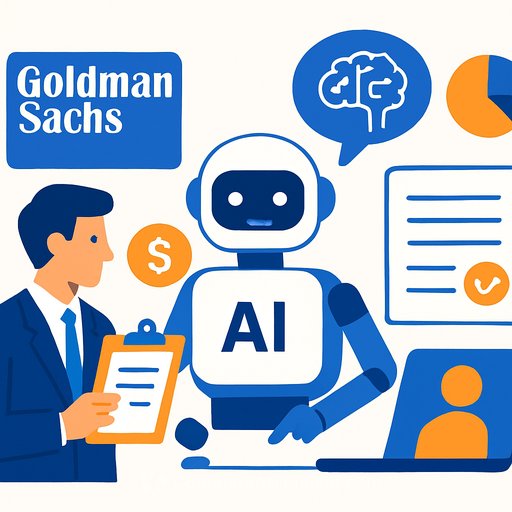
Goldman Sachs Is Building AI "Co-Workers" For Back-Office Scale
- Embedded engineers: Anthropic has worked inside Goldman for six months to build autonomous agents for high-volume, rules-heavy tasks.
- Efficiency first: Expect cycle-time gains and constrained headcount growth, not near-term layoffs.
- Beyond coding: Early wins in accounting, compliance, and onboarding show AI can handle complex, process-intensive work.
Goldman Sachs is rolling out AI agents built with Anthropic that target the slowest, most labor-intensive back-office functions. Initial focus: accounting for trades and transactions, plus client vetting and onboarding.
These agents are based on Anthropic's Claude model and are positioned as digital co-workers that reason through multi-step workflows. The goal is simple - compress task time, standardize execution, and reduce rework.
What's Working Inside The Bank
Goldman started with an autonomous AI coder (Devin) for its engineers. The surprise came when similar reasoning strengths transferred to accounting and compliance areas that blend document parsing, data reconciliation, and strict policy checks.
Early takeaways: complex, rules-based work is fair game if it's well-scoped, measured, and supervised. Expect faster onboarding, quicker reconciliation, and fewer handoffs.
Headcount, Jobs, And Third Parties
Leadership's stance is capacity, not cuts. AI will absorb workload spikes and help the firm hold the line on future headcount growth. That said, third-party spend may come under pressure as internal agents mature.
Next candidates under review include employee surveillance and pitchbook assembly - both high-volume and policy-driven with clear audit trails.
Why Finance Teams Should Care
This is a blueprint for where AI creates real ROI: standardized processes with high volume, heavy documentation, and explicit rules. If you're leading finance, ops, or compliance, the message is clear - prioritize workflows with measurable cycle time and error rates, then automate the critical path.
- Start with narrow, clearly labeled use cases (KYC checks, reconciliation exceptions, reference data updates).
- Instrument everything: baseline SLAs, error rates, rework time, handoffs, and client touchpoints.
- Keep a human in the loop where judgment or policy exceptions apply.
- Build auditability: input logs, prompts, outputs, approvals, and policy mappings.
- Segment data and permissions; never mix client-confidential and test environments.
Risk, Controls, And Model Management
Treat AI agents like any model: validation, monitoring, and change control. Map prompts and policies to controls, and enforce role-based access. Run shadow mode before production; compare agent decisions against human baselines for a full cycle.
For structured guidance, the NIST AI Risk Management Framework is a solid starting point for control design and oversight. View the framework.
Metrics That Matter
- Cycle time per workflow and per exception type
- First-pass yield and downstream rework
- Policy adherence and escalation rates
- Internal customer satisfaction (ops, risk, compliance) and external client NPS on onboarding
- Third-party spend avoided or reallocated
Vendor And Model Strategy
Anthropic's Claude is being used for reasoning-heavy tasks and document parsing. If you're evaluating options, compare models on structured test sets that mirror your controls and documents, not generic benchmarks.
Learn more about Claude's capabilities and updates here: Claude.
What To Watch Next
- Time-to-onboard and break-resolution speed as leading indicators of real value
- Policy exception handling quality versus human reviewers
- Vendor consolidation as agents replace slices of BPO work
- Governance maturity - agent approval workflows, incident response, and periodic audits
Practical First Steps For Finance Leaders
- Pick two workflows with clear rules and high repetition (e.g., AML screening triage, trade break categorization).
- Design prompts as policies: cite rule, cite source, show steps, and show confidence score.
- Deploy in shadow mode for 30-60 days; compare to human outcomes.
- Move to supervised production with tight SLAs and rollback plans.
- Report monthly on cycle time, errors, and client impact to the risk committee.
Upskill Your Team
If your accounting, risk, or ops teams need a fast start with finance-grade AI tools and guardrails, explore this collection: AI for Finance.
The takeaway: AI agents are ready for the tedious, rules-heavy work that slows client onboarding and reconciliation. Treat them like any critical system - clear scope, strong controls, rigorous measurement - and they'll pay for themselves in speed and scale.
Your membership also unlocks: