Five Strategies for Deeper AI Adoption at Work
Most people try AI tools and stop. A Stanford study of Google employees found why some adopt AI deeply while others abandon it after initial experiments.
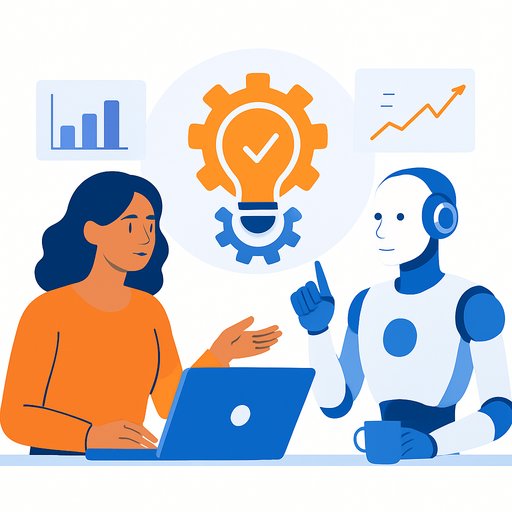
Researchers observed Google workers over 18 months as they learned and used AI in daily tasks. They discovered that successful adopters didn't rely on prompt engineering tricks. Instead, they applied product management principles to their AI work.
The difference was fundamental. Many users got stuck in "simple substitution" - swapping an existing task for an AI alternative. The effort required often exceeded the benefit, so they moved on. Deep adopters took a different path: they rethought entire workflows rather than hunting for quick fixes.
The Product Manager Mindset
Proficient AI users unknowingly followed a product manager playbook. They identified high-value opportunities, understood what various AI tools could do, and matched the two. Because generative AI is a general-purpose tool with many functions, this mindset helps you choose the right one for the job.
The Stanford research identified five concrete strategies:
1. Start with what's blocking your work
Don't begin with the technology. Begin with the work itself. Identify the hurdles that, if removed, would let you move faster, think more creatively, or analyze more deeply. These blockers show exactly where an AI solution could help most.
2. Choose the right tool, beyond a chatbot
Once you've spotted an opportunity, find the right AI tool for that specific job. Many tools exist, and many work better than a chatbot for your problem. Evaluate which tool could work sustainably, even if it means adjusting your usual process.
3. Start small and experiment rapidly
Don't redesign your entire workflow immediately. Focus on prototyping, testing, and refining. Starting small helps you discover what actually works and avoids frustration or expensive missteps.
4. Think across systems
Deep adoption means moving past one-off tasks and embedding AI into your everyday processes. The biggest gains often come from bridging datasets, creating workflows that eliminate multiple manual steps, or strengthening strategic thinking by combining different expertise areas.
5. Share your playbook
Document what worked so others can skip the trial and error. Package your findings into repeatable templates - you can use AI to build these - so your team benefits from what you learned instead of starting from scratch.
For product professionals, this approach aligns directly with how you already think about problems. Learn more with our AI Learning Path for Product Managers, which covers applying product thinking to AI adoption. You can also explore strategies for AI Productivity & Workflow Automation Training to embed these tools into your daily work.
Your membership also unlocks: