Innovation: Google backs African push to reclaim AI language data
Most AI bots still stumble over African languages. That failure blocks real products, real services, and real users. A new dataset aims to change that - and crucially, keep ownership on the continent.
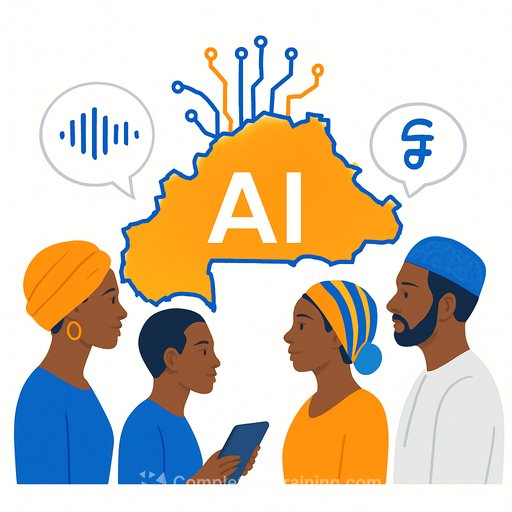
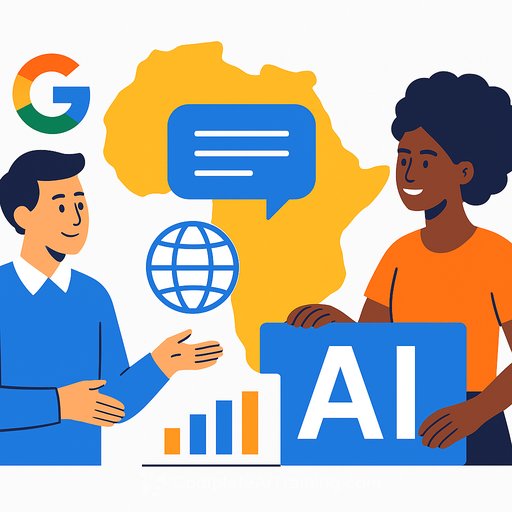
Google has launched WAXAL, a 21-language speech dataset named after the Wolof word for "speak." It covers languages like Acholi, Hausa, Luganda, and Yoruba, and was built with African partners over three years. The twist: the data is owned and controlled by the African institutions that created it, not Google.
Partners include Makerere University (Uganda), the University of Ghana, Rwanda's Digital Umuganda, and the African Institute for Mathematical Sciences (AIMS). This model centers local control and long-term stewardship - a shift from years of Big Tech dominance over global data.
The numbers are strong: over 11,000 hours of speech drawn from nearly 2 million recordings, with about 1,250 hours transcribed for automatic speech recognition and 20+ hours of studio-grade audio for Text-To-Speech. It's released under a permissive license to allow commercial use, lowering barriers for startups and public projects.
Real work is already happening. The University of Ghana is using WAXAL for maternal health research. More broadly, universities and labs across the continent are moving from "data collectors" to infrastructure hubs - the place where models, tools, and companies get built.
This push sits inside a bigger fight over data ownership. For years, massive datasets were gathered - often without clear consent or compensation - and used to train models elsewhere. With data-driven businesses estimated to generate trillions annually, countries are asserting control, keeping data within borders, and asking a simple question: who benefits? For further reading on datasets, governance, and academic collaborations, see Research.
WAXAL wasn't easy to build. African languages are dense with tone, context, and dialect variation. Teams leaned on linguistics departments for transcription standards and built portable recording boxes with noise-canceling to capture clean audio in tough settings.
There are still gaps. For instance, the Yoruba set has been flagged for missing diacritics, which can hurt text-to-speech quality. And with vast dialect diversity, coverage remains a moving target. Six more languages are already in the pipeline, bringing the set to 27, with sustainability tied to ongoing local partnerships.
Google isn't alone. Microsoft recently introduced Paza, a pipeline and benchmarking tool for dozens of African languages, signaling a wider shift to community-led infrastructure. Expect faster iteration, more open baselines, and better products for real users.
Why this matters for product, IT, and dev teams
- Build locally relevant apps: ASR, TTS, call analytics, voice assistants, and IVR can finally move beyond English-first roadmaps.
- Ship with confidence: The permissive license supports commercial deployment - and helps keep IP, jobs, and value local.
- Mind the details: Diacritics and dialects aren't "nice to have." Bake orthography checks and dialect coverage into your data and QA plans.
- Close the loop: Partner with universities and community groups for ongoing data improvements, testing, and bias checks.
- Public sector impact: Health, education, and emergency services can reach citizens in their own languages - no translator required.
How to get started
- Review the dataset announcement and documentation on the official Google AI blog for scope, license, and usage notes. Google AI Blog
- Prototype fast: fine-tune an open ASR/TTS baseline on WAXAL; run A/B tests across dialects and accents before scaling.
- Fix gaps early: collect supplemental samples where diacritics or domain terms are weak; set up a feedback loop with native speakers.
- Invest in community: fund or join local language labs to keep the data fresh and inclusive. See one key partner here: African Institute for Mathematical Sciences (AIMS).
Bottom line: Africa owning African language data is the difference between building for users and guessing from afar. WAXAL makes that ownership real - and opens the door for products that actually work for millions of people.
If you're upskilling teams to ship voice products faster, explore practical paths by role here: AI Learning Path for Training & Development Managers
Your membership also unlocks: