Google Brings Intrinsic In-House: The Android Playbook for Robotics
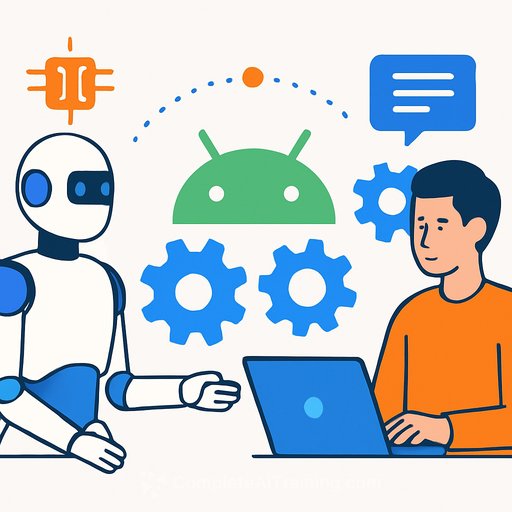
Google just folded Intrinsic-its robotics software effort-into the core company. This is a platform move, not a side bet. Think Android, but for robots: a common operating layer, partners that handle the hardware, and a developer ecosystem that compounds value over time.
Intrinsic stays a distinct group under its own brand, led by CEO Wendy Tan White. Inside Google, it plugs directly into DeepMind's AI stack, Gemini models, and cloud infrastructure-shortening the path from research to factory floor.
Why this matters for executives
- Standardization: A common OS for robots reduces custom integration, cuts deployment time, and lowers total cost of ownership.
- Ecosystem leverage: Intrinsic partners include FANUC, Universal Robots, and KUKA-giving immediate reach into industrial settings without Google building hardware.
- AI goes physical: As AI moves from screens to real tasks, expect faster iteration cycles and software-like updates for automation.
- Market size: McKinsey projects general purpose robots could hit $370B by 2040-this is a meaningful growth vector for operational performance and margins.
- Competitive pressure: Amazon and Tesla are building rival stacks. Waiting invites lock-in to someone else's standards.
What Intrinsic actually is
Intrinsic is building an operating system for robotics so manufacturers "can focus more on solving the problem, and not the plumbing." Its flagship product, Flowstate, is a web platform to build robotic applications without thousands of lines of code. The system is hardware- and model-agnostic: "It doesn't matter what the hardware is and it doesn't matter what the AI model is."
By moving inside Google, Intrinsic gains tighter integration with DeepMind's research, Gemini models, and Google Cloud. The team remains led by Wendy Tan White and continues collaborating across AI, infrastructure, and operations groups.
Google's new robotics stack at a glance
- OS layer: Intrinsic's platform and Flowstate to program and orchestrate robots.
- AI control: Gemini Robotics and Gemini Robotics-ER to translate high-level goals into physical actions.
- Research engine: DeepMind's models and data pipeline supporting training and deployment.
- Hardware network: Partnerships across industrial leaders (FANUC, Universal Robots, KUKA) and humanoids via Apptronik.
- Real-world integrations: Gemini integrated into Boston Dynamics' Atlas for manufacturing scenarios (Boston Dynamics), and a Foxconn partnership for AI-assisted electronics assembly in U.S. factories.
- Scale economics: Google is doubling AI serving capacity roughly every six months to meet demand-expect rapid capability growth.
Context: Google's second attempt at robotics
Google previously bought Boston Dynamics and Schaft in 2013, only to sell them in 2017 after struggling to land a clear business model. The difference now: modern AI can convert natural language and intent into reliable physical actions. With DeepMind, Gemini, and major industrial partners, the pieces line up for a platform play that didn't exist a decade ago.
Signals you should watch
- Partner momentum: Expansion across top industrial robot makers and system integrators.
- Model upgrades: Improvements in manipulation, safety, and edge-case handling via Gemini iterations.
- Reference wins: Measurable throughput and quality gains in Foxconn's U.S. deployments and beyond.
- Developer adoption: Growth in apps and skills built on Flowstate and related toolkits.
Implications for manufacturers and logistics leaders
- From bespoke to platform: Shift your automation roadmap to favor reusable building blocks over single-use integrations.
- Data advantage: The OS that captures real production data wins. Build a stance on data ownership, retention, and model fine-tuning rights now.
- Vendor strategy: Reduce lock-in with multi-vendor hardware support and API-first contracts.
- Workforce design: Upskill operators into "robotic process owners" who configure cells instead of writing code.
- Security and safety: Clarify on-prem, edge, and cloud boundaries; validate functional safety standards and audit trails for regulated environments.
How to evaluate Intrinsic (and peers) this quarter
- Hardware coverage across your installed base (FANUC, Universal Robots, KUKA) and future purchases.
- Cycle time, first-pass yield, and changeover time versus your current cells.
- Integration with PLCs, MES, and ERP. Availability of managed connectors and SDKs.
- Deployment model (on-prem/edge/cloud), latency, offline modes, and failover behavior.
- Licensing and TCO: per-robot, per-cell, or usage-based; upgrade cadence and model-inference costs.
- Data policy: who owns production data, how it's used to train models, and opt-out options.
- Safety certifications, auditability, and compliance documentation.
- Service model and SLAs: installation, tuning, retraining, and 24/7 support.
- Roadmap for Gemini Robotics/ER in high-precision tasks, plus reference deployments.
90-day action plan
- Weeks 1-2: Form a cross-functional cell (Ops, IT/OT, Safety, Finance). Define three priority use cases with clear ROI levers (assembly, kitting, quality).
- Weeks 3-4: Vendor briefings and sandbox trials of Flowstate-style tooling. Validate hardware compatibility and data policies.
- Weeks 5-8: Run a pilot on one station with measurable baselines. Target fast wins: changeovers, reduced programming time, scrap reduction.
- Weeks 9-12: Build the business case and 12-18 month rollout plan. Lock integration principles and a standards-first procurement policy.
KPIs to track
- Cycle time per station and takt variance
- First-pass yield and rework rate
- Changeover time and schedule adherence
- OEE impact and unplanned downtime
- Programming hours saved per deployment
- Time-to-commission new tasks/cells
- Safety incidents and near-miss counts
Risks and watch items
- Over-reliance on a single OS provider; keep an exit path and open standards where possible.
- Edge-case brittleness in real environments; budget for ongoing tuning.
- Hidden inference and data egress costs; model updates that change performance profiles.
- Talent gap at the OT/AI boundary; invest in training and clear ownership.
- Regulatory and customer audit demands on data, safety, and traceability.
Bottom line
Google is turning robotics into a software platform play. Intrinsic as the "Android of robotics" is more than a slogan-it's a distribution and developer strategy built to compress costs and time-to-value across factories and warehouses.
If you operate complex lines, run a structured pilot this quarter. The companies that standardize on a flexible robotics OS early will move faster, spend less on integration, and compound learning across sites.
Resources
Your membership also unlocks: