AI's Energy Bottleneck: How Google Cloud Plans to Scale Without Hitting the Wall
AI's constraint is no longer just compute. It's electricity. Google Cloud CEO Thomas Kurian put it plainly: energy and data centers are emerging as bottlenecks on par with chips-and the company has been planning for it for years.
The scale is hard to ignore. Some AI-focused data centers already draw as much electricity as 100,000 homes, and the largest facilities under construction could use 20 times that. Meanwhile, global capacity is set to jump by roughly 21,000 megawatts in the next two years.
Google Cloud's Three-Point Plan
Kurian outlined a simple framework built for scale under tight constraints.
- Diversify energy inputs, but be realistic about physics: Not all energy sources can handle sudden load spikes from training clusters. High-intensity training jobs create surges that some generation types can't support consistently.
- Drive efficiency inside the walls: Google is optimizing how energy is used and reused in its facilities. AI-driven control systems monitor thermodynamics to reduce waste and recirculate what's already onsite.
- Bet on new energy tech: The company is investing in fundamental technologies to create new forms of energy. Details are limited, but the direction is clear: don't rely only on the grid.
Why This Matters for Executives
AI demand is rising faster than grid capacity, permitting, and interconnection queues can keep up. Even with better chips and models, energy supply and data center availability will define competitive advantage.
Build speed is a chokepoint too. Standing up a U.S. data center campus-especially one ready for AI training-can take years. That's a strategic variable, not an operational detail.
Signals You Should Track
- Grid access and interconnection timelines: Lead times can span 24-48 months in congested regions.
- PUE, WUE, and thermal reuse: Efficiency is now a board topic, not just a facilities KPI.
- Energy mix fit for AI training: Intermittent sources may need firming via storage or complementary generation.
- Co-development models: Partnerships that bundle land, power, and new capacity are becoming standard.
Execution Plays to Consider
- Secure firmed power early: Structure PPAs with storage or hybrid generation to handle load spikes from training.
- Split training and inference footprints: Place training near firm generation; position latency-sensitive inference closer to users.
- Adopt energy-aware scheduling: Align model training windows with lower-cost or lower-carbon availability.
- Invest in onsite or adjacent generation: Explore thermal reuse, advanced cooling, and campus-scale microgrids.
- Pressure-test sites for permitting risk: Model different jurisdictions for timelines, incentives, and interconnection probability.
Partnerships Will Shape Capacity
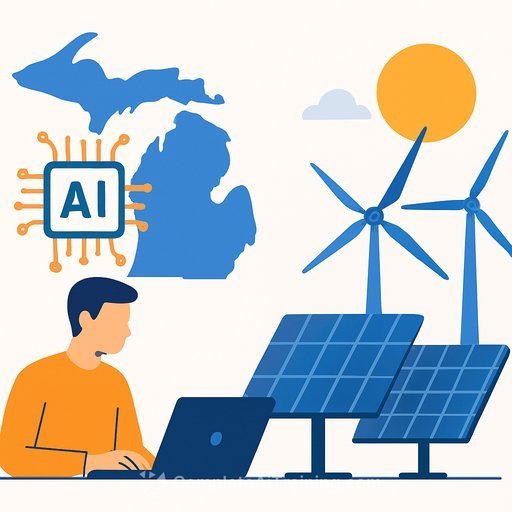
Google Cloud and NextEra Energy are expanding their partnership to build new U.S. data center campuses with dedicated power plants. Expect more tie-ups like this: integrated energy plus compute is becoming the default path to scale.
The Competitive Context
Industry leaders have warned that energy access now sits alongside chip supply as a gating factor for AI progress. Build-time advantage matters too; some regions can bring new sites online much faster than others. If your strategy assumes "we'll find the power later," you're already behind.
Key Numbers to Anchor Your Strategy
- AI-heavy data centers can consume as much electricity as 100,000 homes; the biggest projects could reach 20 times that.
- Global data center capacity is expected to expand by ~21,000 MW in the next two years.
Further Reading
- International Energy Agency: Data centres and data transmission networks
- Knight Frank: Global Data Centre Outlook
Upskill Your Leadership Bench
If your board and operating leaders are making AI bets without an energy-aware roadmap, the risk is hidden in plain sight. Align your AI strategy with infrastructure reality and train teams to plan across chips, models, sites, and power.
- AI courses by job role for executive and strategy teams
The takeaway: AI scale goes to the operators who treat energy as a first-class product decision, not an afterthought. That's the shift Google Cloud is signaling-plan your portfolio accordingly.
Your membership also unlocks: