Google DeepMind to roll out science-focused AI models for Indian researchers
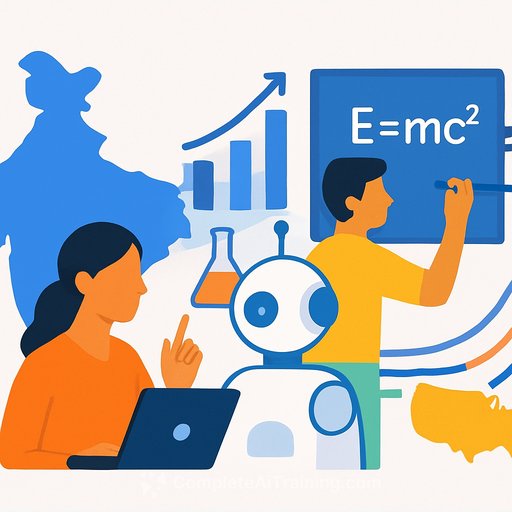
Google DeepMind has partnered with India's Anusandhan National Research Foundation (ANRF) to make its science-centric AI stack available for students and researchers across the country. The rollout includes access for training, hackathons, and community contests built around research-grade models.
This move lands under DeepMind's National Partnerships for AI program, following similar engagements in the US and UK. The focus is practical: get frontier models into the hands of labs working on nationally relevant problems.
What's being rolled out
- AlphaGenome: An AI model for exploring human genome landscapes and variant context.
- AI Co-scientist: A multi-agent system that acts as a virtual lab collaborator for hypothesis generation, literature synthesis, and experimental planning.
- Earth AI: A collection of models for environmental monitoring and disaster response workflows.
These models will feature in training initiatives, hackathons, and community challenges-useful on-ramps for wet labs, field teams, and computational groups to test workflows without long setup cycles.
Learn more about the organization behind the program at Google DeepMind.
Education and workforce moves
DeepMind will work with Atal Tinkering Labs to embed robotics and coding into local curricula. Gemini chatbots will be integrated into teacher workflows to assist with content creation and classroom support.
In parallel, Google Cloud will help scale the government's iGOT Karmayogi platform to upskill public servants-targeting 2 crore (20 million) employees across 18 Indian languages. Platform details are available at the official portal: iGOT Karmayogi.
Funding: $30M AI for Science Impact Challenge
Google announced a $30 million fund to back researchers using AI to drive scientific breakthroughs. Expect both funding and technical support, which could offset compute costs and speed up method development.
Labs aiming at breakthroughs in genomics, climatology, materials, or policy-relevant domains should prepare proposal-ready problem statements and lightweight demos aligned with India's priority areas.
Applications already in motion
Google says Indian startups and institutions are applying its agricultural models to improve yield and farmer incomes. In energy, it is working with Open Climate Fix to integrate WeatherNext into India's electricity grid for improved demand and generation forecasting.
For researchers, this signals a pathway from model access to deployment in production environments-especially where time-series prediction and geospatial data are central.
Infrastructure to back it up
At the India AI Impact Summit 2026, Google highlighted the India-America Connect Initiative-new subsea cable routes to strengthen AI connectivity between India and the US. The company also reiterated a $15B investment in Visakhapatnam over five years to build an Indian AI data center hub.
The plan includes a new subsea cable landing station in Vizag, three subsea routes linking India with Singapore, South Africa, and Australia, and four additional fiber routes to improve capacity and resilience across the US, India, and parts of the Southern Hemisphere.
What this means for research teams
- Faster cycles: AI Co-scientist can compress literature review, baseline method selection, and experiment planning into hours, not weeks.
- Better coverage: Earth AI unlocks large-area monitoring, scoring, and alerting-valuable for disaster risk models and climate adaptation work.
- Deeper exploration: AlphaGenome supports variant-level analysis and candidate prioritization for wet-lab validation.
- Deployment paths: Integration with Google Cloud and grid-level forecasting suggests clearer routes from prototype to impact.
Action steps for Indian researchers
- Coordinate with your institute's ANRF liaison to understand access windows, compute quotas, and IP terms.
- Shortlist 1-2 projects per group that map cleanly to AlphaGenome, AI Co-scientist, or Earth AI-keep scope tight and data ready.
- Prepare datasets: document provenance, licensing, consent, and anonymization. Pre-compute embeddings or tiles where useful.
- Draft a concept note for the $30M challenge: statement of need, baseline benchmarks, proposed model fit, evaluation plan, and expected public benefit.
- Build a minimal MLOps lane on Google Cloud if you plan to scale-versioning, lineage, and cost controls from day one.
- Pre-clear ethics/IRB and data-sharing MOUs to avoid delays once access goes live.
Open questions to track
- Access and quotas: Who gets early access, and what are the compute and token limits?
- Data governance: How will sensitive health, genomic, or geospatial data be handled across cloud regions?
- IP and publication: Clarity on model-assisted authorship, code release, and reproducibility expectations.
- Localization: Timelines for multilingual model support in research settings and tooling.
Further learning
If you're planning to integrate these tools into your lab workflows, this curated hub may help: AI for Science & Research. For a structured path, see the AI Learning Path for Research Scientists.
Your membership also unlocks: