
AI news ·
Google DeepMind chief executive Demis Hassabis argues artificial intelligence cannot independently invent special relativity
Google DeepMind's CEO says AI lacks the 1% of human insight to overturn scientific assumptions. It handles 99% of routine work, but breakthroughs need human judgment.
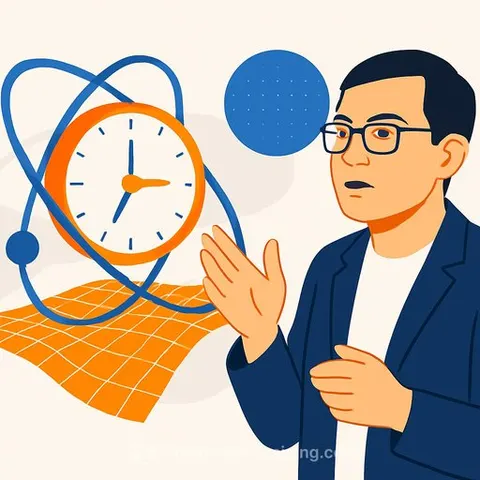
A thought experiment from Google DeepMind CEO Demis Hassabis is forcing the AI community to confront a hard question about machine creativity: if an advanced AI's training data were cut short at 1901-giving it only the physics known before Einstein's breakthrough-could it independently produce the theory of special relativity? Hassabis believes the answer is no. The test probes not just raw processing power, but whether today's AI can overthrow the fundamental assumptions of a scientific era.
Special relativity did not simply fill a gap in 19th-century physics. It dismantled the notion of absolute time, a concept that underpinned every law of motion. Newtonian mechanics described a world where time ticked uniformly for all observers, and space was a fixed stage. Maxwell's equations showed that the speed of light was constant, which clashed with the classical rule that velocities simply add. The Michelson-Morley experiment failed to detect the expected "aether wind," deepening the puzzle.
Most physicists of the time tried to patch the old framework: maybe the aether was dragged along by the Earth, or objects contracted at high speeds. Einstein did something different. He abandoned the search for an absolute reference frame and started from two postulates: the laws of physics are the same in all inertial frames, and the speed of light is constant for all observers. From that, time and space became relative.
The kind of shift AI struggles with
This pattern-long stretches of routine work punctuated by rare reconstructions of the entire framework-was described by Thomas Kuhn in The Structure of Scientific Revolutions. Most research operates within an accepted set of rules. When an anomaly like the null result of the Michelson-Morley experiment appears, scientists check instruments, tweak parameters, or add auxiliary hypotheses. They rarely question the rules themselves.
All the data Einstein used-the equations, the experiments-were already in the literature by 1901. Yet the breakthrough required seeing that the problem wasn't a faulty measurement or a missing aether property; it was the premise of absolute time. That step is not a logical deduction from existing literature. It is a refusal to treat a core assumption as given.
What current AI does well-and where it stalls
Today's large language models are masters of recombination. Trained on enormous text corpora, they learn statistical patterns that allow them to summarize, reason by analogy, and generate novel combinations of known ideas. For a clearly defined research task, AI can scan thousands of papers, produce candidate hypotheses, and write experimental protocols in minutes.
But the model's sense of what is "reasonable" comes from the distribution of ideas in its training data. If that data overwhelmingly assumes the existence of the aether, the model will treat the aether as a valid starting point. It can list dozens of possible explanations for the Michelson-Morley result, including the radical option that the aether doesn't exist. What it cannot reliably do is decide that this one, outlier idea is the one worth placing the entire enterprise on-especially when the whole community believes otherwise.
Hassabis has drawn a sharp line between finding the best move on a known board and changing the rules of the game. AlphaGo's famous "Move 37" against Lee Sedol was a stunning innovation, but it occurred within the fixed rules of Go and a clear win condition. Relativity required throwing away the rulebook that treated time as absolute. That is not a more efficient search of the possibility space; it is a search in a different space altogether.
The 99% and the 1%
AI's strength in science is not in asking questions that challenge foundational assumptions but in handling the enormous volume of work that supports them. Literature reviews, data cleaning, computation, code generation, and the iterative testing of hypotheses can all be accelerated. This frees researchers to focus on judgment, interpretation, and the detection of deeper inconsistencies.
Thomas Edison's formula that "genius is one percent inspiration and ninety-nine percent perspiration" captures the division. The perspiration-the exhaustive work of normal science-is increasingly automatable. The inspiration comes from a human sensitivity to contradiction, a willingness to doubt the most basic premises, and the capacity to build a new explanatory structure when no standard answer exists. Einstein's advantage was not more information; it was a different way of looking at the same information.
Why this matters for researchers
For working scientists and research professionals, the message of Hassabis's test is practical, not philosophical. As AI tools become more powerful, the value of human labor in science will shift upstream. Deciding which question to investigate, spotting when an old model has exhausted its usefulness, and judging which anomalous result truly deserves a radical reinterpretation-these are the skills that will command the highest premium. The 99% of perspiration that AI can absorb will free more time for precisely that kind of thinking.
Understanding these limitations-and the tasks AI can already handle-is essential. Professional development resources such as AI for Science & Research Courses help researchers integrate current AI capabilities into their workflows without losing sight of the human judgment that drives breakthrough science. In an era where AI can do more of the grind, the ability to ask questions that reframe the problem is more valuable than ever.