Google puts real AI in classrooms: $5M funding and a hands-on eye disease detection quest
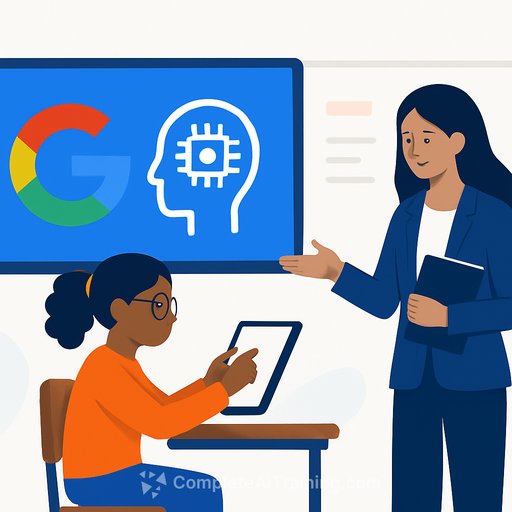
Google.org is investing over $5 million in computer science education and rolling out a new AI Quest that has students detect eye disease using models inspired by real diabetic retinopathy research. During CS Education Week, hundreds of Google volunteers are visiting classrooms worldwide to lead the experience. This move adds to a recent $30 million global commitment and pushes Google's total CS education investment past $240 million.
The Buzz
- Over $5M in new Google.org funding for computer science education
- New AI Quest: students use AI models to detect eye disease and help prevent blindness
- Hundreds of Google volunteers leading gamified AI Quests in classrooms globally
- Funding builds on a $30M commitment and more than $240M invested to date
Why this matters for educators
Students learn best by doing. This program moves past vague AI talk and puts actual tools in their hands to solve a concrete problem that mirrors real research.
As one leader put it, "While coding tasks may change in the AI era, the foundational principles of computer science remain more vital than ever." The message is clear: algorithms, data, evaluation, and ethics are still the backbone-AI just makes applying them more immediate.
What's funded (and why it's useful)
The funding targets known gaps: teacher preparation for AI-integrated coursework and standards that reflect current practice. Support includes teacher training at California State University Dominguez Hills and backing for the Computer Science Teachers Association to publish updated K-12 standards with a modern web presence.
If you're aligning curriculum, keep an eye on the CSTA standards update. It's a practical anchor for lesson objectives, assessments, and PD plans. You can track their work here: CSTA Standards.
Inside the new AI Quest: eye disease detection
The quest places students in the role of medical researchers working with AI. They experiment with a model that classifies retinal images for signs of disease, then compare outcomes and discuss how those results would influence care.
- Work with labeled images to see how a model identifies risk
- Adjust inputs and review performance trade-offs (precision vs. recall)
- Discuss bias, false positives/negatives, and the human-in-the-loop
- Connect model outputs to real decisions and accountability
The simulator is built on the same technology family used in Google's medical AI research on diabetic retinopathy, making the learning authentic rather than abstract.
Where this fits in your curriculum
- Middle and high school CS: algorithms, data, and model evaluation
- STEM/biology: diagnostics, measurement, and ethical use of technology
- Career pathways: AI literacy, prompt quality, and evaluation skills
Use it as a capstone for a unit on classification, a cross-curricular project with science, or a performance task tied to standards.
Partnership momentum you can leverage
The Raspberry Pi Foundation and Google DeepMind integrated AI Quests into the Experience AI program, which UNESCO recognized for responsible AI education. That reach now extends to millions of students with Google.org support.
If you want a broader framework for responsible use, explore Experience AI's recognition via UNESCO or similar initiatives from reputable organizations to inform your policy and parent communications.
Quick setup guide for schools
- Time: 45-90 minutes works well for a single quest module
- Tech: Laptops or Chromebooks with reliable internet
- Class flow: Brief intro to classification ➝ hands-on model use ➝ results review ➝ ethics discussion
- Assessment: Exit ticket on trade-offs (precision vs. recall) + reflection on when to trust or question AI output
- Safety: Emphasize that AI assists experts; it doesn't replace professional judgment
How this compares to other initiatives
Microsoft and Apple have strong education programs that emphasize coding fundamentals. Google's approach adds something different: immediate practice with AI models tied to real research use cases. That relevance tends to boost engagement and retention.
What to do next
- Coordinate a volunteer session with your regional Google contacts or CS Ed Week partners.
- Map the quest to your learning targets and the CSTA standards.
- Prep students with a short primer on classification, datasets, and model limits.
- Plan a follow-up project (e.g., flood forecasting quest) to reinforce concepts.
- For staff PD and structured learning paths, see curated AI upskilling options by role: Complete AI Training: Courses by Job.
FAQ for educators
- Grade levels: Best for grades 7-12; adaptable for early college.
- Equity: Build in supports-step-by-step instructions, vocabulary cards, and peer roles.
- Data privacy: Use provided demo data; no student data should feed the model.
- Documentation: Pre-write your parent letter and syllabus note on AI use and evaluation.
Bottom line
This is a practical way to teach core CS concepts and AI literacy in one sitting. Students don't just hear about AI-they apply it, question it, and learn how to use it responsibly. For schools, it's a fast, credible path to bring AI into the classroom without reinventing your course.
Your membership also unlocks: