University of Hawaiʻi receives $50,000 Google grant for robotic perception research
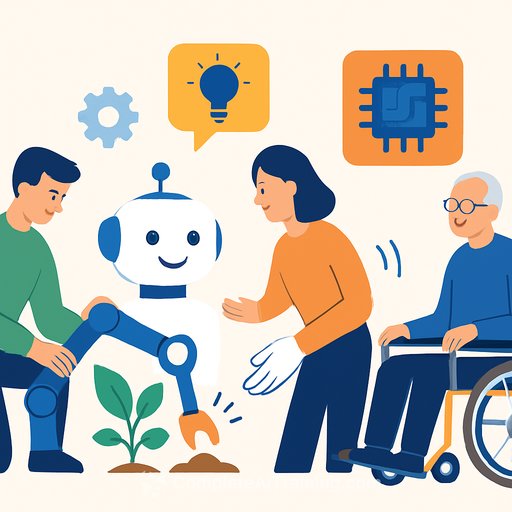
The University of Hawaiʻi at Mānoa will use a $50,000 research gift from Google to advance work in robotic perception led by Assistant Professor Huaijin Chen in the Department of Information and Computer Sciences. The funding supports research in artificial intelligence, 3D vision and tactile sensing across three application areas: healthcare, agriculture and human-robot interaction.
Chen's team is developing robots that can better understand and respond to physical environments. The work includes funding for graduate and undergraduate researchers, equipment, computing resources and experimental testing.
Three research directions
Health and elderly care: One focus involves robots designed to support older adults with mild cognitive impairment. The systems combine 3D vision and adaptive robotic behavior to respond more naturally in assistive settings. This builds on Chen's earlier work using computer vision and AI to identify early signs of Alzheimer's disease.
Tactile sensing: Researchers are exploring how robots can gather information through touch. Better tactile perception could improve how machines handle delicate tasks and detect shape and movement during physical interaction.
Agriculture: The third area targets outdoor farming environments. Robots need to navigate fields, identify crops and interpret terrain under varying light and weather conditions. Team ʻĀina has already begun deploying robots to inspect pineapple fields as part of this work.
The research sits within AI for Science & Research, where perception systems must operate reliably outside controlled laboratory settings.
Your membership also unlocks: