
AI news ·
Google, Microsoft and xAI agree to let U.S. government review advanced AI before public release
Google, Microsoft, and xAI have agreed to let the U.S. government review their advanced AI systems before public release. The government gets early visibility into security and safety risks but no direct control over the products.
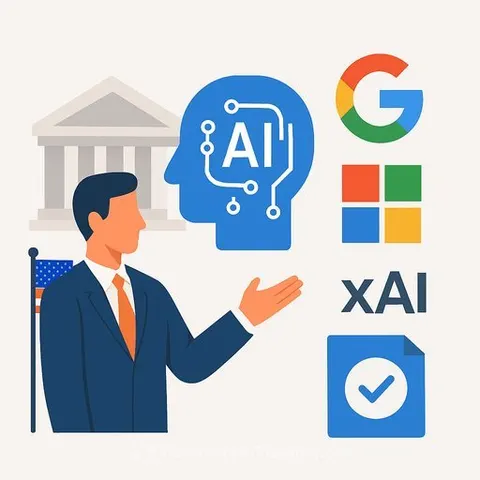
Google, Microsoft and xAI agree to U.S. government AI review before public release
Google, Microsoft and Elon Musk's xAI have agreed to allow the U.S. government to review advanced artificial intelligence systems before their public release. The arrangement marks a significant shift in how governments and technology companies coordinate on AI development.
The government will assess potential national security threats, cybersecurity vulnerabilities, misinformation risks and other dangers tied to increasingly sophisticated AI models. The companies retain control of their products - the government gains early visibility, not direct authority.
Why this matters for your work
AI is no longer treated as a standard technology sector. Governments now view it as strategic infrastructure comparable to nuclear technology, aerospace systems or military communications.
For developers and IT professionals, this means the tools you build with and the infrastructure you manage will likely face new oversight requirements. Understanding how these systems work - and how governments evaluate them - is becoming essential knowledge.
The agreement signals that Washington wants closer coordination with companies building the world's most powerful AI systems. This affects hiring, compliance, product roadmaps and deployment timelines across the industry.
What triggered government involvement
Officials fear advanced AI systems may perform actions that are difficult to predict or control. Specific concerns include:
- AI models generating harmful biological research guidance
- Mass production of misinformation and deepfakes
- Automated cyberattacks and financial system manipulation
- Foreign influence campaigns and election interference
- Potential military misuse
Early visibility allows authorities to identify risks before systems reach the public or hostile actors.
Why companies are cooperating
Technology firms face mounting public concerns about AI safety. Cooperation demonstrates responsibility and may prevent stricter regulation later.
Companies also recognize that AI systems are now connected to military strategy, intelligence operations and cybersecurity. Ignoring national security concerns is no longer viable for major tech firms.
Cooperation may also give companies influence over how future AI regulations are designed - a significant advantage over competitors who resist government engagement.
The innovation versus oversight tension
Critics argue that mandatory reviews and licensing systems could delay product launches and increase costs for startups. Large corporations may benefit most from compliance requirements that smaller competitors cannot afford.
Supporters of oversight counter that uncontrolled AI development could create catastrophic consequences if safety standards are ignored. They compare current AI development to building an airplane while already flying it.
This debate will likely define the industry for the next decade.
Global competition and regulation
The United States views AI as critical geopolitical competition with China. American officials worry that stricter rules on U.S. companies while Chinese firms operate under different standards could shift technological power.
The European Union already implements extensive AI rules through its AI Act. The United Kingdom, Canada and several Asian nations are developing their own governance frameworks. Different regional approaches could create fragmented global AI environments.
Many experts believe future AI governance will eventually require international agreements similar to climate treaties or nuclear non-proliferation frameworks.
What could change for users and developers
Consumers and developers may eventually see:
- More safety restrictions in AI tools
- Stronger identity verification systems
- Limits on certain prompts and capabilities
- Increased monitoring for harmful usage
- Slower rollout of highly advanced features
- Clearer transparency about synthetic content
AI products could increasingly resemble regulated infrastructure rather than experimental tools.
Privacy and surveillance concerns
AI systems require enormous amounts of data for training and operation. As governments increase oversight, users fear expanded surveillance capabilities.
Key questions remain unanswered: Who can access AI training data? Can governments monitor AI interactions? Will AI conversations remain private? The tension between safety and privacy will likely become one of the defining debates in the AI era.
Future regulatory frameworks
Some experts believe extremely powerful AI systems may eventually require government licenses or certifications before deployment - similar to how pharmaceutical firms, airlines and nuclear facilities operate.
Possible future requirements include mandatory safety testing, independent audits, transparency reports, cybersecurity standards, and emergency shutdown procedures.
Although no universal framework currently exists, discussions are becoming more serious annually.
What happens next
The next phase will involve deeper negotiations between governments, technology companies and international organizations. Expect new AI safety frameworks, expanded government review systems, stronger cybersecurity rules and increased transparency requirements.
This agreement may be remembered as the moment AI stopped being viewed purely as commercial innovation and started being treated as critical strategic infrastructure.
The decisions made in the coming years about how AI is monitored, regulated and deployed will shape not only the technology industry but the future structure of global power in the twenty-first century.
For IT and development professionals, staying informed about these regulatory trends is no longer optional - it's essential to your career. Consider exploring Generative AI and LLM Courses to understand the systems now under government scrutiny, and AI for IT & Development resources to see how these oversight frameworks will affect infrastructure and deployment practices.