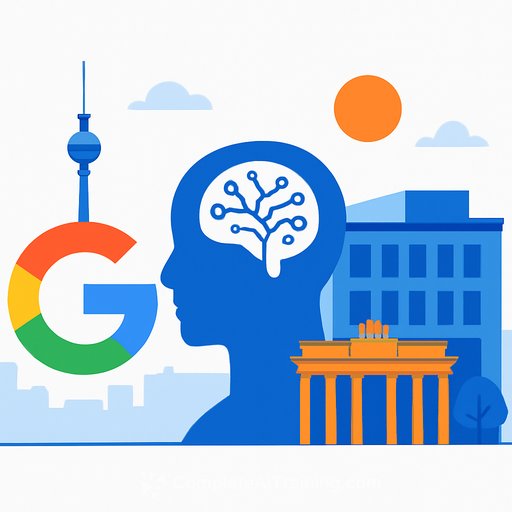
Berlin becomes home to Google AI research centre
Google planting an AI research centre in Berlin is a signal: Europe's scientific engine just got a stronger industry link. If you work in science or research, expect more collaboration routes, sharper tooling, and faster paths from proof-of-concept to impact.
Why Berlin matters
Berlin sits at the intersection of strong universities, vibrant startups, and Europe's policy core. That mix attracts talent, speeds up cross-disciplinary work, and keeps projects aligned with EU standards from day one.
What researchers can expect
- Collaboration: Joint projects, visiting researcher roles, and co-authorship opportunities with Google teams.
- Resources: Access to workshops, seminars, and (where applicable) compute programs Google supports for academics.
- Open science: Contributions to open-source libraries, datasets, and benchmarks that your team can build on.
- Talent pathways: Internships, PhD collaborations, and postdoc-to-industry bridges for your lab.
Likely areas of focus
Based on typical Google Research activity, expect traction in multimodal models, efficiency and scaling, responsible AI methods, health and bio signals, sustainability, and scientific ML. Keep an eye on the publication stream to spot alignment early.
Explore current Google Research topics and publications.
How to position your lab (now)
- Map overlap: Align one or two ongoing projects to problems Google actively publishes on. Create a short one-pager with objectives, expected outcomes, and data readiness.
- Package your work: Reproducible code, clear licenses, data documentation, baselines, and a simple README. Make "clone-and-run" real.
- Prove value with small wins: A lean benchmark improvement or a new evaluation protocol beats a grand plan with no results.
- Skill up: Ensure the team is fluent in JAX/TF or PyTorch, modern evaluation practices, and basic ML systems engineering.
- Sharpen outreach: Prep a concise collaboration brief and a slide deck. Respect IP, define attribution, and state publication expectations up front.
Collaboration channels worth exploring
- Academic programs: Internships, visiting researcher roles, and grant-style collaborations through Google's research initiatives.
- Community: Reading groups, workshops, and challenge leaderboards. Show up with results and practical feedback, not theory alone.
- Open-source: Contribute fixes, tests, and examples to libraries used by Google teams. It's a low-friction way to build relationships.
Data, compliance, and ethics
Expect strict alignment with GDPR, data minimization, and auditable ML workflows. Build in data documentation, DPIAs where applicable, versioned training sets, model cards, and clear human-in-the-loop points. If you handle sensitive data, formalize governance before you pitch.
Institution-level moves
- Templates ready: MOUs, NDAs, IP clauses, and publication policies that enable quick starts without months of legal back-and-forth.
- Compute and storage: Secure environments, access controls, and cost tracking. Benchmark your stack for training efficiency and reproducibility.
- Talent pipeline: A structured process for internships and joint supervision with clear milestones and evaluation criteria.
KPIs to track
- Joint publications accepted at target venues and their downstream citations.
- Open-source contributions adopted by external teams (issues closed, stars, forks, downloads).
- Benchmark gains on well-defined tasks with transparent evals.
- Career outcomes for students and early-career researchers.
Next practical steps
- Shortlist 1-2 projects with clear alignment and outcome metrics.
- Harden your repos for replication and code review.
- Identify one collaboration lead per project with decision rights.
- Reach out with a concise, evidence-first brief and a proposed 6-12 week pilot scope.
If you're building skills around Google's ecosystem, these curated resources can help:
Berlin getting a Google AI research centre raises the bar. Keep your work tight, measurable, and easy to integrate. That's how you get from email to experiment, and from experiment to impact.
Your membership also unlocks: