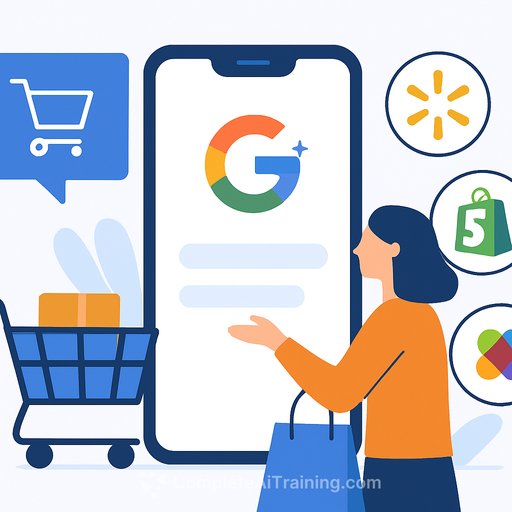
Google taps Walmart, Shopify, and Wayfair to enable shopping inside Gemini chat
Google is partnering with Walmart, Shopify, and Wayfair to let users find and buy products directly inside the Gemini AI chatbot. Walmart will layer in purchase-history signals to personalize suggestions-an approach central to AI for Marketing. The feature launches in the U.S. first, with plans to expand internationally. This move raises the bar against OpenAI and Amazon on AI-driven commerce.
Why product teams should care
- Fewer steps: discovery, selection, and checkout happen in one conversation.
- Higher intent: the chat captures context (problem, budget, preferences) before a product is shown.
- Retail data meets model intelligence: personalization (e.g., Walmart purchase history) becomes a core differentiator.
- New baseline UX: once users experience one-tap buying in chat, standard funnels feel slow.
How this likely works (at a high level)
- User asks for a product or solution inside the Gemini chat.
- Gemini retrieves structured product data via partner APIs and ranks options.
- Personalization signals (where available) adjust results and bundles.
- Embedded purchase flow completes the order without leaving the chat.
- Order details and support live in the same conversation thread; teams should borrow patterns from AI for Customer Support to handle returns and inquiries without channel switching.
What to build next
- Conversation intent mapping: define intents like "replace," "compare," "gift," "repair," with slot-filling for specs and constraints.
- Structured product data: enrich catalog with attributes, compatibility, and policies (returns, warranties) for grounded answers.
- Real-time inventory and pricing: webhooks or streaming updates to avoid stale or out-of-stock suggestions.
- Checkout primitives: cart, address, tax, fulfillment, and post-purchase flows that can be triggered by the assistant.
- Trust rails: price transparency, source disclosure, and easy access to policies inside the chat.
Data and privacy considerations
- Clear consent for using purchase history and account data in recommendations.
- Define what data the model can see, log, or learn from; separate training from inference where needed.
- Short retention windows for sensitive events (payments, location) and strict access controls.
- Opt-outs that actually degrade personalization, not the checkout experience.
KPIs that matter
- Conversion rate from first message to purchase (a core focus of AI for Sales programs).
- Time-to-purchase and steps saved vs. web flows.
- Average order value and attach rate for bundles.
- Repeat purchase rate from chat-originated orders.
- Resolution rate for post-purchase support inside the chat.
Risks to plan for
- Hallucinated specs or mismatched accessories: ground responses on catalog and compatibility graphs.
- Inventory drift: require fresh stock checks before final confirmation.
- Bias and fairness: rotate sources, explain rankings, and monitor for skew.
- Returns friction: present policy summaries and easy label generation inside the conversation.
Competitive context
This is a push to make the assistant the first stop for shopping, not search. It pressures marketplaces and brand apps to plug into assistant-driven buying. Expect rapid iteration from rivals and tighter integrations between models and merchant data.
Rollout notes
U.S.-first launch with international expansion planned. Start modeling geo, tax, and payment method differences now. If you sell cross-border, prebuild compliance gates and catalog variant logic per region.
Team checklist
- API readiness: product, inventory, pricing, checkout, and order status endpoints.
- Content ops: product attributes, policies, and FAQs structured for retrieval.
- Observability: trace conversations to decisions (ranking, disclaimers, stock checks).
- Guardrails: test suites for safety, accuracy, and edge cases before each release.
If you want a deeper grasp of conversational commerce patterns and how to ship them, see our role-based programs at Complete AI Training.
For an overview of the Gemini model family and capabilities, see Google's Gemini page.
Your membership also unlocks: