
AI news ·
Google X's Tidal partners with SalMar to deploy AI and robotics across salmon farming operations
Google X's Tidal will deploy underwater robotics, AI monitoring, and automated feeding systems across SalMar ASA's salmon farms. SalMar, the world's second-largest salmon producer, aims to cut costs and improve fish welfare.
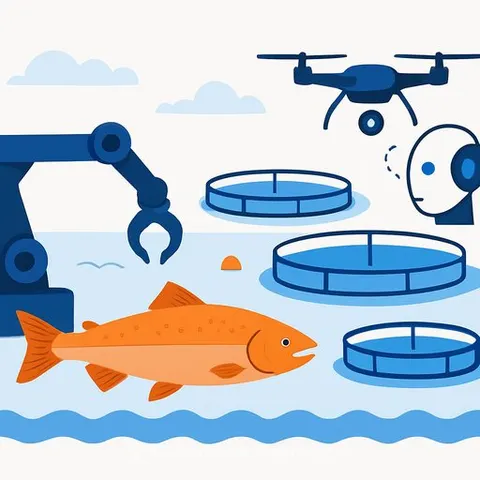
Google X's Tidal partners with SalMar to automate salmon farming operations
Tidal, an aquaculture AI and robotics company from Google X, will deploy its automation systems across SalMar ASA's salmon farms. SalMar, the world's second-largest salmon producer, will use Tidal's underwater robotics, sensors, and AI platform to improve fish welfare and reduce operational costs.
The collaboration focuses on three areas: automated feeding systems, lice mitigation technology, and real-time farm monitoring. These deployments will run across multiple SalMar sites.
What Tidal will deploy
Tidal's camera systems and environmental sensors will stream data into a central platform for continuous monitoring. The company will roll out autonomous feeding systems to improve feed consistency, reduce waste, and lower feed conversion ratios across several farms.
A new in-pen lice mitigation system will be tested and validated at SalMar facilities. Lice infestations are a major operational challenge in salmon farming, affecting fish health and production costs.
AI tools will track individual fish growth, welfare indicators, and lice levels to support breeding programs. SalMar will also use large language models developed with Google to improve enterprise-wide operations.
Why this matters for operations teams
Salmon farming operations deal with competing pressures: maintaining fish welfare, controlling disease, managing costs, and meeting sustainability targets. Manual monitoring across multiple sites is labor-intensive and reactive rather than preventive.
Automated systems allow operations teams to shift from responding to problems to forecasting them. Real-time data on feeding, water conditions, and fish health enables faster decisions and reduces downtime.
Tidal's autonomous feeding reduces guesswork in portion sizes, which directly affects feed costs-typically the largest expense in aquaculture. Better lice detection and treatment tracking reduce the need for chemical interventions.
Timeline and scale
The collaboration is already underway, with deployments at multiple SalMar sites. No specific timeline for full rollout was announced.
Gustav Witzøe, chairman of SalMar, said the partnership aims to "move the aquaculture industry toward smarter, more sustainable operations." Rajesh Jadhav, CEO of Tidal, emphasized that the deployment demonstrates the company's ability to operate at industrial scale in real-world conditions.
For operations managers in aquaculture or similar industries, this partnership illustrates how AI Agents & Automation can reduce manual work while improving decision-making. If you're responsible for deploying automation in your operations, the AI Learning Path for Operations covers the practical skills needed to implement and manage these systems.