Google's newest AI agents bring telcos closer to autonomous network operations
Updated 03:00 EST / March 02, 2026
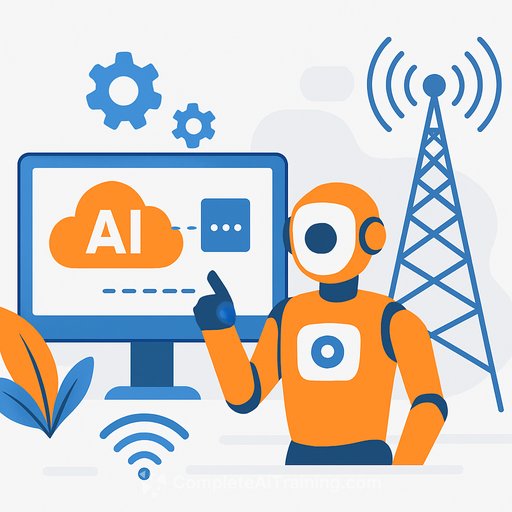
Google announced new AI agents at MWC Barcelona that push its Autonomous Network Operations vision forward. The focus: digital twins that mirror live network state and agent-driven actions that move beyond alerts to real remediation.
The goal is straightforward-self-healing, zero-touch networks that can sense, reason, and act without human oversight. For operations leaders, this is about cutting outage minutes, reducing change risk, and scaling efficiency without scaling headcount.
Digital twins that operate like the network-because they are the network
Google's network digital twin is a dynamic, temporal graph of the physical and logical network. It reflects real-time performance, lets teams test changes under realistic conditions, and supports post-incident root cause analysis by querying historical states.
Practically, that means you can forecast the blast radius of a failure, simulate upgrades before rollout, and validate policies against live topology and traffic patterns.
Open data models to speed adoption
To help teams build twins faster, Google is releasing source code for its telco data pipeline and data models on GitHub. Communications service providers can standardize on shared ontologies and skip most manual schema mapping, shrinking time-to-value and reducing integration debt.
The new agents: from monitoring to action
- Data Steward Agent: Automates data governance so the twin stays accurate and aligned with the physical network-no stale views, fewer blind spots.
- Autonomous Network Agents for voice core and OSS: Drive closed-loop operations across voice services and orchestration domains.
- Action examples: Reroute traffic during an outage using the best available path, and restore call quality when performance degrades-without waiting for a human to click "approve."
Why operations leaders should care
- Lower MTTR with automated diagnosis and remediation.
- Safer changes via twin-based what-if testing before production.
- Consistent policy enforcement and fewer config drifts.
- Better capacity planning using demand forecasts from the twin.
- Audit-ready history for compliance and incident reviews.
Partner momentum
Google cites adopters including Deutsche Telekom and Vodafone. It's also collaborating with MasOrange and NetAI on a GraphML-based AIOps initiative-GraphML details are available here-and working with Nokia on a network-as-code push to make networks programmable with natural language prompts.
90-day implementation playbook
- Weeks 1-2: Inventory data sources (telemetry, topology, configs, tickets). Assign data owners and access controls.
- Weeks 3-4: Align on the shared ontology. Map the top 20 entities and relationships; automate ingestion for high-value feeds.
- Weeks 5-6: Pick a pilot domain (e.g., voice core QoS or fiber access fault isolation). Define success metrics and guardrails.
- Weeks 7-8: Build the twin MVP. Validate against live KPIs; backtest against the last three major incidents.
- Weeks 9-10: Introduce agent actions in "suggest" mode. Require human approval while you measure precision/recall.
- Weeks 11-12: Graduate low-risk remediations to auto-approve with blast-radius limits and rollback policies.
Guardrails and risk controls
- Model drift: Schedule continuous validation; set thresholds that trigger fallback to manual control.
- Actuation safety: Enforce change windows, role-based approvals, and circuit-breakers with instant rollback.
- Interoperability: Prefer open ontologies and APIs to avoid lock-in across vendors and domains.
- Data privacy: Mask customer data, minimize retention, and log every agent decision for audits.
- Cost governance: Track compute and data egress; set budgets for simulations and inference workloads.
Team skills that matter
You'll need people who can translate network intent into policies, map data models, and run safe automation. If your team is building toward zero-touch operations, start here:
KPIs to track from day one
- Mean time to detect, diagnose, and remediate (MTTD/MTTI/MTTR).
- Percentage of incidents resolved with zero-touch automation.
- Change failure rate and average rollback frequency.
- Configuration drift rate across domains.
- Forecast accuracy for demand and fault prediction.
- Customer-impact metrics: call quality scores, SLA adherence, ticket deflection.
Bottom line
Digital twins plus action-oriented agents move network ops from reactive to proactive. Start with a focused pilot, lock down your data model, and graduate safe automations with clear guardrails. The sooner your team builds confidence in the twin, the faster you'll reduce outages, change risk, and operational toil.
Your membership also unlocks: