PM Publishers and Google bring Gemini to 2M textbooks: what educators need to know
PM Publishers is integrating Google's Gemini across 250+ school textbooks for the 2026-27 academic year. The rollout spans nursery to class 10 across computer science, English, Hindi, art & craft, general knowledge, and foundation subjects.
Phase one targets 2,000+ schools and over 2 million students. The goal is simple: make every textbook interactive, context-aware, and useful for real learning-both in class and at home.
How it works
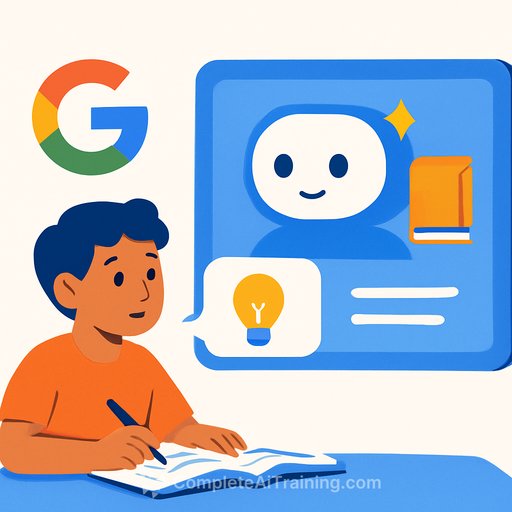
Each PM Publishers (PMP) book will include QR codes that open a custom Gemini "Gem" tuned to that specific textbook. Students scan, ask questions, and get answers grounded in the chapter they're studying.
The Gem provides chapter summaries, interactive activities, and extra resources. Older students can work independently; parents of younger learners get a clear, guided way to explain concepts without guessing.
Why this matters for educators
- Curriculum-grounded help: Responses align to the textbook, reducing off-topic assistance.
- Lesson support: Quick summaries and activities speed up planning and classroom engagement.
- Differentiation: Students ask targeted questions at their level and pace.
- Home learning: Parents get structure and clarity for homework and revision.
Scope and timing
- Launch: Academic year 2026-27
- Coverage: 250+ book titles
- Grades: Nursery to Class 10
- Reach (phase one): 2M+ students across 2,000+ schools
What the companies said
Rajesh Bajaj, Managing Director, PM Publishers Pvt. Ltd., said: "Our goal is to make learning more engaging, interactive, and future-ready. With Google Gemini, we are giving students and teachers a powerful tool that amplifies curiosity, supports creativity, and promotes the responsible use of AI in education."
Sanjay Jain, Head of Google for Education, India said: "At Google, we believe AI should be a learning companion that sparks curiosity, rather than just a tool for retrieving answers. By integrating Gemini directly into PM Publishers' curriculum, we hope to give students and parents a personal AI tutor that is grounded in the textbooks they trust and enhance the classroom experience."
Rollout checklist for school leaders
- Devices and access: Ensure students can scan QR codes and access the web in class and at home.
- Usage norms: Set clear rules for asking questions, citing AI assistance, and avoiding shortcut behavior.
- Privacy review: Confirm data policies and admin controls with your vendor and IT team. See Google for Education for product and policy resources.
- Teacher training: Run short, focused PD on prompting, verifying AI outputs, and integrating activities into existing lesson plans. See AI Learning Path for Secondary School Teachers for classroom-facing modules and sample activities.
- Assessment alignment: Decide where AI support is allowed (practice, revision) vs. where it's restricted (graded work).
- Equity and accessibility: Plan for students without personal devices; check multilingual support and readability for younger grades.
Questions to resolve before deployment
- What student data (if any) is stored, for how long, and who has access?
- How are the "Gems" updated when curricula change or errors are found?
- What offline or low-bandwidth options exist for schools with limited connectivity?
- How will teachers escalate content concerns or request adjustments to the AI responses?
- What analytics (if provided) can inform instruction without over-surveilling students?
Practical classroom uses
- Pre-teach and review: Use summaries to preview topics and close gaps after lessons.
- Guided practice: Turn interactive activities into station work or homework with clear success criteria.
- Student inquiry: Encourage "show your steps" prompts so students document thinking, not just answers.
- Parent support: Share QR norms with families and suggest time-limited, concept-first usage.
Policy and professional development resources
- UNESCO guidance on AI in education: unesco.org
- Upskilling for educators (courses by job): Complete AI Training
- AI courses by leading companies (including Google): Explore curated options
Bottom line
Textbooks are getting an AI layer that responds to what students are learning-when they're learning it. If you're on the academic or IT side, start with access, norms, privacy, and PD. Keep the teacher at the center, use AI to extend good practice, and measure impact against your existing outcomes.
Your membership also unlocks: