Put AI governance into practice in government
Civil servants are relying on AI more each month, and citizens feel the impact. That only works if people trust the results. Here's the gap: 78% of public sector organizations say they trust AI, yet only 40% have invested in the safeguards to back that up. Trust without governance is a risk, not a strategy.
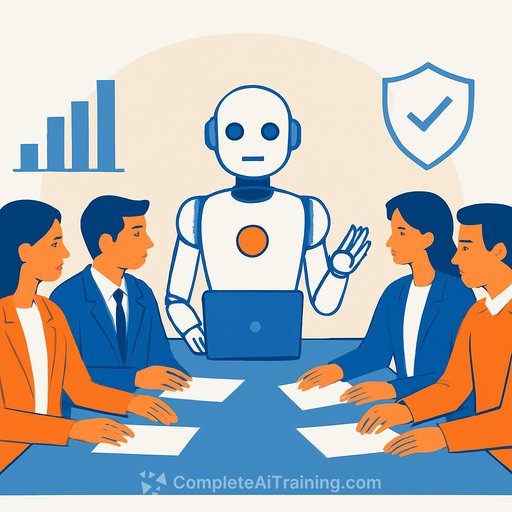
AI governance gives you the structure to earn that trust - see AI Governance for CIOs for practical guidance on governance structures, accountability, and oversight. It's the strategic and operational framework that keeps AI ethical, compliant, and workable across the full lifecycle - policy, design, build, deploy, monitor, and retire. Think oversight, documentation, controls, and culture working together.
Governance starts with trust, not with paperwork
Regulation matters, but it isn't the starting point. Trust is. As Kalliopi Spyridaki notes, compliance is necessary, yet governance must come first. Treating governance as a checkbox after deployment forces reactive fixes and slows useful innovation.
The smarter move is to embed accountability, risk classification, and transparency from the outset. That approach gives leaders, staff, auditors, and the public confidence that AI can be used responsibly at scale. It also aligns with long-standing public duties around data protection, security, and access to information. Accuracy, accountability, and transparency should be the default settings.
Intentionality creates operational trust
Government use cases carry both personal and systemic risks - from unfair benefit decisions to the erosion of confidence in institutions. AI governance reduces those risks with clear standards, defined accountability, and multidisciplinary oversight that includes ethics, legal, security, and domain experts.
Vrushali Sawant frames it well: intentionality means designing with purpose and accountability. Start with simple questions and keep asking them throughout the lifecycle: Who benefits? Who could be harmed? Is AI the right tool for this problem?
Put principles into practice with ongoing monitoring, audits, and remediation. Use Model Cards - "nutrition labels for AI" - to document purpose, data sources, fairness checks, known limits, and approved uses. Combine that with audit trails and usage tracking so governance is a living practice, not a shelf document.
Make AI visible: central inventory and shadow AI controls
Not every risk is technical. You face deepfake-driven mis/disinformation, fraudulent digital services, biased automated decisions, and attacks on smart infrastructure. There's also shadow AI: unsanctioned tools that leak data, create compliance exposure, and slip past IT.
Stand up a centralized view of models, agents, tools, and use cases. Require registration before use. Tie each listing to an owner, risk tier, data access, and monitoring plan. This single source of truth lets you spot shadow AI, retire risky tools, and scale the good ones with confidence.
Build the operating model
- Define roles: executive sponsor, accountable owner, product manager, model risk lead, privacy officer, security lead, audit, and domain experts.
- Classify use cases by risk (e.g., impact on rights/benefits, data sensitivity, automation level, public visibility).
- Gate every high-risk use case with a pre-deployment assessment covering legality, equity, explainability, human oversight, and incident handling.
- Document decisions and assumptions: problem statement, success metrics, data lineage, model versioning, evaluation results, and intended users.
- Require human-in-the-loop for any consequential decision; log overrides and reasons.
- Monitor continuously: drift, performance, fairness, and misuse signals; trigger retraining or rollback with clear thresholds.
- Establish an issue response runbook: who investigates, who communicates, when to suspend, how to fix, and how to notify affected parties.
- Bake governance into procurement: mandate transparency artifacts (e.g., Model Cards), testing evidence, and access for audits.
- Track third-party and open-source components; verify licenses, security posture, and data handling claims.
- Communicate with the public: what the system does, where humans are involved, and how to appeal outcomes.
Project teams and product owners can follow the AI Project Management path to align lifecycle oversight, risk gates, and deployment controls with governance expectations.
Culture and literacy make it stick
Governance is a people system. Josefin Rosén puts it plainly: AI literacy sits at the heart of responsible innovation. Without a baseline understanding of how these systems work and where they fall short, it's hard to procure, deploy, or oversee them well.
Invest in training for leaders, project teams, and front-line staff. Create governance champions inside departments. Set crisp metrics - percentage of models with Model Cards, time to remediate issues, share of high-risk use cases under human oversight - and review them regularly.
If your team needs a practical way to build skills by role, see these curated learning paths: AI courses by job.
90-day starter plan
- Days 1-30: Stand up a cross-functional AI governance board. Publish a lightweight policy with risk tiers, required documentation, and approval gates. Inventory active AI tools and models.
- Days 31-60: Create Model Cards for top-priority systems. Add human-in-the-loop where decisions affect services or rights. Configure monitoring for performance, drift, and fairness.
- Days 61-90: Launch an issue response playbook. Update procurement templates. Train managers and product owners. Publicly post summaries of how AI is used and how to contest outcomes.
Helpful frameworks
Use established guidance to speed alignment and reduce rework:
- NIST AI Risk Management Framework for risk, controls, and measurement.
- OECD AI Principles for values, accountability, and transparency.
AI in government is no longer a pilot. Build trust on purpose. Start small, document well, keep humans in the loop, and make learning part of the job. That's how responsible AI becomes standard practice.
Your membership also unlocks: